
Flashcards
F214.3 Photosynthesis Biology Revision Cards
Cards in this deck (12)
- 1Autotroph (definition)An organism that can use light or chemical energy and inorganic molecules to synthesise large organic molecules.
- 2Heterotroph (definition)Organisms that ingest and digest complex organic molecules, releasing the chemical potential energy within them
- 3What is a photoautotroph?An organism that can photosynthesise
- 4What is photosynthesis?The process where light energy from the sun is transformed into chemical energy which is used to synthesise large, organic molecules.
- 5How does respiration rely on photosynthesis?It requires the oxygen created in photosynthesis for aerobic respiration.
It also requires the large organic molecules formed in photosynthesis to be broken down to release energy. - 6Where does photosynthesis take place?In specialised organelles found in plants called chloroplasts. The two main stages of photosynthesis take place here
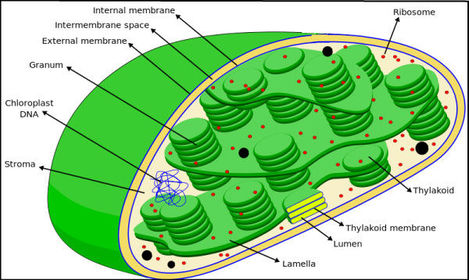
- 7What is the structure of a chloroplast?
- 8How is the inner membrane of the chloroplast adapted to its role?The inner membrane contains transport proteins which control the entry and exit of substances between the cytoplasm and the stroma.
- 9How is the grana of the chloroplast adapted to its role?It provides a surface for photosynthetic pigments and photosystems to maximise absorption of light.
- 10How is the stroma of the chloroplast adapted to its role?It contains the enzymes for the light independent stage. It surrounds the grana so it easy for the products of the light dependent reaction to move o the stroma for the light independent reaction.
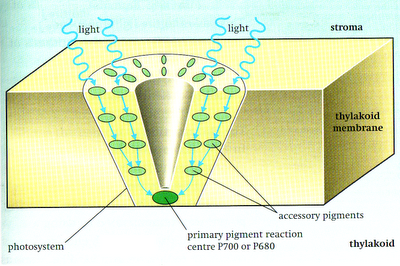
- 11Photosynthetic pigment (definition)Molecules that absorb light energy. Each pigment absorbs a different wavelength of light whilst reflecting the others.
- 12What does a photosystem look like?
Information
- Description
- A Levels Biology (A2 Biology) Flashcards on F214.3 Photosynthesis Biology Revision Cards, created by Laura Perry on 11/05/2016.
- Created by
- Laura Perry
- Views
- 9
- Tags
- Rating