
Flashcards
Breathing and the Heart ✔
Cards in this deck (17)
- 1What do the lungs do?They are important to the body in the process of breathing, where gas exchange happens.
- 2What is breathing?Breathing is when oxygen is taken from the air outside into the blood.
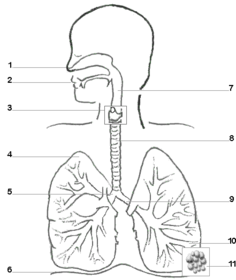
- 3The air that we breathe in has dust and smoke particles and microbes (which cause disease) in it. Those particles enter the air passages. - Which two special cells keep the lungs clean and free from disease?1) Cells that produce mucus: the mucus traps the harmful substances
2) Cilia: the cilia sweep the mucus up and out of the lungs to the throat to be swallowed. - 4Label this image: (1, 2, 4, 5, 6, 8, 9, 10, 11)1- Nose
2- Mouth
4- Right Lung (from their POV)
5- Bronchi (meaning the two)
6- Diaphragm
8- Trachea/Windpipe
9- Bronchus (one)
10- Bronchiole (the smaller branches)
11- alveoli - 5How do we breathe?1) The air enters the nose or mouth and passes down the trachea into lungs through the bronchi.
2) The bronchi branches out into smaller bronchioles which end in air sacs (alveoli).
3) The oxygen enters the blood in the alveoli and is carried by the blood to all the cells in the body. - 6What happens in the alveoli?Gas exchange happens in the alveoli, which are located in the lungs:
-the oxygen first diffuses from the alveoli into the blood
-since all cells produce carbon dioxide as a waste product, this is carried in the blood from the cells to the lungs and is breathed out. - 7What causes suffocation?Suffocation occurs when air does not get into the lungs.
- 8respiration ≠ breathing - explain why.Breathing is the physical process of inhaling and exhaling, whereas respiration is the chemical process of producing energy to be used by all cells.
- 9ventilation: What happens to your ribcage/diaphragm when you: i] breathe in ii] breathe outi] your ribcage comes up and out; your diaphragm flattens
ii] your ribcage goes back down and in; your diaphragm is pushed up - 10What does the heart do?It pumps blood around the body.
- 11True or False: The heart is mainly made of fat.False.
The heart is mainly made from muscle tissue. - 12The blood is carried in tubes, called _____, to the organs and tissues in the body.vessels
- 13What are the two types of vessels?-artery: carries blood away from the heart- it does have a pulse
-vein: carries blood towards the heart- does not have a vein
aRTERY=aWAY / vEIN= (b)vACK - 14What is blood made up of?Blood is made up of plasma and red and white blood cells.
- 15Name two things the blood transports.-oxygen
-carbon dioxide
-glucose
-food molecules - 16What causes a heart attack?-The vessel that brings blood to the heart is called the coronary artery.
-This artery can become narrowed by a build up of fatty deposits inside it.
-The blood cannot flow so well through the narrow regions and sometimes blood clots are trapped and block the coronary artery, causing a heart attack. - 17Define valves.valve: are between the chambers to stop blood from flowing backwards.
Information
- Description
- breathing and the heart.
- Created by
- Farha Idrees · May 2016
- Updated
- Jul 2, 2016
- Views
- 67
- Tags
- Rating