
Flashcards
Chapter 5 Homework
Cards in this deck (44)
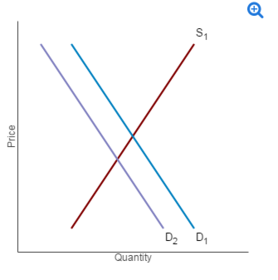
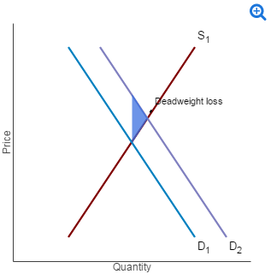
- 1Consider the market illustrated in the figure. Supply curve S1 represents the private cost of production and demand curve D1 represents the private benefit from consumption. Suppose the consumption of this good creates a positive externality. In turn, the social benefit from consumption is represented by demand curve D2. Show how the externality affects market efficiency.The market equilibrium is where the private cost and private benefit curves intersect. The efficient equilibrium is where the social cost and social benefit curves intersect. In this example, the private cost and social cost curves are equal. Notice that when there is a positive externality in consumption, too little of the good or service will be produced at the market equilibrium. This creates a deadweight loss equal to the area between the social benefit curve and the social cost curve for units produced at the efficientefficient equilibrium but not at the market equilibrium.
- 2How do externalities affect markets? If a negative externality in production is present in a market, thenthe private cost of production will be different than the social cost of production.
Private cost is the cost borne by the producing of a good or service, and social cost is the total cost of producing a good or service, including both the private cost and any external cost. If there is a negative externality, private cost and social cost will not be equal. - 3How do externalities in the production of electricity result in market failure? Because of externalities, the market for electricity willprovide too much electricity.
Externalities result in market failure, which is a situation where the market fails to produce the efficient level of output. For example, in the market for electricity, a negative externality results in the market providing too much electricity because the market does not account for the cost of electricity on others. - 4ExternalityA benefit or cost that affects someone who is not directly involved in the production or consumption of a good or service.
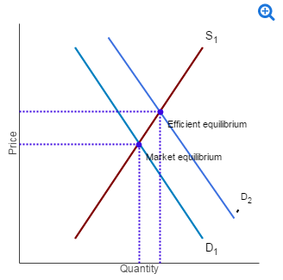
- 5Consider the market illustrated in the figure. Supply curve S1 represents the private cost of production and demand curve D1 represents the private benefit of consumption. Suppose consuption of this good creates a positive externality. Show how the externality affects the market. 1) Draw either a new supply or new demand curve incorporating the positive externality in consumption. 2) Indicate the market equilibrium price and quantity. 3) Indicate the effective equilibrium price and quantity.
- 6How do property rights affect externalities and market failure?Externalities and market failure will result from the difficulty of enforcing property rights.
Externalities and market failure result from incomplete property rights or from the difficulty of enforcing property rights in certain situations. - 7Property rightsThe rights individuals or businesses have to the exclusive use of their property, including the right to buy or sell it.
- 8Suppose the figure to the right illustrates the marginal cost and marginal benefit from reducing sulfur dioxide pollution. Suppose also that the United States is currently planning to eliminate 5.5 million tons of pollution per year. What would be the net benefit to the United States of instead eliminating 10.0 million tons of sulfur dioxide? Use the triangle drawing tool to shade in the net benefit to society from eliminating 10.0 million tons of pollution per year compared to eliminating 5.5 million tons of pollution. Label this shaded area 'Net benefit'.The benefit to society of reducing pollution is equal to the area under the marginal benefit curve. The cost to society of reducing pollution is equal to the area under the marginal cost curve. The net benefit to society from reducing pollution is equal to the difference between the total benefit of reducing pollution and the total cost.
Therefore, the net benefit to society of reducing pollution by an additional 4.5 million tons per year is the difference in the marginal benefit and marginal cost curves for pollution reduction between 5.5 million and 10.0 million tons per year.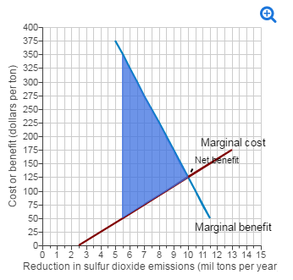
- 9What must be true for the Coase Theorem to hold? For the Coase Theorem to hold.all parties to an agreement must have full information about the costs and benefits of the externality.
In practice, we must add a couple of other qualifications to the Coase Theorem. In addition to low transaction costs, parties to the agreement must have full information about the costs and benefits associated with the externality, and all parties must be willing to accept a reasonable solution. - 10The Coase TheoremThe argument of economist Ronald Coase that if transaction costs are low, private bargaining will result in an efficient solution to the problem of externalities.
- 11Suppose the production of electricity by a utility generates pollution that harms others. Suppose also that Coase bargaining can occur between the utility and the victims of pollution but that the utility has not been legally liable for the damages from its pollution. How would making the utility legally liable for the damages from its pollution affect pollution reduction? If the electric utility and the people suffering the effects of the utility's pollution can bargain, then making the utility legally liable for the damages from its pollution willIn the absence of the utility being legally liable, the victims of pollution have an incentive to pay the utility to reduce pollution up to the point where the marginal benefit of the last ton of reduction is equal to the marginal cost. If the utility is legally liable, it has an incentive to pay the victims of pollution to allow it to pollute up to the same point. Therefore, property rights (and legal liability) do not matter for the amount of pollution reduction because such rights (and such liability) do not change the marginal benefits and the marginal costs of pollution reduction.
not change the amount of pollution reduction because the marginal benefit and marginal cost of pollution reduction will not change. - 12Suppose the figure to the right illustrates the marginal cost and marginal benefit from reducing sulfur dioxide pollution. Suppose also that the United States is currently generating 13.0 million tons of pollution per year. What is the optimal level of pollution reduction?The optimal level of pollution reduction is 7 million tons per year.
The net benefit to society from reducing pollution is equal to the difference between the benefit of reducing pollution and the cost.
To maximize the net benefit to society, sulfur dioxide emissions—or any other type of pollution—should be reduced up to the point where the marginal benefit from another ton of reduction is equal to the marginal cost.
The economically efficient reduction of sulfur dioxide emissions is 7.0 million tons per year. At that level of emission reduction, the marginal benefit and the marginal cost of the last ton of sulfur dioxide emissions eliminated are both $250 per ton.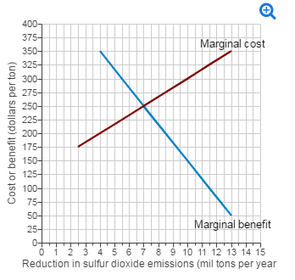
- 13How might society solve problems associated with externalities and market failure? If an externality is present, resulting in market failure, thenprivate solutions may reduce or correct market failure.
In the presence of an externality, government intervention may actually increase economic efficiency and enhance the well-being of society. It is also possible, however, for people to find private solutions to the problem of externalities. In an important article written in 1960, Ronald Coase of the University of Chicago, winner of the 1991 Nobel Prize in Economics, argued that under some circumstances, private solutions to the problem of externalities will occur. - 14Market failureA situation in which the market fails to produce the efficient level of output.
- 15Transaction costsThe costs in time and other resources that parties incur in the process of agreeing to and carrying out an exchange of goods or services.
- 16Which of the following is an example of transaction cost associated with negotiating the reduction of a negative externality? An example of a transactionthe cost associated with drawing up a binding contract to reduce a negative externality.
In the case of externalities, transaction costs would include the time and other costs of negotiating an agreement, drawing up a binding contract, purchasing insurance, and monitoring the agreement. - 17How might transaction costs affect private solutions to externality problems? Transaction costsmay make private solutions to reduce negative externalities no longer feasible.
Transaction costs may be higher than the net benefit from reducing a negative externality. In such cases, a private solution to an externality problem is not feasible. - 18Suppose the figure illustrates the marginal cost and marginal benefit from reducing sulfur dioxide pollution. How could the government use a command-and-control approach to reduce pollution to the optimal level for society? The government couldlimit sulfur dioxide pollution to a particular quantity per year.
In this example, the government could impose a quantitative limit on the amount of pollution firms are allowed to generate such that 8.5 million tons of pollution are reduced.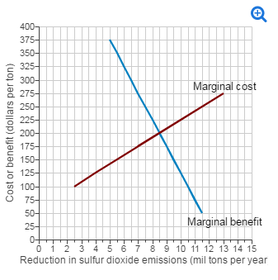
- 19Command-and-control approachAn approach that involves the government imposing quantitative limits on the amount of pollution firms are allowed to emit or requiring firms to install specific pollution control devices.
- 20Suppose the government requires each firm to reduce sulfur dioxide emissions by an equal amount such that total emissions are reduced by 8.5 million tons per year. Is this approach necessarily economically efficient? This command-and-control approachis not efficient because firms can have different costs of reducing pollution.
Some firms may already use low-sulfur coal and can reduce emissions further only at a high cost. Other utilities may be able to reduce emissions at a lower cost. Therefore, a command-and-control approach that requires each firm to reduce pollution by the same amount may not be an economically efficient solution to the problem of externalities because the same amount of pollution could be eliminated at lower cost. - 21Suppose the figure to the right illustrates the market for toilet paper, where Upper S 1S1 represents the marginal private cost of production and Upper D 1D1 represents the marginal private benefit from consumption. Companies that produce toilet paper bleach the paper to make it white. Some paper plants discharge the bleach into rivers and lakes, causing substantial environmental damage. Assume that Upper S 2S2 represents the marginal social cost of producing toilet paper (incorporating the externality). What could the government do to internalize the externality?In the presence of a negative externality, the government could tax toilet paper production.
A.C. Pigou, a British economist at Cambridge University, argued that to deal with a negative externality, the government should impose a tax. Pigou also argued that the government can deal with a positive externality by giving a subsidy.
In particular, the government should set a Pigovian tax of $
nothing per ton of toilet paper produced. - 22Pigovian taxes and subsidiesGovernment taxes and subsidies intended to bring about an efficient level of output in the presence of externalities.
- 23In particular, the government should set a Pigovian tax of $ 150 per ton of toilet paper produced.A.C. Pigou, a British economist at Cambridge University, argued that to deal with a negative externality, the government should impose a tax equal to the cost of the externality.
The cost of the externality equals the size of the vertical distance between the marginal private cost and marginal social cost curves.
In this example, the government would need to set a Pigovian tax equal to $150 to internalize the externality caused by toilet paper production. - 24Cap-and-trade systemA system of tradable emission allowances.
The federal government gave utility companies allowances equal to the total amount of allowable sulfur dioxide emissions and allowed companies to buy and sell them on the Chicago Mercantile Exchange. Utility companies that can reduce their emissions at low cost have done so and then sold their allowances. Those utility companies that can only reduce their emissions at high cost have purchased the allowances. - 25Suppose the United States has two utilities, Commonwealth Utilities and Consolidated Electric. Both produce 20 million tons of sulfur dioxide pollution per year. However, the marginal cost of reducing a ton of pollution for Commonwealth Utilities is $400 per ton and the marginal cost of reducing a ton of pollution for Consolidated Electric is $500 per ton. The government's goal is to cut sulfur dioxide pollution in half (by 20 million tons per year). If the government issues 10 million tradable pollution permits to each utility, what will be the cost of eliminating half of the pollution to society?Using a cap-and-trade system of tradable emission allowances will eliminate half of the sulfur dioxide pollution at a cost of $8,000 million per year.
With a cap-and-trade system of tradable emission allowances, utilities that can reduce emissions at low cost will do so and will sell their allowances. Utilities that can only reduce emissions at high cost will buy the allowances and will pollute. In this example, since Commonwealth Utilities can reduce pollution at lower cost ($400 per ton versus $500 per ton), they will sell their 20 million permits and reduce sulfur dioxide by 20 million tons per year. The cost will be $8,000 million, from 20 million tons of pollution multiplied by the $400 cost of reduction per ton. - 26If the permits are not tradable, what will be the cost of eliminating half of the pollution?If permits cannot be traded, then the cost of the pollution reduction will be $ million per year.
If the pollution permits cannot be traded, then both utility companies will eliminate 10 million tons of sulfur dioxide emissions. This reduction will cost Commonwealth Utilities $4,000 million, from 10 million tons of pollution multiplied by the $400 reduction cost per ton, and it will cost Consolidated Electric $5,000 million, from 10 million tons of pollution multiplied by the $500 reduction cost per ton. The total cost of reducing sulfur dioxide by 20 million tons per year will be $9,000 million. - 27Companies producing toilet paper bleach the paper to make it white. The bleach is discharged into rivers and lakes and causes substantial environmental damage. The diagram to the right illustrates the situation in the toilet paper market. The private profit minusmaximizing output level isQ3
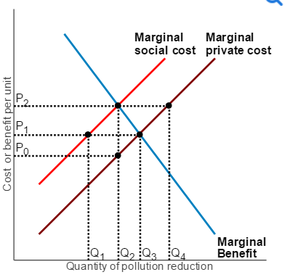
- 28Companies producing toilet paper bleach the paper to make it white. The bleach is discharged into rivers and lakes and causes substantial environmental damage. The diagram to the right illustrates the situation in the toilet paper market. Suppose the government wants to use a Pigovian tax to bring about the efficient level of production. What should the value of the tax be?$(P2 - P0) per unit of output
- 29In England during the Middle Ages, each village had an area of pasture, known as a commons, on which any family in the village was allowed to graze its cows or sheep without charge. Was the common land used optimally?Grazing created a negative externality, resulting in the commons being overused.
The commons ended up overgrazed. For example, a family thinking of buying another cow and grazing it on the commons would gain the benefits from increased milk production, but adding another cow to the commons would create a negative externality by reducing the amount of grass available for the cows of other families. Because this family—and the other families in the village—did not take this negative externality into account when deciding whether to add another cow to the commons, too many cows were added. The grass on the commons was eventually depleted, and no family's cow got enough to eat. - 30Consider the market illustrated in the figure to the right for fishfish from the oceanthe ocean. Suppose the fishfish are a common resource. Supply curve Upper S 1S1 represents the private cost of production and demand curve Upper D 1D1 represents the private benefit from consumption. Show how the private market overuses common resources. 1.) Use the line drawing tool to first draw either a new supply (Upper S 2S2) or demand (Upper D 2D2) curve showing the true cost of catching fishcatching fish. Properly label this line. 2.) Use the point drawing tool to indicate the actual price and quantity in the private market. Label this point 'Actual equilibrium'. 3.) Use the point drawing tool to indicate the efficient equilibrium price and quantity. Label this point 'Efficient equilibrium'.The actual equilibrium is where the private cost and private benefit curves intersect. However, for a common resource, such as fish in the ocean the efficient level of use is determined by the intersection of the demand curve—which represents the marginal benefit received by consumers—and a new supply curve, which represents the marginal social cost of catching fishcatching fish. Because the marginal social cost is greater than the marginal private cost, the new supply curve is above the original supply curve representing the private marginal cost of production. That is, because the individuals who catch fish ignore the external cost of their actions, the actual equilibrium quantity is greater than the efficient quantity.
- 31A small town provides a fireworks display, which is a public good, every fourth of July. For simplicity, assume the town only has two residents: Hayden and Madison. Their demands for the fireworks display are illustrated in the figure to the right. Construct the market demand curve for this public good. Use the line drawing tool to draw the market demand curve (DMarket) for the fireworks display. Properly label this line.To find the demand curve for a public good, add up the price at which each consumer is willing to purchase each quantity of the good. For example, if Hayden is willing to pay $3.75 for two fireworks and Madison is willing to pay $3.25, then the market will demand 2 fireworks at a price of $7.00. A quantity of 2 and a price of $7.00 is a point on the market demand curve.
Calculated similarly, if Hayden is willing to pay $0.75 and Madison is willing to pay $1.75 for 14 fireworks, then the market will demand 14 fireworks at a price of $2.50. A quantity of 14 and a price of $2.50 is another point on the market demand curve.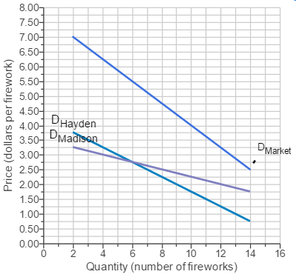
- 32Private goodA good that is both rival and excludable.
- 33Public goodA good that is both nonrivalrous and nonexcludable.
- 34Quasi-public goodA good that is excludable but not rival.
- 35Common resourceA good that is rival but not excludable.
- 36RivalryThe situation that occurs when one person's consuming a unit of a good means no one else can consume it.
- 37ExcludabilityThe situation in which anyone who does not pay for a good cannot consume it.
- 38Consider the consumption of national defense. What type of good is national defense? National defense isa public good.
National defense is a public good because it is nonrival and nonexcludable. - 39Consider the consumption of public pasture land. What type of good is public pasture land? Public pasture land isa common resource.
- 40Consider the market for a public good such as dams along a river, illustrated in the figure to the right where S 1 represents marginal private costs and D 1 represents marginal private benefits. The dashed green line represents the corresponding marginal social benefit.The private market tends to
underprovide
public goods.
Use the triangle drawing tool to shade in the amount of deadweight loss created by the private market. Properly label this shaded area.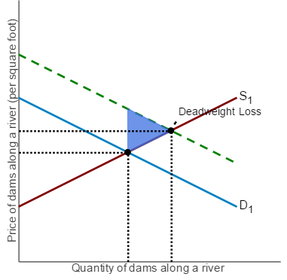
- 41Suppose a new recreational neighborhood park would cost $20,000, including opportunity costs, to construct and maintain. If built, the park would be a public good. For simplicity, assume the neighborhood park would be used by three families, each of whom would derive a marginal benefit equivalent to $8,000 from the park. Should the neighborhood park be built?It would be optimal for the park to be built.
- 42If left to the private market, without private bargaining or government intervention, would the park be built?Without private bargaining or government intervention, the park would not be built.
- 43Suppose a common resource—wood in a public forest—is being overused because residents consider the benefits of gaining firewood or wood for building but do not account for the cost of deforestation when chopping down trees. What could be done to prevent wood in the forest from being overused? To prevent overuse of the common resource,the government could impose restrictions on access to wood in the forest
The source of the overuse of common resources is the same as the source of negative externalities: lack of clearly defined and enforced property rights. In situations in which enforcing property rights is not feasible, two types of solutions to the overuse of common resources are possible.
If the geographic area involved is limited and the number of people involved is small, access to the commons can be restricted through community norms and laws (limits enforced by social pressure). If the geographic area or the number of people involved is large, legal restrictions on access to the commons are required (taxes, quotas, and tradable permits). - 44Consider a Lacoste shirt. Is the consumption of Lacoste shirts rival and excludable? The consumption of Lacoste shirts isrival and excludable.
Rivalry is the situation that occurs when one person's consuming a unit of a good means no one else can consume it. If you consume a Lacoste shirt, for example, no one else can consume it.
Excludability is the situation in which anyone who does not pay for a good cannot consume it. If you don't pay for a Lacoste shirt, for example, Lacoste can exclude you from consuming it. Therefore, the consumption of Lacoste shirts is rival and excludable.
Information
- Description
- Business/Economics Flashcards on Chapter 5 Homework, created by void pickle on 19/10/2016.
- Created by
- void pickle
- Views
- 15,324
- Tags
- Rating