
Flashcards
9.) Semantics 2
Cards in this deck (30)
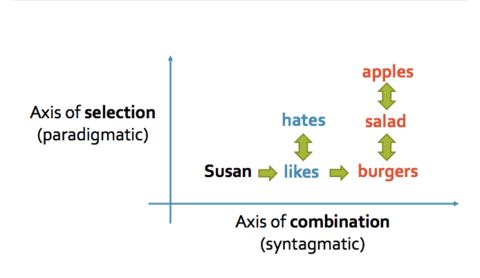
- 1Paradigmatic vs. syntagmatic
- 2Susan likes ____? Question of what can come next; what can be combined with the rest of the sentence?Syntagmatic
- 3Does she like burgers? No, she loves burgers!!! Questions of what words can be used to replacer certain words.paradigmatic
- 4Paradigmatic relation:'vertical' relationship of linguistic forms which can replace each other in a structure.
- 5Syntagmatic relation:'horizontal' relationship holding between linguistic forms which co-occur in the same structure.
- 6Paradigmatic relations: Different types of synonym1.) Near-synonym: start – begin, finish – end, answer – reply...
2.) Emotional: Mum – Mummy, kitten – kitty, Daniel – Danny...
3.) Regional: lorry – truck, sweets – candy, schauen – gucken...
4.)Stylistic: car – automobile, big – substantial, get – obtain... - 7Paradigmatic relations: What is a euphemism?the substitution of an agreeable or less offensive expression in place of one that may offend or suggest something unpleasant to the listener; sometimes used to avoid taboo words but also for fun.
--> Less offensive / more pleasant - 8Paradigmatic relations: antonymyOpposite meaning
Open – Closed
Clean – Dirty
Big – Small
Right – Wrong
Eat – Drink
Black – White
Young – Old
Husband – Wife
Do – Undo
Good – Bad - 9Paradigmatic relations: Four types of antonym:• Gradable
• Non-gradable
• Reversives
• Converses - 10Paradigmatic relations: Gradable antonymslike a scale / continuum
comparative test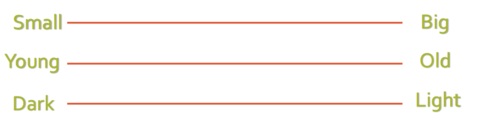
- 11Paradigmatic relation: Non-gradable antonymseither one or the other
dead-alive
true-false
on-off
comparative test not possible - 12Paradigmatic relations: Reversivesone is the reverse action of the other
enter - exit
open - close
dress - undress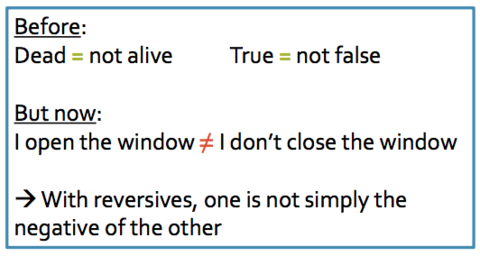
- 13paradigmatic relations conversesreferring to a relationship from different points of view
• Buy – Sell
• Mother – Daughter
• Predator – Prey
• Lend – Borrow
--> If there is one, there has to be the other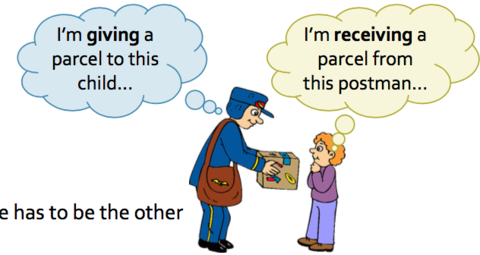
- 14Paradimgatic relations: hyponomyX is a kind of Y
A labrador is a kind of dog. A rose is a kind of flower. A strawberry is a kind of fruit. - 15Paradimgatic relations: hyponomy terms
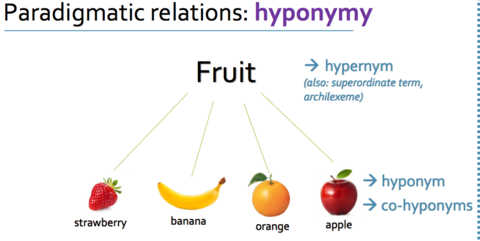
- 16paradigmatic relations: hyponymy lexical sets
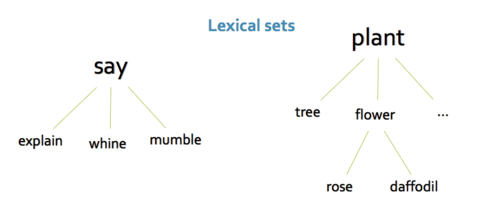
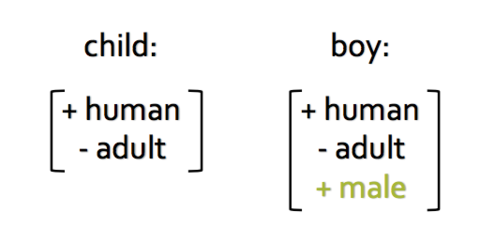
- 17Paradigmatic relations: connection between synonymy and semantic features?same set of semantic features
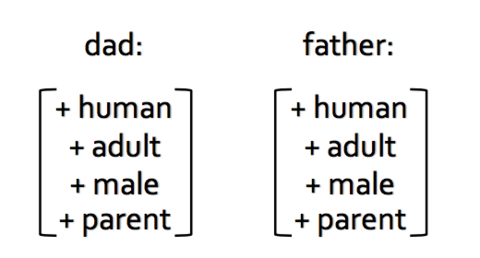
- 18Paradigmatic relations: connection between antonymy and semantic features?one semantic feature is different
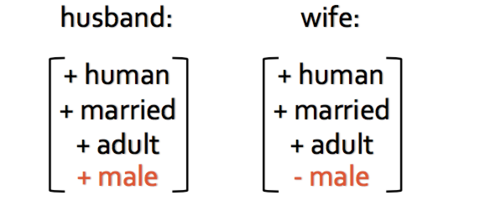
- 19Paradigmatic relations: connection between hyponymy and semantic features?hyponyms contain all the features of the hypernym, plus additional features
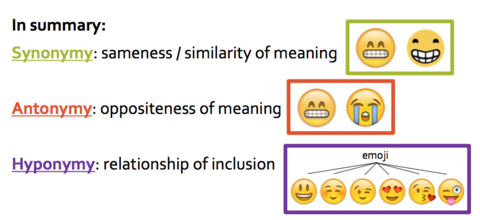
- 20paradigmatic relations summary
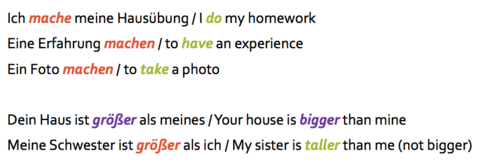
- 21syntagmatic relations: What is collocation?-> The statistical tendency for lexical items to co-occur (i.e. what words tend to ‘go together’)
He has blond hair
*She has a blond car?
--> She has a beige / yellow car
To do your homework
to have an experience
he's a handsome - 22Collocations can be ____in_____ languages, e.g.Collocations can be different in different languages, e.g.
- 23syntagmatic relations: Collocation bonds?words don’t need to be next to each other to co-occur
Argument - strong
-You make a strong argument..
-His argument was strenghened by..
-The strength of her argument..
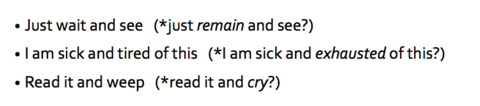
-He argued strongly for ... - 24syntagmatic relations: Highly-fixed collocations??Formulaic phrases, highly conventionalized
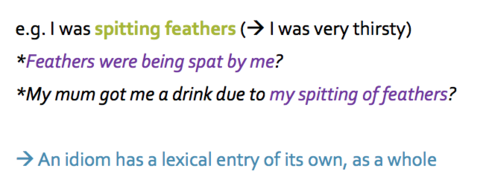
- 25syntagmatic relations: what is an idiom?A conventionalized phrase whereby the meaning cannot be
derived from its components
eg. It's raining cats and dogs - 26idioms: strong syntactic restrictions?--> Can’t usually change things like word order since the phrase is so fixed
- 27Metonymy?--> A new use of a word based on a close connection in everyday
experience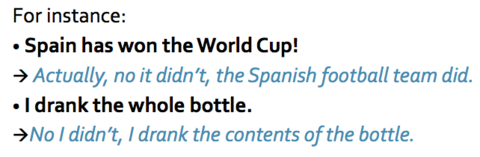
- 283 types of metonymy1.) Content - container
I drank the whole bottle/I finished my plate/I ate the whole packet
2.) Function - symbol
Parliament has declared--/The White house has announced
3.) Whole - part
We counted 24 heads/ iI've got a new set of wheels - 29Metaphor?--> Seeing one thing in terms of another
eg. seeing argument as war
or ideas as food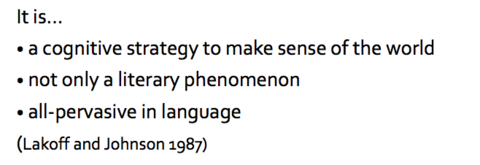
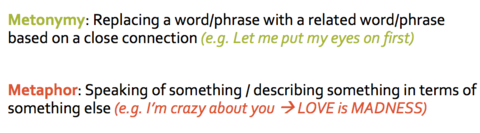
- 30summary metonymy and metaphor
Information
- Description
- Linguistics (Semantics) Flashcards on 9.) Semantics 2, created by Lisza Neumeier on 26/11/2016.
- Created by
- Lisza Neumeier · Nov 2016
- Updated
- Apr 6, 2018
- Views
- 85
- Rating