
Flashcards
AQA Geography A Changing Urban Environments
Cards in this deck (58)
- 1UrbanisationA process where an increasing proportion of the population lives in towns and cities, resulting in their growth
- 2Rural-to-urban MigrationMoving home from a rural area to settle in a town or city
- 3Causes of Urbanisation-Natural increase, people in the cities have children, so the city grows
-Rural-to-urban migration, people move from rural areas to cities, so the city grows - 4Reasons for Rural-to-urban Migration-Push factors that cause people to leave rural areas like
-E.g. drought, few opportunities, bad infrastructure, poor medical facilities, little recreation, unemployment
-Pull factors that attract people to urban areas
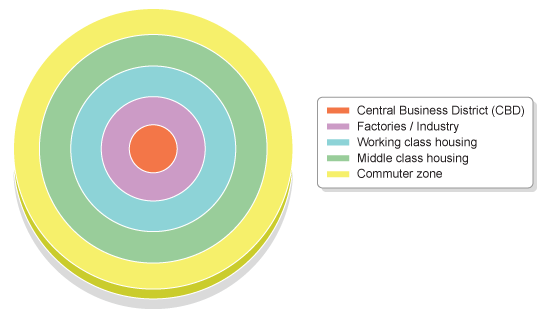
-E.g. opportunities, education for children, jobs, infrastructure, transport, medical facilities, recreational activities - 5Burgess Model
- 6Central Business District-High rise buildings
-Offices, banks, admin etc.
-Expensive shops
-Pedestrian only zones
-Land marks
-Expensive land value - 7Inner City-High density
-Factories
-High unemployment rates
-High traffic pollution
-Derelict - 8Lower Class Housing-Cramped
-Noise pollution
-Cheap
-Old
-Cheap land
-Terraced housing
-High traffic pollution
-New high rise flats
-Vandalism and graffiti - 9Suburbs-Larger housing
-Cheaper than CBD but more expensive than Inner city
-Home to CBD commuters
-Semi detached houses with gardens - 10Rural Urban Fringe-Where the town/city meets the country
-At the very outskirts
-Detached housing
-Country side
-Clean air
-Very expensive - 11Uses of Land in Urban Areas-Leisure and recreation
-Residential
-Transport
-Business and commerce
-Industry - 12Issues of Urban Areas in MEDCs-Housing
-The Inner City
-Traffic
-The CBD
-Multicultural Mix - 13Brownfield SiteLand that has been built on before and is now to be cleared and reused, normally in the inner city
- 14Greenfield SiteLand that has not been built on before, usually in the country side of rural urban fringe
- 15Brownfield Sites: Advantages-Easier to get permission
-Sites are not left derelict
-Utilities such as water and electricity already provided
-Roads already exist
-Near to facilities
-Shorter commute time - 16Greenfield Sites: Advantages-Cheaper to prepare as no clearing is required
-No restrictions of already existing road networks
-Pleasant country side environment
-More space for gardens - 17Housing: Issue-UK population increased by 10.5% since 1971
-Number of household increased by 30% (more people living alone)
-New, single person housing accounts for 70% of rising housing demand
-People leave home earlier, marry later and divorce is more common
-Demand is more than supply so housing prices rise - 18Housing: Solution-Government has a target to build 240 000 new houses every year by 2016 so prices don't spiral out of control
-Target of 60% to be built on brownfield sites
-Some will have to be on greenfield sites though - 19Inner City: 1) UDCsUrban Development Corporations
-Large-scale projects where major changes were made with the help of public and private funding - 20Example: London Docklands Development Corporation LDDC-1981 to 1998 London Docklands Development corporation (LDDC)
-Received £1.86 bn public and £7.7 bn private investment
-144 km new improved roads
-Docklands light railway
-762 ha derelict land recovered
-24 000 homes built
-2 700 businesses trading
-5 new health centres and the redevelopment of 6
-11 primary schools, 2 secondary, 3 post-16 colleges, 9 vocational training centres
-85 000 people now working in the Docklands - 21Traffic: Issue-30% of households have more than one car
-45% of households have one car
-The large amount of cars cause: -air and noise pollution
-Discoloured buildings
-Impacts respiratory issues like asthma - 22Traffic: Solution-Making public transport more attractive
-Park and ride schemes
-London has introduced congestion charges of £10 per day for driving in central London - 23CBD: Issue-1960s to 1980s CBD struggled to attract people
-Out of town shopping centres became popular as they had lots of parking with cleaner air - 24CBD: Solution-Pedestrian only areas to increase safety and air quality
-Street furniture (e.g. benches) made the area more appealing to shoppers
-Made the physical environment look better (e.g. by cleaning historic monuments) - 25Multicultural Mix: Issue-People chose to segregate themselves to remain with people of their own culture because:
-Support from others
-Familiarity
-Specialist facilities
-Employment factors
-Safety in numbers - 26Multicultural Mix: SolutionIn Leeds:
-Increasing children's achievement by improving educational provisions
-Improving literacy where English is a second language
-Increasing employment by teaching basic skills and giving access to information and training
-Increasing community involvement by ensuring minority groups' needs are understood and met
-Providing facilities where all sections of community are encouraged to meet - 27Causes of Squatter Settlements-Squatter settlements occur as an evolution of the informal sector
-Rapid rural to urban migration doesn't allow the time to build proper housing
-New arrivals make they're own makeshift shelters on areas of unoccupied land with whatever they can find - 28Living Conditions in Squatter Settlements-No basic infrastructure like sanitation, sewage and fresh water pipes, electricity or roads
-Houses are made of any material that can be found haphazardly arranged
-Incredibly over crowded
-Water needs to be fetched from a nearby source
-Rubbish accumulates in the streets
-Sewage flows through the streets
-Occupants have unreliable, poorly paid jobs
-Poverty
-Major crime issues - 29Improving Conditions: Own Initiative-Some residents attempt to improve their shelters
-Replacing flimsy, temporary material with more permanent brick and concrete
-Catching rainwater on top of the roof
-Obtaining electricity (often illegally)
-This process is very slow - 30Improving Conditions: Self-help-Local authorities support squatter settlers improving their homes
-Involves same improvements as own initiative but more organised
-Cooperation between residents to remove rubbish
-Local authority offers grants, cheap loans and possibly materials
-Standpipes are likely to be provided for water and sanitation
-May begin to start health care and/or schools
-Legal ownership of land can be granted to encourage inhabitants to improve the place - 31Improving Conditions: Site and Service-More formal way of helping
-Land is identified for the scheme
-Infrastructure is laid out ahead of time
-People can then build houses on these plots with whatever they can afford at the time
-They can then improve the houses later - 32Improving Conditions: Local Authority Schemes-Can take many different forms
-Can be large scale, involving the building of:
-Schools
-High rise flats
-Entire new settlements - 33Kibera: Location and Size-Kibera is a squatter settlements in the south of Nairobi, Kenya's capital
-60% of Nairobi's inhabitants live in slums, over half of them in Kibera
-800 000 to 1 million people living an area of 225 ha
-Density where people have 1 m2 - 34Kibera: Conditions-100 000 children orphans due to aids
-Homes are made of mud, wood or corrugated iron
-Paths have a ditch in the middle carrying sewage
-Rubbish litters the area
-Smells of charcoal and human waste
-One water standpipe supplies 40 families
-Private operators bring in hose pipes and charge twice the price of water
-Crime issues, police reluctant to enter - 35Kibera: Solutions-Practical Action (British charity) developed low cost roofing tiles that can be used in self help schemes
-UN-Habitat provides electricity to some places at a price of 300 Kenyan shillings per shack
-Two main water pipes (from world bank and the council) provide water at 3 Kenyan shillings per 20 l
-Medical facilities provided by charities
-Gap-year students encouraged to go and help there
-15-year project starting 2003 plans to rehouse thousands of people as a joint venture between Kenyan Government and UN-Habitat, relocated 770 families to flats with running water, electricity and sanitation in the first year - 36Issues of Rapid Urbanisation-Environmental disasters
-Electronic waste
-Water pollution
-Waste and pollution - 37Why do these issues exist?-Rapid urbanisation makes it harder to control what's happening and enforce regulations
-Not enough people to enforce the regulations on a growing population
-Non existent or poor regulations make matters worse - 38Water Pollution: Ganges-Ganges river has toxins, chemicals and dangerous bacteria at 3000 times the rate that WHO suggests as safe
-1 billion l of untreated sewage pumped into Ganges DAILY
-This is predicted to double in the next 20 years
-Thousands of cremated bodies put into the river
-corpses that were not properly cremated, of unwanted babies and animals float in the river
-More than 420 million people rely on it, Hindu's bathe in it
-People drink this water - 39Environmental disasters: BhopalDecember 1984
-Poisonous gas escaped from a chemical plant
-Killed at least 3000 people
-More died later on
-50 000 suffered from permanent disabilities - 40Electronic waste: India-4.5 million new computers every year plus many second hand ones
-India's poor scrape a living by recycling materials from e-waste
-Boil, crush and burn parts to extract valuable metals like gold or platinum
-Toxic chemicals like lead and cadmium pose severe health risks
-India's hospitals see patients with over 10 times the normal amount of lead in their bloodstream - 41Waste and Pollution: Shanghai-Construction boom is creating 30 000 tonnes of waste a day
-Industry is responsible for 70% of CO2 emissions
-73% electricity produced by coal-fired power
-Responsible for 400 000 deaths annually - 42Dealing with Water Pollution: GangesGanges Action Plan
-Set up in 1986
-Set up sewage treatment plants to deal with the sewage
-However, didn't account for population growth so pollution has risen to the same level as before
-Set up electrical crematories - 43Dealing with Waste Disposal-Sao Paulo, Brazil has two large incinerators that burn 7 500 tonnes of waste a day
-Shanghai, China has an effective solid waste disposal unit in houses which is then used as fertiliser nearby - 44Dealing with Air Pollution-Need to reduce the emissions of sulphur dioxide and oxides of nitrogen
-Switching to cleaner energy sources works, but this will probably require the implementation of a carbon tax
-Shanghai uses low sulphur coal
-Increasing public transport and it's popularity also helps - 45Sustainable CitiesAn urban area where residents have a way of life that will last a long time. The environment is not damaged and the economic and social fabric can stand the test of tome
- 46Characteristics of Sustainable Cities-Clean environment
-Sound economy with jobs
-Local people involved in decision making
-Public transport
-Manage waste effectively
-Strong sense of community
-Create green spaces and gardens - 47What can Cities do to Increase Sustainability?-Conserve historic environment
-Reducing and safely disposing of waste
-Providing adequate open space
-Involving local people
-Effective public transport system - 48Conserving Historic Environment-Liverpool Maritime Mercantile City
-Areas around it's water front and associated with it's development
-Buildings are architecturally as they were in the 18th and 19th century even though their functions have changes - 49Reducing and Safely Disposing Waste-2008 UK was producing 400 million tonnes of waste
-Majority came from mining and quarrying but 30 million from households, this can be reduced
-20% of household waste is garden waste and 17% in kitchen waste, this can be composted
-18% of household waste is paper and cardboard that can be recycled
-2011 40% of UK household waste recycled, 2001 11% recycled
-Still has more landfill sites than most European countries
-Consumer pressure can change the amount of plastic in packaging - 50Providing Adequate Open Space-Official green belts where authorities restrict building
-Designated open areas for use as parks, playing fields and gardens - 51Involving Local People-If people have ownership of ideas and feel involved they are more likely to respond positively
-Consulting people at planning stages is very important
-Residents form association to have a stronger collective voice
-Planners can have surveys before designing and submitting plans - 52Efficient Public Transport Systems-If the government's limiting the number of cars that can be used, they need to provide alternative transport
-Underground, buses and rail links
-Look at the London Olympics - 53London Olympics 2012: During the Olympics-Olympic park built on brownfield sites in formerly derelict Stratford, East London
-Physical area improved through parks and landscaping
-70% of events took place on site
-Majority of athletes and coaches accommodated in nearby Olympic village, reducing transport
-No car parking provided, forcing people to use vastly improved transport system
-Extensive improvement to the Tube
-97% of materials from demolished buildings reused
-Timber sourced from sustainable forests
-Buildings like the velodrome designed to make maximum use of natural light and ventilation, reducing need of electricity
-Rainwater collected and used to irrigate gardens and lawns and flush toilets
-Green spaces created, especially along the river Lea
-River Lea cleaned of thousands of tonnes of rubbish
-Waterside footpaths and tracks for cyclists
-4000 new trees planted - 54London Olympics 2012: After the Olympics-Sports stadiums to be used in the future
-2017 World Athletic champions to be held there
-Aquatic Centre is now a swimming facility for local residents
-High tech international broadcast centre may be used by Media and IT companies, creating 3000 jobs
-Some housing from Olympic village now affordable housing for residents - 55Curitiba: Parks-Population 1.8 million in Brazil
-Role model city for sustainability
-Network of 28 riverside parks
-100 miles of city trails
-Lakes have been created in these parks that fill and flood the parkland thereby reducing flooding risk in the city - 56Curitiba: Recycling-Green exchange programme allows low income families in squatter settlements exchange rubbish for bus tickets
-70% of rubbish recycled by residents - 57Curitiba: BRT systemBus Rapid Transport system
-First Brazilian city to have designated bus lanes
-Direct lane buses operate from key pick up points
-Speedy buses operate on the 5 main city routes with interlinked stops
-Inter-district buses join up districts without crossing the city centre
-Feeder mini-buses pick people up from residential areas - 58Curitiba: Housing-COHAB is the cities public housing programme
-Goal that residents have homes, not shelters
-housing policy that will provide 50 000 homes for the urban poor
Information
- Description
- GCSE Geography (Human Geography) Flashcards on AQA Geography A Changing Urban Environments, created by Natalia Cliff on 01/06/2017.
- Created by
- Natalia Cliff
- Views
- 133
- Tags
- Rating