
Flashcards
Logic Midterm Study Guide
Cards in this deck (32)
- 1ValidityAn argument containing premises from which the conclusion may logically be derived or be formally guaranteed.
Name for this very specific relationship between the premises and the conclusion. In a valid argument, the premises entail the conclusion.
The quality of a deductive argument whereby if all premises are true, then the conclusion must be true - 2TruthThe quality of a claim whereby it is true or false
- 3SoundnessA deductive argument that is valid and has all true premises. (In the real-world truth of an argument)
If an argument is valid and has true premises - 4OperatorsA modifier of claims that allows us to express more complicated states of affairs. The basic operators discussed in this book are: and, or, not, in…then, if and only if.
- 5DeductionAn argument whereby the conclusion follows from the premise(s) with necessity so that, if all the premises are true, then the conclusion cannot be false
- 6InductionAn argument whereby the conclusions follows from the premise or premises with some degree of probability less than 1.
- 7Arguments• One or more claims called a premise (or premises)
• Intended to support the truth of a claim
• Called the conclusions - 8QuantifiersAn indicator of how many of something is referred to in a claim, and there are three basic quantifiers: all, some, and none
- 9EvidenceA reason or set of reasons to believe that a claim is true or false
- 10Direct EvidenceEvidence that you as a critical thinker have immediate access to, for instance, seeing that something is red or round or recognising that a particular claim follows form a mathematical theorem
- 11Indirective EvidenceEvidence that you are distanced by some sort of mediator. For instance, if someone testifies that they saw someone hit your car, you don't have immediate access to the fact that someone hit your car - you only have access to the testimony.
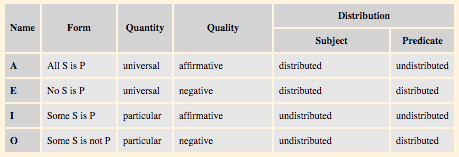
- 12DistributionA distributed term is a term of a categorical proposition that is used with reference to every member of a class. If the term is not being used to refer to each and every member of the class, it is said to be undistributed.
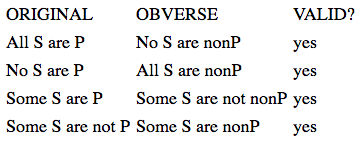
- 13ObversionFormed by changing its quality and replacing the predicate term with its term complement
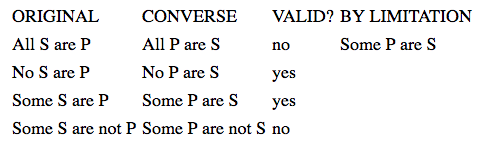
- 14ConversionFormed by interchanging its subject and predicate terms
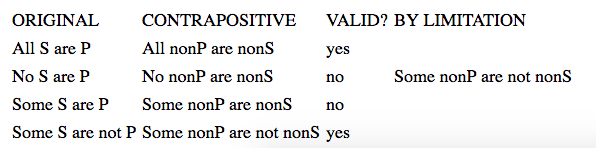
- 15ContrapositionFormed by replacing its subject term with the term complement of its predicate term and replacing the predicate term with the term complement of its subject term
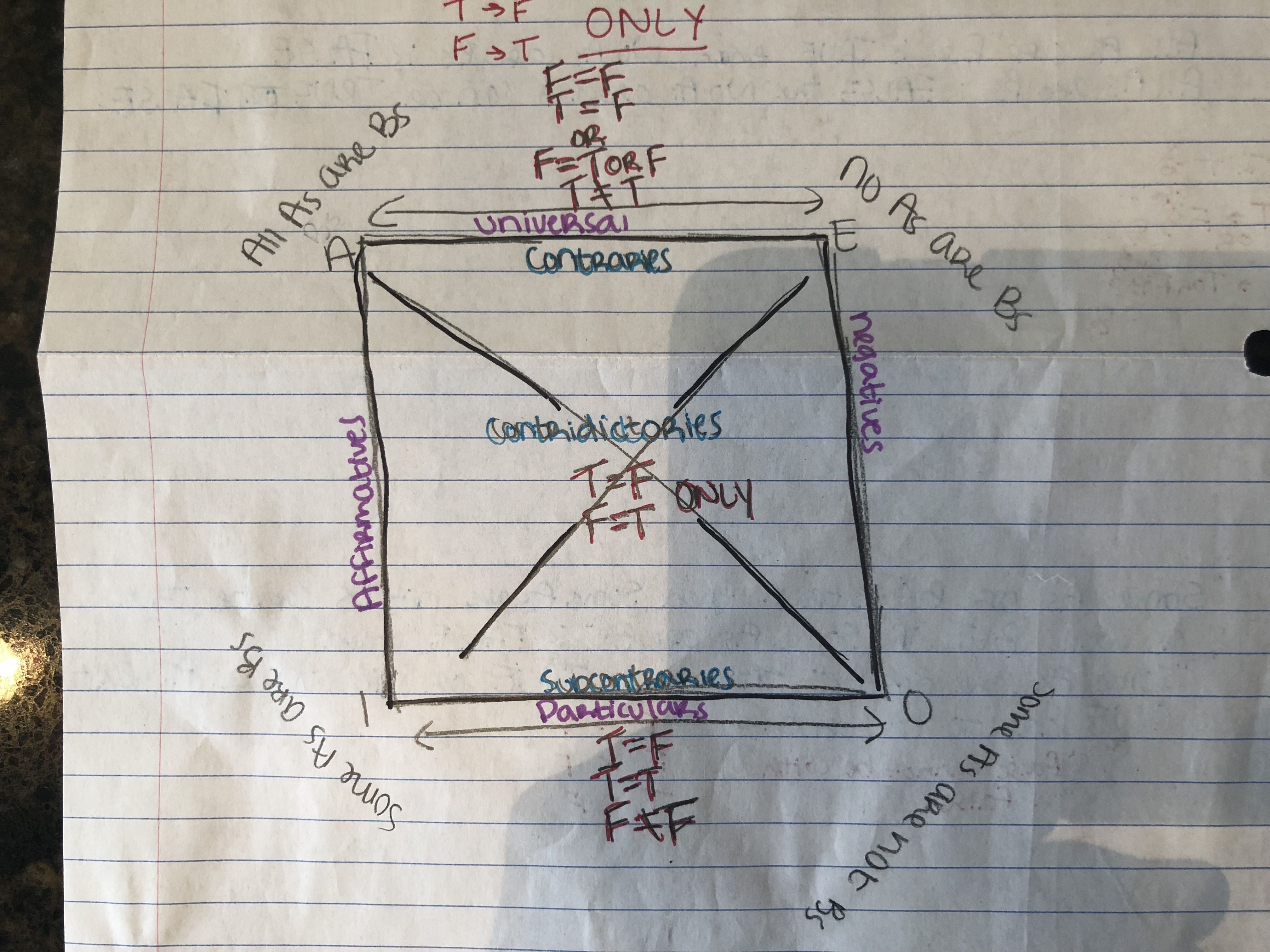
- 16SubalternationThe left and right sides of the square of opposition. A- and I- claims and E- and O- claims are in a relationship.
• A-claim is true, I-claim is true
• A-claim is false, I-claim is undetermined
• I-claim is true, A-claim is undetermined
• I-claim is false, A-claim is false
• E-claim is true, O-claim is true
• E-claim is false, O-claim is undetermined
• O-claim is true, E-claim is undetermined
• O-claim is false, E-claim is false - 17Contrary ClaimsThe A-claims and E-claims are never both true at the same time
• Contrary claims are never both true
• Contrary claims can both be false
• If one contrary claim is false, it is undetermined whether the other is true or false - 18Subcontrary ClaimsI-claims and O-claims are never both false at the same time
• Subcontrary claims are never both false
• Subcontrary claims can both be true
• If one subcontrary claim is true, the other is undetermined - 19Contradictory ClaimsA-claims and O-claims, E-claims and I-claims; are opposite truth values.
• If one is true, the other is false
• If one is false, the other is true
• Both CANNOT be true
• Both CANNOT be false
A-claim is true, O-claim is false
O-claim is true, A-claim is false
E-claim is true, I-claim is false
I-claim is true, E-claim is false - 20Standard-Form Categorical Claims4 Parts of a Categorical Claim:
Quantifier (ALL/NO/SOME)
Subject (CATEGORY OF THINGS)
Copula/Quality (ARE/ARE NOT)
Predicate or Object (SOME OTHER CATEGORY OF THINGS) - 21Basic ClaimsA-Claim: All As are Bs
E-Claim: No As are Bs
I-Claim: Some As are Bs
O-Claim: Some As are not Bs - 22A-ClaimAll A are B (All things that are A are also things that are B)
The football-looking intersection between S and P is left unshaded while the rest of S circle is shaded in. This expresses that here is no member (instance, individual, element) of S (shaded area = nothing) that is not a member of B; all As are Bs.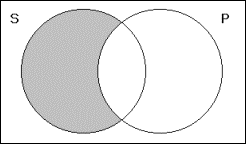
- 23E-ClaimNo A are B (there are no things that are A that are also things that are B)
Notice that the football-looking intersection between categories S and P is shaded. This diagram expresses that there is no member of S (shaded area = nothing) that is a member of B; No A are B.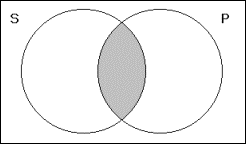
- 24I-ClaimSome A are B (there is at least one thing- maybe more- in the S category that is a B)
The X indicates that there is at least one member of S that is also a member of P.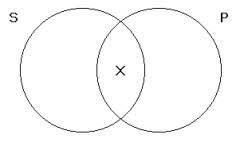
- 25O-ClaimSome A are not B (there are at least one thing - maybe more - in the A category that is not in a B)
The S category has an X in it indicating that there is at least one S that is not in P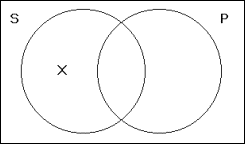
- 26Indian Syllogism1. A proposition to be proved
2. A reason for its being true
3. An example to show that the reason embodies a general rule
4. An assertion to the effect that the reason ripples to the case at hand
5. An assertion that the proposition must, therefore, be true - 27Aristotelian Syllogism1. General statement (major premise)
2. Specific statement (minor premise)
3. Conclusion - 28PremiseOverall structure of the argument, are the claims that support the conclusion
- 29ConclusionA claim in need of support by evidence
- 30Middle TermTerm that is the subject or predicate in both of the premises of the syllogisms, but not in the conclusion.
- 31Major(P) Term Minor(S) Term Middle(M) TermAll comedians (MIDDLE/M) are shy people (MAJOR/P).
Some comedians are good actors (MINOR/S).
Some good actors (S) are shy people (M). - 32Square of Opposition
Information
- Description
- Philosophy Flashcards on Logic Midterm Study Guide, created by Timothy Nguyen on 20/02/2018.
- Created by
- Timothy Nguyen
- Views
- 2
- Rating