
Flashcards
D&L - TB9 - Tutorial
Cards in this deck (22)
- 1Aggression Causes:- Neuropsychological abnormalities.
- Harsh parenting.
- Socioeconomic deprivation.
- Poor peer relations.
- Attitudes and beliefs supporting aggression.
- Drug and alcohol abuse. - 2Can viewing violence on TV contribute to increased aggression? Connected Kids Report (2015).- Children spend 6.5 hours every day in front of TV and computer screens.
- 3Can viewing violence on TV contribute to increased aggression? Wilson et al. (2002).Violence occurs more frequently in children's programmes than in other programmes.
- May be because children's TV is normally cartoons and not actual actors. - 4Can viewing violence on TV contribute to increased aggression?By age of 16, the average American child will have seen approximately 13,000 killings on TV.
- 5Why might observing TV violence lead to aggressive behaviour?- May encourage violence through imitation.
- Violence may become associated with stimulation of positive feelings through arousal.
- Viewing violence may desensitise children to the negative consequences of aggression - becomes more 'normal'.
- Viewing violence may teach children aggressive 'scripts' for dealing with social situations - more aggressive schemas, leading to aggressive behaviour.
- Learnt behaviour? - 6How are scripts thought to contribute to aggressive behaviour?- Researchers suggest children learn 'scripts' from watching violent TV.
- Children come to believe that one way to deal with problems/resolve situations through violence.
- Effect may be particularly pronounced when the situations they encounter are similar to the ones they've seen on screen.
- Children may learn that aggression is normative/socially acceptable. - 7An Alternative Hypothesis- Children who are highly aggressive might seek out violent TV programmes.
- Aggressive children might feel happier and more justified in their own aggressive behaviour if they believe other people act in a similar way. - 8Previous Experimental Research:- Children exposed to violent or non-violent behaviour on TV behave more aggressively immediately afterwards.
- Typical paradigm involved showing children wither violent or nonviolent behaviour video and observing following behaviour.
- Findings children who see violent clips behave more aggressively toward each other and towards objects. - 9Main findings of Huesmann et al (1984) and Huesmann & Eron (1986)?- Huesmann and colleagues conducted a 3-year longitudinal study of children in 5 different countries.
- Children’s TV viewing habits in the first grade predicted their aggressive behaviour 3 years later, even when initial levels of aggression were controlled for.
- This relationship between TV habits and aggression held true for boys and girls.
- The more aggressive children watched more TV, preferred more violent programmes, identified more with aggressive characters and perceived TV violence to be more like real life, than the children which were less aggressive. - 10What were the aims of the Huesmann and Colleagues study?- To follow-up the longitudinal study of 557 children conducted by Huesmann and colleagues.
- To investigate the long-term relations between viewing media violence in childhood and aggressive behaviour in young adulthood.
- To compare different theories of the violent effects of television. - 11The authors sought to address 4 questions. What were they?1. To what extent does early childhood exposure to media violence predict young-adult aggression and violence?
2. Are there gender differences in the predictability?
3. Does the extent to which children viewers identify with the aggressive character and believe that the plot is realistic affect the strength of the prediction?
4. To what extent does any long-term relation seem to be due to more aggressive children simply liking to watch violence or seem to be due to a “third variable” that increases the likelihood of watching violent TV or ? - 12Discussion Point: Do you think the aims of this study are important? If so, why?• Yes.
• Gun crime – what is happening in childhood for these things to happen in adulthood.
• This is a stage when children can be easily influenced, they need to learn that even if they are watching these things they aren’t necessarily right.
• Make parents more aware.
• Up the age of aggressive video games? Make them all difficult to access. - 13Participants?- How old were the participants at follow-up and what measures were taken?
• 20- to 25-years-old (Mean age = 22).
- How many of the participants from the original study could be included in the sample? Did sample attrition introduce any biases?
• 329.
• The more aggressive children from the original sample did not participate in the follow-up – keep this in mind. - 14Method?- How was adult aggressive behaviour measured?
• Self-report.
• Reports from other people.
• Archival data. - 15Discussion Point: Designing a study now, to test the relationship between exposure to violence and later aggression, what measures would you take to assess children's exposure to violence?• Parent’s to report behavioural characteristics of child.
• Teacher’s to report behavioural characteristics of child.
• Aggressive/violent toys vs non-aggressive/violent toys – do they play with toy soldiers and guns?
• What online games do they have? Are they aggressive e.g. wars and shooting?
• Look at their social media pages and see if there are any violent or aggressive topics on there.
• TV diary – what do they watch on the TV? How aggressive are these shows?
• Monitor device/internet history?
• Observation of the child – antisocial behaviour. - 16Results: Did viewing TV violence in childhood predict adult aggression 15 years later? If so, how strong was the association?• Yes.
• Males, r = .21.
• Females, r = .19. - 17Results: Was the relation between TV violence viewing and adult aggression influenced by other variables?• Analyses were conducted controlling for parent variables, SES and intellectual ability.
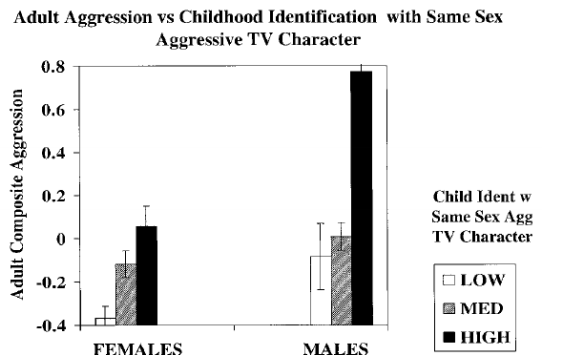
• The observed relations held true even when controlling for these variables. - 18Explain this figure:- Participants who had high identification with same-sex aggressive characters in childhood scored significantly higher on adult aggression 15 years later.
- This effect was stronger for males - 19Discussion Point: - How convincing do you find the claim that these data suggest a causal relationship between watching violent TV and aggression in adulthood?- Did not really control for earlier aggression.
- May have been more aggressive and the TV made it worse.
- May be a correlation, but too many factors to affecting aggression for a causation.
- A lot of really aggressive children didn't participate so can't see the effects on them.
- Could look again at age 30-40, 20-25 is still young. - 20Discussion Point: - While viewing TV violence explained some of the variance in adult aggression, it did not account for all the individual differences in adult aggression. What other factors do you think contribute to the extent to which an adult engages in aggressive behaviour?- Upbringing - Aggressive/arguing parents.
- Life events - Bereavement or Divorce.
- Time in education.
- Mental illness.
- Socio-economic status/issues, e.g. job security.
- Competition over resources - Culture in the job or company in which they work.
- Genetics - Hormones, in particular testosterone.
- Energy - Extra energy levels may be released as aggression.
- Culture.
- Drugs.
- Peers.
- Family. - 21Discussion Point: What recommendations do the authors make for the prevention of violence?- Reduce production of violent material.
- Reduce children's exposure to violence.
- Parental co-viewing and commentary.
- School-based attitude change interventions. - 22Discussion Point: - What do you think would be interesting next steps for future research?• Looking at gaming and internet use such as social media.
• Compare cultures where it is very frowned upon to be aggressive compared to cultures where aggression is accepted.
• Giving children anti-bullying/violence/aggression classes early on in school or pre-school.
• Why did the most aggressive children drop out – research this.
Information
- Description
- The Influence of TV Violence on Aggression
- Created by
- Bethan Williams
- Views
- 2
- Rating