
Flashcards
week 5
Cards in this deck (14)
- 1what's the purpose of moderation vs. mediation?moderation: for whom or under what conditions does the intervention work best? a moderator is a variable that affects the relationship between 2 other variables.
mediation: what are the underlying mechanisms of treatment success? - 2what does the GLM of a moderator look like?y(i) = b0 + b1*x(i) + b2(m(i) + b3*x(i)*m(i) + error(i)
- 3interpret the b1 and b2 (also generally) if the GLM would be (for EMDR vs. WLC): PTSDpost = b0 + b1*intervention + b2*workingmemory.c + b3*int*WMb0 = expected DV for IV=0 when m=0 --> expected PTSDpost for the WLC at average working memory.
b1 = difference in expected DV between IV=1 and IV=0 when m=0 --> difference in expected PTSDpost between EMDR and WLC at average working memory - 4now (also generally) interpret the b2 and b3 for: PTSDpost = b0 + b1*intervention + b2*workingmemory.c + b3*int*WMb2 = difference in expected DV if moderator increased by 1 for people in IV=0 --> difference in expected PTSD if working memory increases by 1 for people in WLC.
b3 = difference in effect of IV on DV if moderator increases by 1 --> difference in the effect of intervention on expected PTSD if working memory increase by 1 - 5how to test a nominal moderator in SPSS vs. a continuous moderatornominal: factorial ANVOA (analyse --> GLM --> univariate --> IV and m in fixed factors).
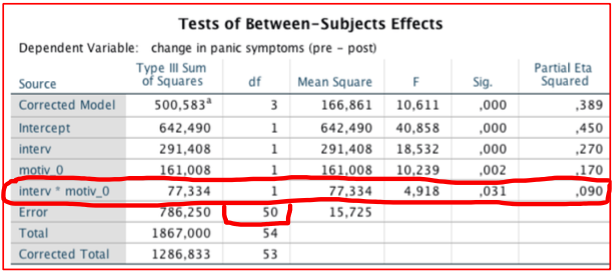
continuous: multiple regression analysis (first: transform --> compute variable --> create interaction. then: regression --> linear) - 6if this were the output of a factorial ANOVA for your nominal moderator, what would you conclude?The effect of intervention on change in panic symptoms depends on people's motivation for treatment. There is a significant interaction effect between intervention and motivation, F-value, p-value.
then look at the plot for the interpretation of the interaction. - 7if this were then the plot of the interaction effect of motivation (high or low) vs. intervention (WLC or CT), what would be your interpretation?(general: there is a greater change in DV after IV=1 than after IV=0. this change is larger for [level of mediator] than for [other level]. in other words, the effect of IV=1 compared to IV=0 on DV is larger for [level of m] than for [other level]).
There is a greater change in panic symptoms after CT than after WLC. This change is larger for high than for low motivated clients. In other words, the beneficial effect of CT compared to WLC on change in panic symptoms is larger for high than low motivated clients.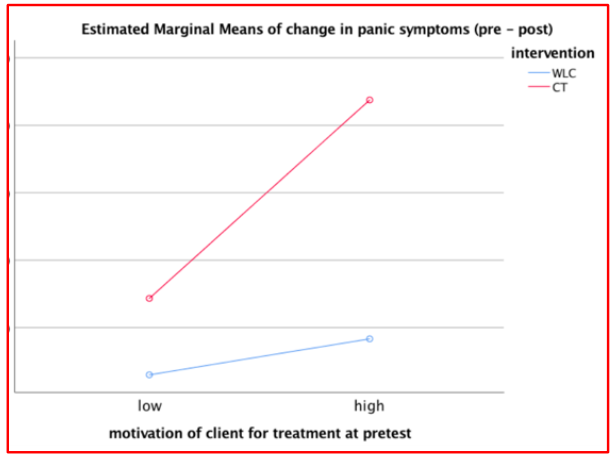
- 8what's partial èta squared (η2)?the proportion of variance in the DV that is uniquely explained by the interaction effect (so: how large is the moderation effect?).
.01 = small, .06 = medium, .14 = large. - 9if this were your output for the multiple regression analysis for your continuous moderator, what would you conclude?The effect of intervention on change in panic symptoms is moderated by the degree of external attribution at pretest. There is a significant interaction effect between intervention and external attribution, b = -1.95, t(47) = -2.87, p = .006.
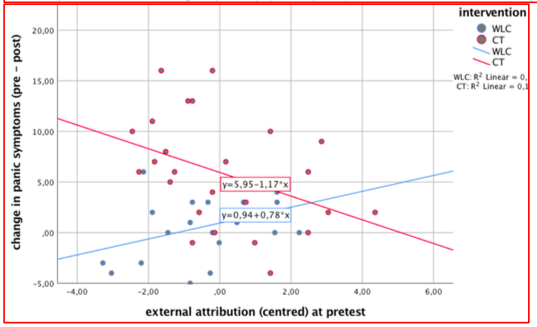
look at plot for interpretation of interaction.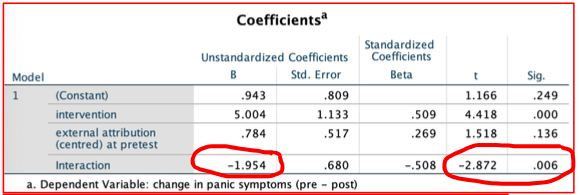
- 10if this were your plot, what would be your interpretation?The beneficial effect of CT compared to WLC on change in panic symptoms increases as external attribution decreases.
- 11MEDIATION. IV: intervention (CT vs. WLC). mediator: catastrophic cognitions. DV: change in panic symptoms. how would you interpret this output?total effect model tells you about path c.
After CT, people on average have a significantly larger change in panic symptoms than after WLC, b-value, t-value, p-value.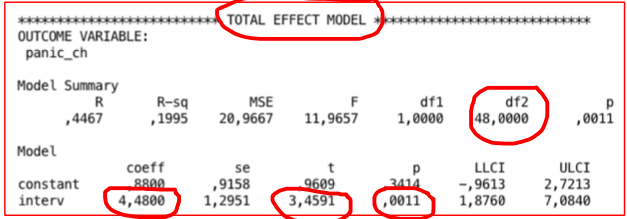
- 12what does this output tell you?tells you about path a.
At intermediate test, people in the CT condition have on average significantly less catastrophic cognitions than people in the WLC, b-value, t-value, p-value.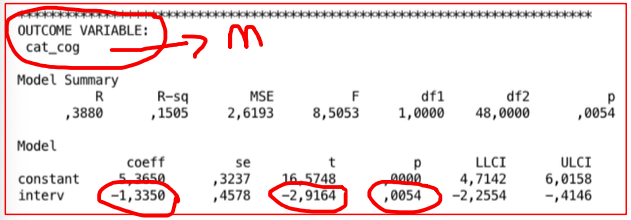
- 13what does this output tell you?tells you about path b and c'.
b: catastrophic cognitions significantly predict change in panic symptoms if controlled for intervention, b, t, p. The more catastrophic cognitions, the less the expected change in panic symptoms, if intervention remains constant.
c': Intervention still significantly predicts change in panic symptoms if controlled for catastrophic cognitions at intermediate test, btp. After CT, people on average have a larger change in panic symptoms than after WLC, if catastrophic cognitions remains constant.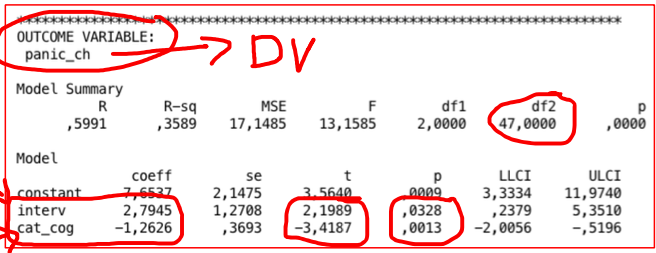
- 14what does this output tell you?tells you about path a*b, so the indirect effect of intervention on change in panic symptoms.
Catastrophic cognitions at intermediate test significantly mediate the effect of intervention on change in panic symptoms, b-value, SE, 95%CI.
Compared to WLC, CT reduces catastrophic cognitions at intermediate test (a) and less catastrophic cognitions are associated with a larger expected change in panic symptoms (b).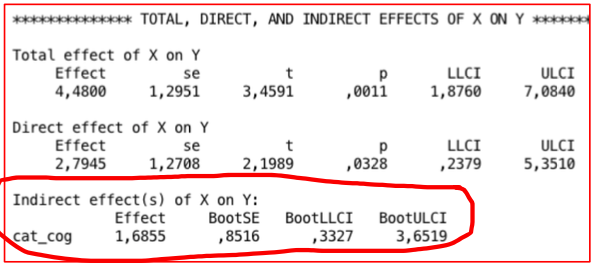
Information
- Description
- university evidence-based CP Flashcards on week 5, created by Sabine - on 08/10/2022.
- Created by
- Sabine -
- Views
- 0
- Rating