
Correlation and Linear Regression
534 resources created by 427 users
This Correlation and Linear Regression page on GoConqr gathers community-made mind maps, quizzes, flashcards and notes, from simple and multiple regression to correlation, heteroskedasticity and logistic regression. It's built for university students and professional candidates practising regression and interpreting results, and for teachers after ready-made material, with a little for school students too. There are over 500 resources here, including more than 30 quizzes, over 300 mind maps and over 100 flashcard sets. Try a quiz to find your gaps, then open a map to fill them.
Top Correlation and Linear Regression resources
-
29 questionschapter 8 In nonlinear models, the expected change in the dependent variable for a change in one of the explanatory v...
-
24 questionschapter 5 Heteroskedasticity means that
-
24 questionschapter 4 When the estimated slope coefficient in the simple regression model, B1 hat , is zero, then
-
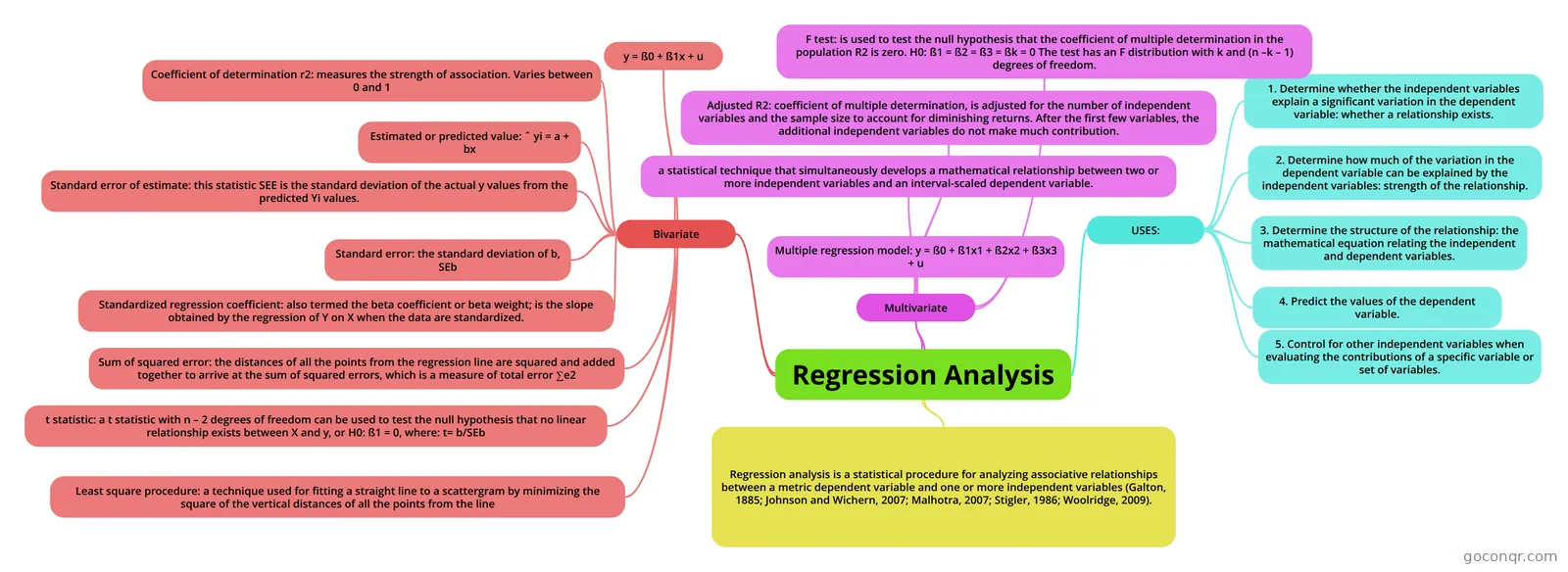 Mind map Regression Analysis
-
5 questionsLinear Regression and Prediction Quiz To plan its upcoming programming, a local television station wanted to study the television watching habits...
-
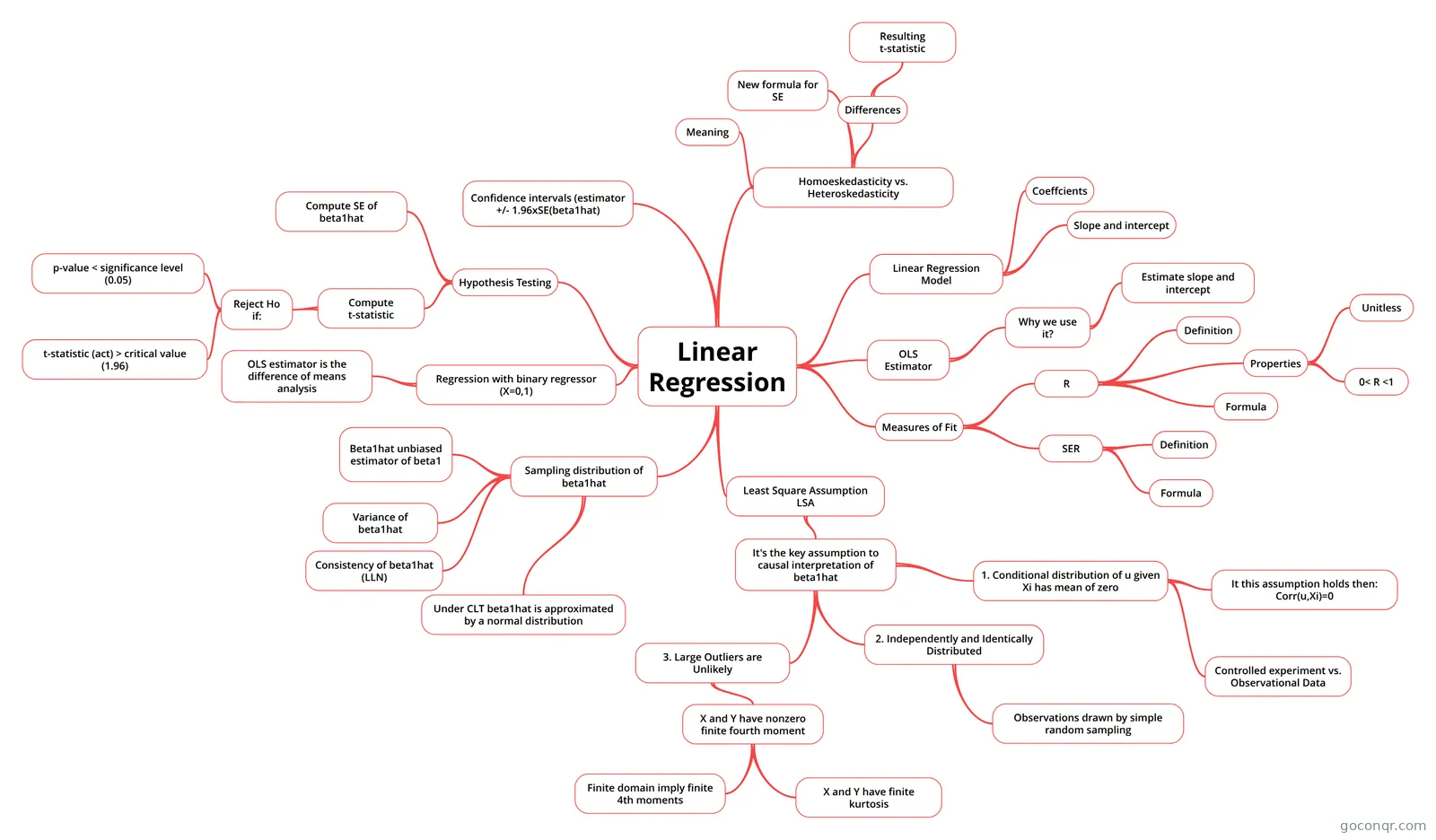 Mind map Linear Regression
-
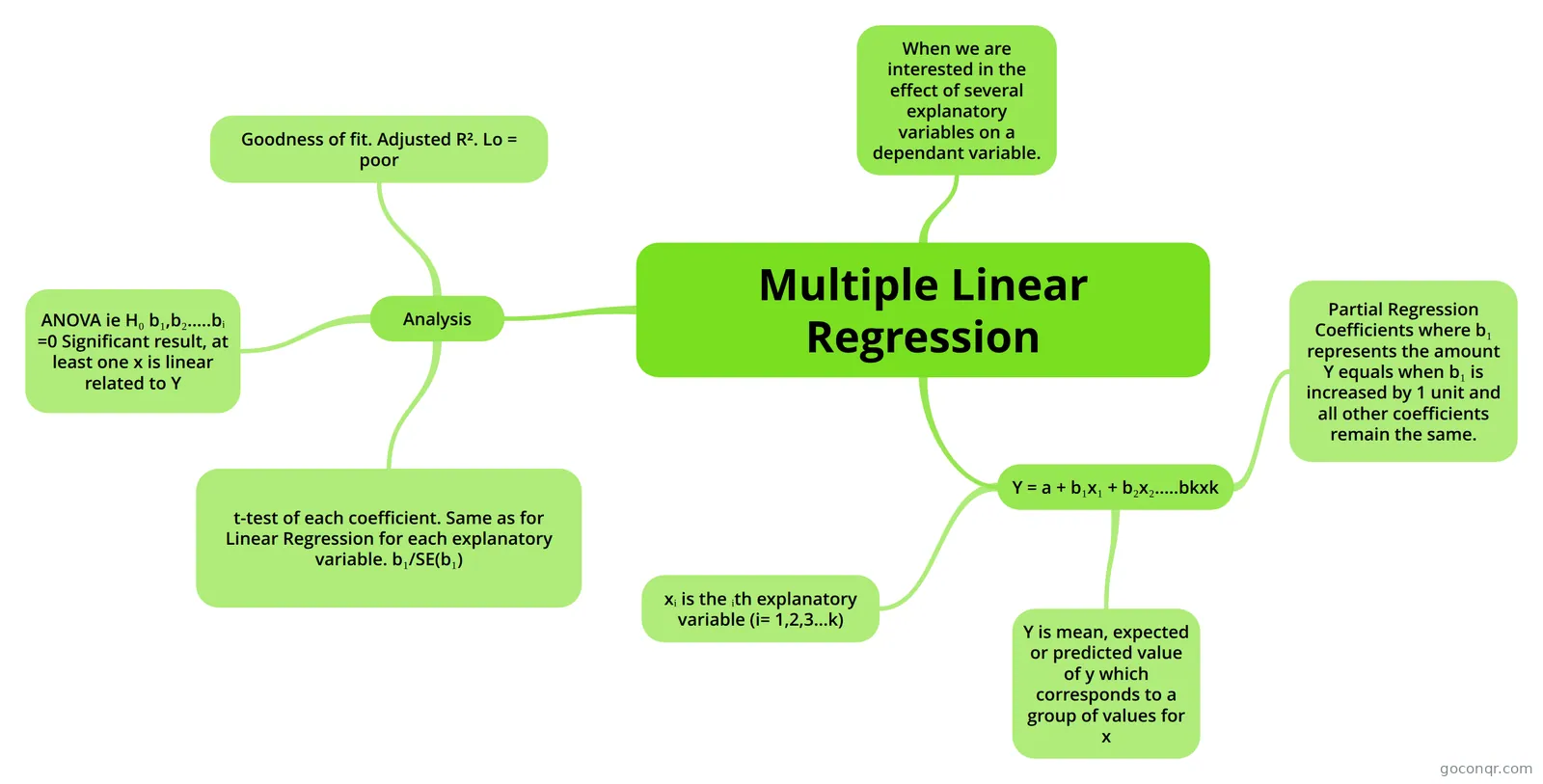 Mind map Multiple Linear Regression
-
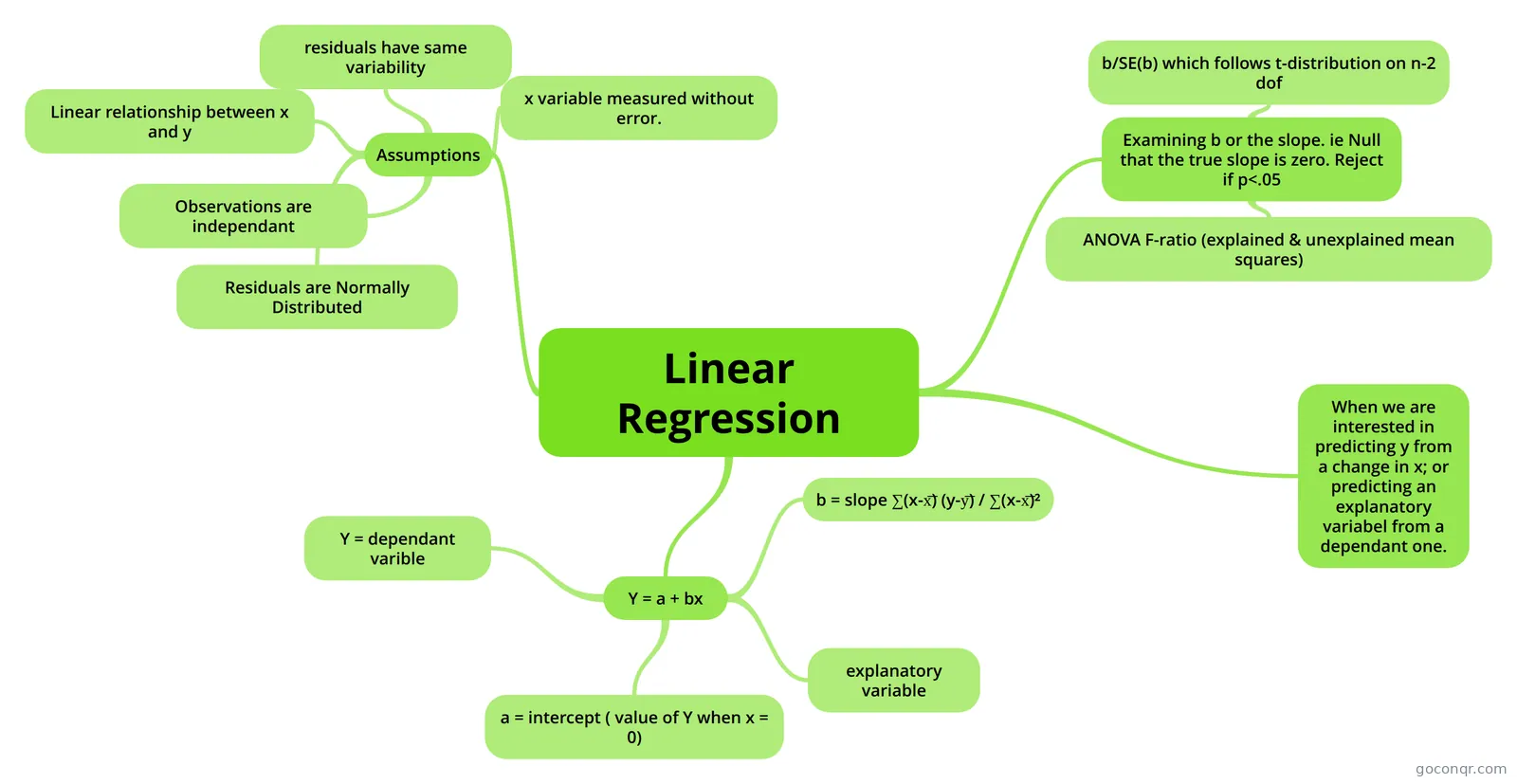 Mind map Linear Regression
Quizzes
See all 38 quizzes-
29 questionschapter 8 In nonlinear models, the expected change in the dependent variable for a change in one of the explanatory v...
-
24 questionschapter 5 Heteroskedasticity means that
-
24 questionschapter 4 When the estimated slope coefficient in the simple regression model, B1 hat , is zero, then
-
5 questionsLinear Regression and Prediction Quiz To plan its upcoming programming, a local television station wanted to study the television watching habits...
-
87 questionsPSYC302 You have a categorical variable with 4 levels. You are interested in whether this categorical variable sign...
-
88 questionsADA As collinearity increases
-
80 questions3rd Year Stats Exam What is the purpose of performing a linear regression analysis?
-
64 questionsPRM EXAM PRACTICE An ad hoc inference is:
Mind maps
See all 330 mind mapsFlashcards
See all 141 flashcards-
5 cardsSPSS Details to include in spss paragraph
-
62 cardsLecture 10 Who 'invented' simple and multiple regression & where did linear regression come from?
-
25 cardsWEEK 3: Logistic Regression What is the difference between Multiple Regression and Logistic Regression?
-
18 cardsWEEK 2: Mediation and Moderation What is Mediation?
-
163 cardsFinal Exam Import from Quizlet
-
91 cardsStudy Guide Exam 1 What is the phi correlation?
-
49 cardsStats Chap 8 Adjusted Predicted Value
-
119 cardsBloque II What does correlation study?
Flowcharts
Notes
See all 15 notes-
Regression Analysis Regression Analysis Regression analysis is a statistical procedure for analyzing associative relationships between a metric dependent variable and one or more independent variables (Galton, 1885; Johnson and Wichern, ...
-
Stats Year 2 Chapter 1 Regression What is regression? Regression is the statistical measure used to determine the strength of relationship between the x and y variables. Depending on the graph you will need to use linear regression or expon...
-
Variables and associations Variable and association types Variable typesContinuousCategoricalAssociation typesInvolves minimally two variablesContinuous - Continuous: Pearson's correlation coefficientCategorical - Categorical: Contingency table...
-
Predictions Prediction, IV & DV PredictionRelationship between an independent variable and a dependent variable.Asymmetric where placement of variables matter.Regression model.Recall: Association is symmetric where placement of v...
-
Spearmans rank Method 1 of 3: By Hand 1 Draw your data table. This will organize the information you need to calculate Spearman's Rank Correlation Coefficient. You will need: 6 Columns, with headers as shown below. As many rows as y...
-
Spearmans rank Method 1 of 3: By Hand 1 Draw your data table. This will organize the information you need to calculate Spearman's Rank Correlation Coefficient. You will need: 6 Columns, with headers as shown below. As many rows as y...
-
Correlation and Causation What is correlation ? Test of relationship between 2 variables ; change in one variable may or may not cause a change in other variableWhat is causation?Implies that if the value of one variable is changed, the other ...
-
Complex Correlations Correlations A correlation looks for a significant relationship between two variables. E.g. does memory increase change with increasing age? Values range from -1 to +1. Hypothesis: Positive or negative r...
Slides
Topics in Correlation and Linear Regression
More Statistics and probability topics
About Correlation and Linear Regression
GoConqr OriginalWhat this page covers
The unit brings together resources on how two or more variables relate, and how to predict one from another. The mind maps are the largest group. Regression Analysis defines regression as a procedure for analysing associative relationships between a metric dependent variable and one or more independent variables. The first Linear Regression map lists the assumptions: a linear relationship between x and y, independent observations, normally distributed residuals with the same variability, and x measured without error.
Where to start
- Open the Regression Analysis mind map for the big picture.
- Move to a Linear Regression map. One covers the OLS estimator, slope and intercept, and measures of fit such as R and SER.
- Read Multiple Linear Regression, which sets out the model Y = a + b₁x₁ + b₂x₂ and so on, with k explanatory variables.
- Try the Linear Regression and Prediction Quiz, which uses a television-watching study as its worked scenario.
Using quizzes and maps together
Take a quiz first and note which questions you miss. Then go to the matching map. The chapter quizzes cover nonlinear models, heteroskedasticity and the meaning of a zero slope coefficient, so they suit a second pass once the basics are secure. Flashcard sets such as Regression diagnostics and assumptions and Pearsons and Spearmans population correlation coefficient are handy for short revision sessions. Notes on Spearman's rank and on correlation and causation sit alongside them.
Where it fits
This unit sits in the Correlation, Regression and Modelling strand of Statistics and probability. Most resources are pitched at university level, with a smaller share for school students. All were made by GoConqr users, so styles vary, and it helps to compare two or three on the same idea.
Ready to begin? Pick a map, take a quiz, and then make your own flashcards from what you find tricky.
Frequently asked questions
Which resource should I open first?
Start with the Regression Analysis mind map, which defines regression and the variables involved. Then open a Linear Regression map for assumptions, the OLS estimator and measures of fit. After that, the Linear Regression and Prediction Quiz lets you check what stuck.
What do the mind maps on this page cover?
They range from simple and multiple regression to correlation, heteroskedasticity, odds ratios, hierarchical and logistic regression. Some follow SPSS lessons, such as SPSS 6: Linear Regression. There are over 300 mind maps, so you can compare explanations of the same idea.
Are the resources free to use?
Yes. Every resource listed here is free to open, study and take, with no account needed. They were made by GoConqr users rather than by GoConqr, so it's worth checking more than one source when a topic feels unclear.
Who are these resources for?
Mostly university students and professional candidates working on regression and correlation, plus teachers who want ready-made material. A few resources suit school students. Quizzes let you practise interpreting slopes, assumptions and prediction, while flashcards help with definitions.
What if the topic I need is missing?
Try nearby titles first, such as Multiple Regression, Correlations or Bivariate Regression, since the same idea often appears under another name. If it still isn't there, a free account lets you make your own quiz, mind map, flashcards or notes.