
Flashcards
Elements Compounds And Mixtures
Cards in this deck (30)
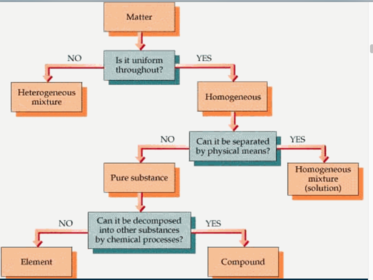
- 1Mixtures, elements, compoundsScientists like to classify things.
One way that scientists classify matter is by its composition.
Ultimately, all matter can be classified as mixtures, elements and compounds. - 2Why isn’t matter classified according to its physical characteristics, such as color?Scientists wouldn’t find it very useful to group gold, sunflowers, and the sun together.
- 3Scientists ask themselves these questionsIs the matter uniform throughout?
Can it be separated by physical means?
Can it be separated by chemical means? - 4Elementssimplest form of pure substance. They cannot be broken into anything else by physical or chemical means.
- 5Compoundspure substances that are the unions of two or more elements. They can be broken into simpler substances by chemical means.
- 6Mixturestwo or more substances that are not chemically combined with each other and can be separated by physical means. The substances in a mixture retain their individual properties.
- 7Mixtures -- SolutionsA special kind of substance where one substance dissolves into another
- 8Is it uniform throughout?If the answer is no, the matter is a heterogeneous mixture.
Considered the“least mixed.”
Does not appear to be the same throughout.
Particles are large enough to be seen and to be separated from the mixture. - 9Examples of heterogeneous mixturesSand and pebbles
Oil and water
Powdered iron and powdered sulfur - 10Can it be separated by physical means?If the answer is yes, the matter is a homogeneous mixture or solution.
- 11Homogeneous MixturesA mixture that appears to be the same throughout.
It is “well mixed.”
The particles that make up the mixture are very small and not easily recognizable.
 - 12Examples of homogeneous mixturesMilk, toothpaste, and mayonnaise are homogeneous mixtures. They are also colloids.
- 13ColloidsIn a colloid the particles are mixed together but not dissolved.
The particles are relatively large and are kept permanently suspended. - 14Colloids Pt. 2A colloid will not separate upon standing.
The particles are constantly colliding, and this allows a colloid to scatter light – thus colloids often seem cloudy. - 15SolutionsA solution is a type of homogeneous mixture formed when one substance dissolves in another.
It is the best mixed of all mixtures.
A solution always has a substance that is dissolved and a substance that does the dissolving.
The substance that is dissolved is the solute and the substance that does the dissolving is the solvent. - 16The universal solvent Water
- 17Water as a solventMany liquid solutions contain water as the solvent.
Ocean water is basically a water solution that contains many salts.
Body fluids are also water solutions. - 18Metals dissolved in metals are calledalloys
- 19Can it be separated by physical means?If the answer is no, the matter is a pure substance.
An element
Or a compound - 20ElementsElements are the simplest pure substance.
An element can not be changed into a simpler
substance by heating or any chemical process.
The smallest particle of an element that has the properties of that element is called an atom.
An atom is the basic building block of matter.
There are more than one hundred known elements in the universe listed on the periodic table of elements.
These elements combine in such a way to create millions of compounds. - 21Elements Pt. 2All elements are made of atoms.
Atoms of the same element are alike.
Atoms of different elements are different. - 22Elements Pt. 3In 1813, a system of representing elements with symbols was introduced.
Each symbol consists of one or two letters.
Two letters are needed for a chemical symbol when the first letter of that element’s name has already been used. - 23CompoundsCompounds are also pure substances.
But compounds are made from more than one element.
Water is a compound.
Water can be broken down into simpler substances – hydrogen and oxygen - 24Can Compounds be Separated?Yes! But only through chemical means.
Heat or electricity could be added to cause this to happen. - 25ElectrolysisThe process of breaking down a compound by passing an electric current through it.
- 26Mixtures – Can they be separated?Yes! By physical means: ● Filtration
● Distillation ● Centrifuge - 27FiltrationThe action or process of filtering something.
- 28DistillationThe process of separating a mixture by heating or cooling the substance so one part will change phase and the other will remain.
- 29Centrifugea machine with a rapidly rotating container that applies centrifugal force to its contents, typically to separate fluids of different densities (e.g., cream from milk) or liquids from solids.
- 30—
Information
- Description
- flashcards on elements compounds and mixtures
- Created by
- Jade Dickey · Dec 2015
- Updated
- Nov 22, 2016
- Views
- 193
- Tags
- Rating