
Flashcards
P5
Cards in this deck (110)
- 1When are the forces of gravity only noticeable?On an astronomical scale
- 2Why do planets stay in orbit around the sun?Because of gravitational attraction
- 3What is the force applied to the centre of an orbit?The centripetal force
- 4The larger the mass the greater/weaker the gravitational force?Greater
- 5The further away an object is the smaller/greater the gravitational forceSmaller
- 6Force is indirectly proportional to...1
-------------
distance squared - 7Why is the orbit time for a planet closer to the sun less?Shorter distance...faster (greater gravity)
- 8How does a satellite orbit the earth?At a tangent and gravity makes it accelerate towards the earth
- 9Whereabouts do polar satellites orbit?20-100km above the north and south poles
- 10How long do polar satellites take to orbit the earth?About 90 minutes
- 11How much of the earth's can polar satellites see?All of it
- 12What are polar satellites used for?Imaging the earth-including short range weather forecasting
- 13Whereabouts do geostationary satellites orbit?Above the equator
- 14How long do geostationary satellites Take to orbit?24 hours
- 15What are geostationary satellites used for?Communication
- 16How do you calculate the distance travelled by a satellite?2 x (pi) x radius (from centre of earth)
- 17All geostationary satellites must be in different/the same orbitThe same
- 18Why can't geostationary satellites be too close together?As their signals would overlap due to diffraction
- 19What is a scalar quantity?Only magnitude (e.g. speed)
- 20What is a vector quantity?Magnitude and direction (e.g. velocity)
- 21What are vectors normally represented by?Arrows
- 22What is 3m/s to the right + 2m/s to the left?1m/s to the right
- 23How is the resultant of two forces that are not in the same direction found?By using Pythagoras (to find size) and trigonometry to find the angle
- 24What does U stand for in equations of motion?Initial velocity
- 25What does V stand for in equations of motion?Final velocity
- 26What does A stand for in equations of motion?Acceleration
- 27What does S stand for in equations of motion?Distance travelled
- 28What does T stand for in equations of motion?Time taken
- 29What is the acceleration of an object thrown into the air?-10m/s(squared)
- 30What is the velocity of a ball at the top of its ascent?0
- 31A ball thrown horizontally from the top of a tower will fall at the same rate as a ball dropped from the top of a tower. True or false?True
- 32What is the trajectory of a ball thrown horizontally?Parabolic/A parabola
- 33What equation do we use to work out the horizontal motion of a ball?distance = speed x time
- 34What type of horizontal velocity does a ball have (been thrown from tower)?Constant
- 35What is the resultant velocity?The vector sum of the constant horizontal velocity and the vertical velocity
- 36What do forces always occur in?Pairs
- 37The action and reaction pairs of forces are... (3 things)equal in size...opposite in direction...act on different objects
- 38What law is it that states that forces come in pairs?Newton's third law
- 39Why do we have weight?Because we are attracted to Earth due to gravity
- 40What is the opposite force to us being attracted to Earth?Earth being attracted to us
- 41Why does a gun recoil after a bullet is shot out of it?Because the bullet exerts the same amount of force onto the gun than the gun does to the bullet
- 42What is the opposite of an explosion? What is still conserved?A collision. Momentum
- 43How does pressure build up in a gas container?The particles of the gas collide with the walls of the container, creating a force (and hence a pressure) on the walls
- 44How does a larger volume increase pressure?Particles collide with walls of container more often, more energy, more pressure
- 45How does increasing the temperature increase pressure?Particles move faster...hit walls more often...with greater force...increasing pressure
- 46Force = rate of change of (what?)momentum
- 47As a rocket moves up, the hot gases released move ......... . Momentum is ................ . This means that the high momentum of the large massed rocket moving up is ............... by the high velocity of the exhaust gases.As a rocket moves up, the hot gases released move DOWN. Momentum is CONSERVED. This means that the high momentum of the large massed rocket moving up is BALANCED by the high velocity of the exhaust gases.
- 48What are microwaves sent into space by?A parabolic transmitter
- 49What satellites are used to receive, amplify and re-transmit the microwaves back to earth?Geostationary satellites
- 50When microwaves return to earth, what are they received by?Parabolic receiver
- 51Why are digital signals used for satellite communication?They do not attenuate as quickly and there is less noise
- 52What frequencies of radio waves does the ionosphere reflect?Below 30 MHz
- 53What happens when radio waves with frequencies above 30 MHz meet the ionosphere?They get absorbed and scattered, reducing signal strength
- 54What range of frequencies are used for satellite communication?Between 3GHz and 30GHZ
- 55How high above the earth do geostationary satellites orbit?36,000km
- 56Why is the size of a geostationary satellite's dish many times bigger than the microwaves wavelength?So their is very little diffraction and this produces a narrow beam that doesn't spread out
- 57Why do the receiving dish and transmitting dish need exact alignment?To ensure the signal hits the geostationary satellite
- 58What do microwaves do as they are fired into space?Pass through the Earth's atmosphere and (as they have a very small wavelength) don't spread out much
- 59What is the ionosphere?A region between 100km and 500km above the Earth
- 60What do radio waves undergo as they enter space?A series of refractions and they speed up as they go, eventually undergoing total internal reflection
- 61The smaller the size of a gap the greater/lesser the diffractionGreater
- 62Which of these diffracts more.... radio waves or TV signals?Radio waves (TV signals transmitter and receiver MUST be in line of sight)
- 63When does maximum diffraction occur?When the wavelength is equal to the size of the gap
- 64Why would radio waves diffract in a hilly area?As they have long wavelengths compared to the distance between hills
- 65What will happen if you place two speakers (connected to the same output) and place them about 1 metre apart?You will hear alternate loud and quiet areas as you move along a line in front of them
- 66What does it mean when two crests/troughs overlap?The waves are in step and the sound will be loud
- 67What does it mean when a trough and a crest overlap?The waves are out of step and the sound will be quiet
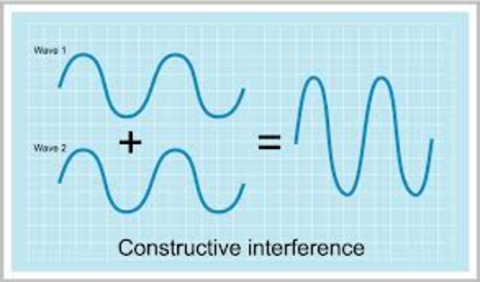
- 68What is constructive interference?The waves meet in phase
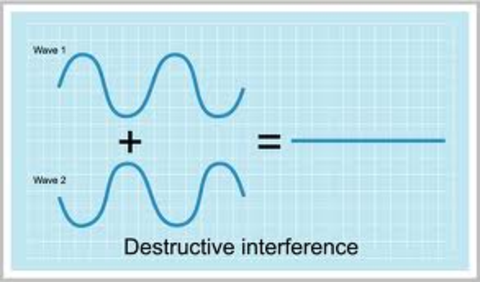
- 69What is destructive interference?Waves meet out of phase
- 70Show the diagram for constructive interference
- 71Show the diagram for destructive interference
- 72In terms of half wavelengths, when does constructive interference occur?When there are an equal number of half wavelengths
- 73In terms of half wavelengths, when does destructive interference occur?When thee are an odd number of half wavelengths
- 74Generally, when does interference between light waves occur?When light diffracts as it passes through narrow slits
- 75What kind of interference is light bands and what kind of interference is dark bands?Light - constructive
Dark - destructive - 76Why do the slits have to be closer together than the speakers?Because light wavelengths are shorter than sound wavelengths
- 77What kind of waves are electromagnetic waves?Transverse waves
- 78When is light polarised?If the oscillations are only in one direction at right angles to the wave direction
- 79How do polaroid sunglasses work?They stop oscillations in all but one direction at right angles to the wave, reducing the amount of light that passes through
- 80What did Newton think of light as and why was he wrong?As a particle and if this was true then light would travel faster in a denser medium
- 81What did Huygens think of light as?A wave
- 82Why does refraction occur?Because when light enters a different medium, it changes speed
- 83What does light do as it enters a more dense medium and why?It slows down - it deviates towards the normal
- 84What does light do as it enters a less dense medium and why?It speeds up - it deviates away from the normal
- 85What is the refractive index?A number that is the ratio of the two speeds of the speed of light between air and a medium
- 86What is the equation for working the refractive index?RI (n) = speed of light in vacuum
----------------------------
speed of light in medium - 87Why does dispersion occur?Because each colour slows down by a different amount when white light enters a medium and speeds up by different amount when leaving
- 88What does Snell's law state?RI (n) = sin incidence
---------------
sin refraction - 89When light passes from a more dense medium into a less dense medium the angle of refraction is ................ than the angle of incidenceLarger
- 90What is the critical angle?The angle of incidence in the more dense medium that produces an angle of refraction of 90 degrees in the less dense medium
- 91What happens if the critical angle is exceeded?The light is totally internally reflected
- 92What do optical fibres rely on?Total internal reflection
- 93What three things are optical fibres used for?-Carrying telephone conversations
-Carrying computer data
-For endoscopes - 94The higher the refractive index of a material, the higher/lower its critical angleLower
- 95n = 1 ---- ?sin c
- 96A parallel beam of light from a distant object can be .................... to a focus in the ........... planeconverged, focal
- 97What happens if the beam is parallel to the principal axis?The light is focused to the focal point on the principal axis
- 98What will a diverging beam from a near object do?It will focus at a point beyond the focal plane
- 99How does a camera work?Light passes through lens...focused on film...size of image is smaller than object
- 100How is a projector different to a camera?Same thing happens but the film is closer to lens and so image is bigger than object
- 101What can we do to find the position and size of an image created by a convex lens?Use a scale diagram
- 102What happens to the top ray?Refracted through focal point of convex lens
- 103What happens to lower ray?No deviation, goes straight through
- 104What are the two properties of an image formed by a magnifying glass?Right way up and cannot be projected onto a screen
- 105What is the difference between simple and more advanced cameras?More advanced have sharper images at any distance as they have an adjustable lens
- 106What is the aperture?An adjustable hole allowing different amounts of light onto the film
- 107What do the condenser lenses do in a projector?Make sure the film is uniformly illuminated
- 108What does the curved mirror do in a projector?Reflects light back into the condenser lenses
- 109Magnification =image size
---------------
object size - 110Why can't the image produced by a magnifying glass be projected onto a screen?It is virtual - no light passes through it
Information
- Description
- GCSE Physics (P5) Flashcards on P5, created by Anna Hollywood on 01/01/2014.
- Created by
- Anna Hollywood
- Views
- 325
- Tags
- Rating