
Flashcards
Biomechanics of Human Movement Mid Term Review
Cards in this deck (64)
- 1Application of mechanics to the study of structure and function of living systemsBiomechanics
- 2The physiological processes and anatomy of the human body with respect to movementKinesiology
- 3Branch of mechanics dealing with systems in a constant state of motionStatics
- 4Branch of mechanics dealing with systems subject to accelerationDynamics
- 5Study of the action of forcesKinetics
- 6Study of the description of motion, including consideration of space and timeKinematics
- 7Quantity of matterMass
(kg)
Example: Hydroworx (level of water knee or chest height) - 8Amount of gravitational force (ma) on the a bodyWeight
Example: Bench Press (weight coming towards and being pushed away from the body) - 9AKA center of mass; point around which body's weight is equally balanced no matter how it is positionedCenter of Gravity
Example: Bosu ball Exercise (the center of the body will always be the point) - 10A push or a pull; is equal to mass (m) * acceleration (a); has magnitude, direction and point of application; measured in Newtons (kg * m/s^2Force
Example: Biodex (leg ext) - 11Resistance to change; resistance to acceleration; tendency to remain in current stateInertia
Example: Plank (constant force) - 12Rotary (angular) or turning force; force when something is rotating; T= FdTorque
Example: Russian Twist - 13A quantity expressing the motion of a body or system, equal to the product of the mass of a body and its velocityMomentum
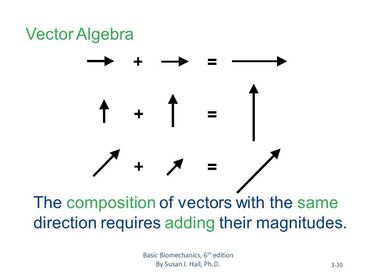
- 14—Vector Algebra- Composition
Arrow=Direction
Size of Arrow= Magnitude - 15—Vector Algebra Resolution
Vectors may be resolved into perpendicular (e.g. horizontal and vertical) components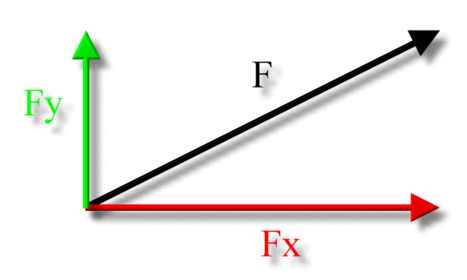
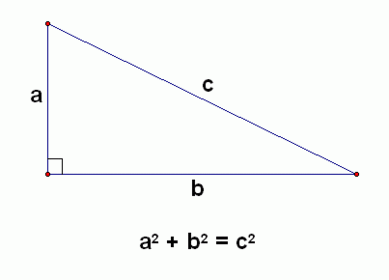
- 16—Pythagorean's Theorem
- 17Name the 2 types of motionLinear (rectangular and curvilinear)
&
Angular - 18Name the 4 steps of of Qualitative AnalysisPreparation
Observation
Evaluation
Intervention - 19What step of QA deals with obtaining pre-requisite knowledge, establishing the problem or chief complaint goalPlanning
- 20What step of the QA pertains to conducting the the analysisObservation
- 21This step of the QA is nothing the strengths and weaknesses of performance based on critical featuresEvaluation
- 22During this step of the QA is when instruction and corrective strategy is implementedIntervention
- 23What are the effects of squat depth on the capsule and ligaments of the kneeTightens joint capsules on anterior capsules and anterior drawer test
- 24What are the effects of the squat depth on the menisci and articular cartilageTibialfemoral compressive forces during knee flexion bear significant amounts of stress
Peak at 130 degress - 25What are the effects of squat depth on muscular development of the kneeThe effect on muscular development is at the hip and knee joint, particularly the Gluetus Maximus
The GM is increased significantly - 26Squat DepthPartial = 40 deg
Half = 70-100 deg
Deep = >100 - 27Squat StanceNarrow vs. wide to decrease tibiofemoral compressive forces; but narrow increase shear forces
Wide stance increases gluteus maximus and abductor longus activity - 28Spine During SquatFlexing the lumbar spine reduces tolerances to compressive loads
Extending the spine increases compressive loads on spine
Increases flexion with back squat (GM,HS)
Front squat= Quads - 29A combination of stability, balance, postural control, coordination and perceptionMovement and Function
(Basic Premise) - 30Name the 3 sources of dysfunctionDevelopmental Movement Dysfunction
Traumatic Movement Dysfunction
Acquired Movement Dysfunction - 31Type of dysfunction that occurs when growth and the command the command movement are not linearDysfunctional
- 32Type of dysfunction where injury or trauma is sourceTraumatic
- 33Type of dysfunction where unnatural activity repeated on a natural movement base and where natural activity repeated on an unnatural movement baseAcquired
- 34A developmental perspective and creates a systematic way to observe, rate, and rank movement patterns on on a numerical scale to focus on significant limitations or asymmetriesFunctional Movement Screening
- 35PRIMITIVE MOVEMENT PATTERNS 1: Basic mobility and stability movement patternsReciprocal reaching patterns
Shoulder mobility test
Supine alternate leg-raising pattern
ASLR - 36PRIMITIVE MOVEMENT PATTERNS 2: Transitional movement patterns in which a higher degree of stabilityPushing up with trunk stability
Trunk stability push-up
Quadruped rotational stability pattern
Rotary stability - 37HIGHER LEVEL MOVEMENT PATTERN:Squatting: Overhead Squat
Stepping: Hurdle Step
Lunging: In-line Lunge - 38FIRST YOU HAVE___________THAN YOU EARN ___________?Mobility
Stability - 39Name 4 Name Filters In FMS:Pain observed with movement screening
Limited movement patterns observed with movement screening
Asymmetrical movement patterns observed with movement screening
Redundancy or repetition, the duplication of inspection to reduce error and to demonstrate consistency or inconsistency within similar movements - 40How to conduct an FMS; what we’re looking for in the 7 screens + 3 clearing testsh
- 41Name the BIG 3Deep squat
Hurdle step
Inline Lunge - 42Name the LITTLE 4Shoulder Mobility
ASLR
Trunk stability push-up
Rotary stability - 43How to interpret the findings for shoulder mobilityPoor thoracic mobility
Excessive development and shortening of pec minor, lats and rectus abdominus
Poor Scapulothoracic mobility and stability
Poor postural control and core stability
Increased external rotation - 44How to interpret the findings for Active Straight Leg RaisePoor Pelvic control
Inadequate mobility of opposite hip
coming from inflexibility
Poor functional hamstring flexibility - 45How to interpret the findings for Rotary StabilityPoor reflex stabilization of trunk and core
Poor scapular and hip stability
Limited knee, hip, spine and shoulder mobility - 46How to interpret the findings for Trunk Stability Push-upPoor reflex stabilization of the core
Compromised upper-body strength or scapular stability
Limited hip and thoracic spine mobility - 47How to interpret the findings for Hurdle StepPoor stability of stance leg or poor mobility of the step leg
Poor asymmetric hip mobility and dynamic stability - 48How to interpret the findings for Inline LungeAnkle, knee and hip mobility for either front or back leg
Dynamic stability
Thoracic spine limitations - 49How to interpret the findings for Deep SquatLimited mobility in upper torso
Poor glenohumeral or thoracic spine mobility
Limited mobility in lower extremities
Poor DF of ankles, flexion of knees and hips
Poor stabilization and control - 50What a therapist/fitness specialist would address firstRefer/ Eliminate pain
Address Asymmetries
Address score of 1 before a 2
Address most primitive patterns first - 51Common Mistakes in Prescribing CorrectivesProtocol Approach
Basic Kinesiology Approach
Appearance of Function Approach
Prehabilitation Approach - 52Common mistake in prescribing correctives is the one size fits all programming: weight loss, LBPProtocol Approach
- 53Common mistake in prescribing correctives is isolated target muscles approachBasic Kinesiology Approach
- 54Common mistake in prescribing correctives is to mimic function in poor wayAppearance of Function Approach
- 55Common mistake in prescribing correctives is arbitrary strengthening to prevent injuryPrehabilitation Approach
- 56Corrective examples for Shoulder MobilityRib grabs, T-spine rotation w/reaching
- 57Corrective examples for Active Straight Leg RaisesRaises with band for stabilization, Partial get-up
- 58Corrective examples for Rotary StabilityBall rock back with arm lift, Rolling (upper and lower body)
- 59Corrective examples for Trunk Stability Push- upReaches from prone-on-elbows or push-up positions, Chops/Lifts from half or tall kneeling
- 60Corrective examples for Hurdle StepsStanding w/leg on chair cable pull-down, Standing w/leg up cable pull-down
- 61Corrective examples for Inline LungeHalf kneeling ankle DF w/dowel, Half kneeling rotation w/dowel
- 62Corrective examples for Deep SqautWhole pattern training: assisted exercises( move w/ less than BW; may allow for greater ROM and more reps)
Reactive neuromuscular training (RNT): use tubing to over correct - 63Corrective examples for Deep SquatReverse pattern: Train motion from bottom up (bend over touch toes, keep touching toes and drop into deep squat, put arms out and stand up)
- 64Corrective examples for Deep SquatReactive neuromuscular training (RNT): use tubing to over correct