
Flashcards
E4M
Cards in this deck (23)
- 1What is willingness to pay?The number you just keyed in is a very important one in economics. It’s what we call the “willingness to pay” (which we’ll sometimes denote for short as “WTP”). It’s the maximum price you are willing to pay for a product or service. Of course, you’d be glad to pay less than your “willingness to pay” if you could, but the important thing is that you wouldn’t pay more than it.
- 2WTP and price are 2 different things - True or False?True
- 3Suppose that normally your WTP for a cashmere sweater is $100. What would your WTP for a cashmere sweater be if they marked it 50% off?$100
is correct
Price does not affect your WTP, so your WTP will not change based on a sale. - 4What are "extrinsic" or "observable" differences wrt WTP?Differences in consumer WTP that arise from differences in, say, age, gender, income, or education are what we call “extrinsic” or “observable” differences. These are things that you can determine about people without actually asking them, such as where they live, whether they are men or women, and so on.
- 5What are "intrinsic" differences wrt WTP?Other differences are “intrinsic”—things that you couldn’t know about a person without asking him or her. They’re hard to observe (and for that reason are also referred to as “unobserved differences”). For example, a person’s tolerance for risk, his or her wish to fit in with others or stand out from others, or even the intensity of his or her passion for Taylor Swift or the New England Patriots.
- 6How are companies figuring out customers' intrinsic characteristics?Better analytics and tracking of what people buy on the Internet, through television, and in stores has made it possible for companies to know much more about customers’ intrinsic characteristics. We will go further into this subject later on in this course (and in the Business Analytics course as well). Suffice it to say here that companies are, increasingly, spending time and money trying to gather data to figure out such “intrinsic” preferences. These efforts mirror the shift from what's often referred to as “demographic targeting” on the Web to “behavioral targeting”—where companies attempt to target users based not only on their demographics, but on their past behavior.
- 7The demand curve is nothing more than a depiction of ______A depiction of many people's WTP
- 8____ is not a factor that shifts the demand curvePrice.
By convention, price is on the y-axis of any demand curve. So a change in price will move us up or down along the existing demand curve but it will not shift the curve. (This is a very common mistake that is made about the demand curve.) In other words, price affects quantity demanded, but doesn't change the underlying WTP or demand. - 9Explain the concept of diminishing marginal returnsAnd the idea
that an individual's demand curve slopes downward, that willingness to pay decreases with each additional unit of the good, is often referred to as diminishing marginal returns. Diminishing marginal returns is an interesting idea for managers to consider, because what it means in essence is that the more you sell,
the harder and harder it is to sell more. Customers just aren't willing to keep paying for more and more units of your product. It also implies that there are natural limits to how large a business might be. So you want to think hard about how severe are diminishing returns for your product and what you might do to try to overcome it. - 10But what factors determine whether the demand curve for a product is steep or flat? Name one.For one, it depends on whether the product has close substitutes or not. Chocolate ice cream has a lot of close substitutes (cookie dough ice cream, chocolate cake, other desserts). If the price of chocolate ice cream suddenly rises, consumers will simply switch to the other products. Baby formula on the other hand has few close substitutes.
- 11But what factors determine whether the demand curve for a product is steep or flat? Name #2.Secondly, it depends on whether the product is a necessity or a luxury. Chocolate ice cream is a luxury good. (That is, despite what some of us may think, we can live without it.) On the other hand, baby formula is considered a necessity. Even if its price rises, consumers will continue purchasing it.
- 12But what factors determine whether the demand curve for a product is steep or flat? Name #3Finally, the time horizon also matters. Consider the demand for gasoline. In the short run, the demand curve for gasoline is quite steep—there are few substitutes and, for many people, driving is a necessity. But over time, people can move closer to work, we can discover alternate fuels, etc. This can cause the demand curve for gasoline to flatten out in the longer run.
- 13Give 1 example each of a steep and a flat item demand curveSo demand curves come with a variety of slopes depending on the nature of the product. On one extreme, a demand curve can be so steep that it is perfectly vertical. Here customers will buy a given quantity no matter what the price. One example that comes close to this case is the demand for insulin by diabetics.
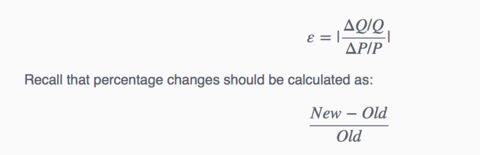
On the other extreme, a demand curve can be so flat that even a small increase in price would drive all customers away. A classic example is demand for paper currency. If someone tried to sell us a $20 bill for anything more than $20 worth of value, we would take our business elsewhere. - 14What is the definition of elasticity? How is it calculated?The elasticity of a demand curve is the percentage change in quantity demanded divided by the percentage change in price. So in order to calculate the elasticity of a curve, you first need to calculate the percentage change in quantity demanded and the percentage change in price separately, and then just divide the former by the latter. Here’s the formal definition:
- 15What is the cost-plus pricing rule?Many businesses base their prices on what costs they incur. For example, a common pricing rule is what’s called “cost-plus” pricing: take your costs and add a mark-up (say, 10%) to figure out what price to charge.
- 16What is value-based pricing?Holzman is taking a very different view: the prices he charges depend on consumer willingness to pay, not on his costs. This idea—of setting prices based on WTP rather than (just) costs is an important one. It’s also referred to as “value-based pricing.” (The reason: you’re basing pricing decisions on the value consumers receive, rather than on the costs you incur.) Increasingly, companies are using value-based pricing approaches to set prices in many settings.
- 17Revenues are maximized when the elasticity of demand is what value?Revenues are maximized when the price is $50—exactly halfway down the demand curve. And, at that price, the elasticity of demand is exactly 1!
- 18Discuss elasticity and raising pricesAnd that illustrates how "optimal prices" are closely linked to elasticities. When demand is elastic, you can’t afford to raise prices. When demand is inelastic, you surely can!
- 19Name one difference between elasticities and slopesThis also brings us to another important difference between elasticities and slopes: the elasticity of demand varies along a linear (or, straight-line) demand curve, reflecting the idea that price sensitivity varies along the curve. On the other hand, the slope of the curve is exactly the same at points A and B, which wouldn’t really help inform pricing decisions.
- 20Discuss elasticity of demand and pricingif demand is inelastic, it pays to raise prices. If it’s elastic, it pays to lower prices. It’s only where demand elasticity equals 1 that it doesn’t pay to either raise or lower prices.
The revenue-maximizing price is when elasticity = 1. This is because it's the point of perfect equilibrium.
So, with an elasticity E<1 you should raise prices, but with an elasticity E>1 you should lower prices. - 21What do you call a demand curve with constant elasticity?This is an interesting demand curve—the elasticity equals 1 at every point! No matter where you price, your revenues will always be the same. This is an exception: in practice, demand curves with constant elasticity ("iso-elastic" demand curves) are rare. In real life, pricing matters!
- 22Apart from price elasticity of demand, name 2 other "elasticities" that are particularly useful.Along with the price elasticity of demand, there are two other "elasticities" that are particularly useful:
The income elasticity of demand: How sensitive is demand to changes in consumer incomes? Some products might not be much affected by changes in your income. For example, if you're not diabetic, you're probably not going to start buying insulin just because you've become wealthier. Other products, such as jewelry, might be very sensitive to changes in income. There are even some goods you might buy less of as your income increases. You might stop buying packets of ramen noodles and start eating more expensive food.
Cross-price elasticity of demand: How sensitive is demand for your product to changes in prices of other products? This is particularly useful to understand the effects of competitive responses and actions—and which other products really affect your demand. We'll come back to cross-price elasticity in our next module. - 23What is negative income elasticity of demand?A negative income elasticity of demand implies that a consumer will buy less of a good as his or her income increases. This could be the case for cheaper foods such as rice. A consumer with a higher income might be able to afford more expensive foods and switch to, say, quinoa, fish or steak instead.
Information
- Description
- Business/Economics Flashcards on E4M, created by Sola So on 03/08/2016.
- Created by
- Sola So
- Views
- 2
- Rating