
Flashcards
BISC 100 - Lecture 19 & 20 - Photosynthesis
Cards in this deck (13)
- 1Sunlight is a type of energy called...radiation
– or electromagnetic energy.
• The full range of radiation is called the
electro-magnetic spectrum - 2Chloroplasts absorbselect wavelengths of light
that drive photosynthesis. - 3Chloroplasts contain several pigments:- Chlorophyll a
– Chlorophyll b
– Carotenoids
Chlorophyll molecules absorb photons (LIGHT)
– Electrons in the pigment gain energy
– The energy is released and used. - 4THE CHLOROPHYLL MOLECULEConsists of a porphyrine ring and
a long chain hydrophobic phytol tail
which keep the chlorophyll molecules
embedded in the chloroplast
membrane (remember hydrophobic hydrophobic
interactions) - 5What is A photosystem?organized group of chlorophyll and other
molecules such as proteins.
– Is a light-gathering antenna. - 6Role of Products Light Reaction in the Calvin Cycle (Dark reaction)• The Light Reactions: Converting Solar Energy to Chemical Energy
• The Calvin Cycle: Making Sugar from Carbon Dioxide using the
products of the light reactions - 7Photosynthetic electron transport chain• Takes place on the thylakoid membrane.
• Connects the two photo systems.
• Releases energy via chemiosmosis that the
chloroplast uses to make ATP.
• Produce reducing power in the form of NADPH
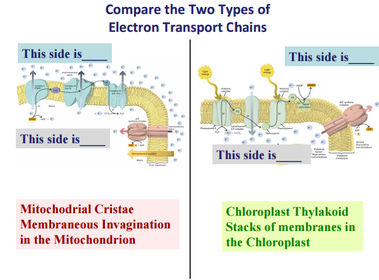
•Oxygen is a byproduct - 8Compare the Two Types of Electron Transport Chains
- 9The Calvin Cycle: Making Sugar from CO2Calvin cycle (“Dark Reaction”)
• Functions like a sugar factory within a chloroplast
• Regenerates the starting material with each turn.
• Ribulose bisphosphate (5C) receives 1C from the
CO2 and make 2 of 3C compound.
• This reaction is catalyzed by the most abundant
enzyme on earth, Rubisco:
Ribulose bis phosphate carboxylase-oxygenase.
• First stable product in Calvin cycle is a 3C compound,
3 phosphoglycerate (3 PGA), is also a product in
Glycolysis. - 10THE CALVIN CYCLE: OVERVIEWLIGHT-INDEPENDENT
REACTIONS
(OCCUR IN STROMA
Of CHLOROPLAST)
Main enzyme involved:
RuBPcarboxylase-oxygenase
(Rubisco) is the most abundant
enzyme in the world - 11C3 plantsCalvin cycle describes what happens in C3 plants
(first stable product of CO2 fixation is
a 3 C compound
Stomata are open during day time.
•Use CO2 directly from the air.
• Are very common and widely distributed
•Most mesophytic (living in moderate
environment) plants are C3 plants
• (ex. Wheat, Rice, Coconut, Maple) - 12Water-Saving Adaptations of C4 and CAM PlantsCAM plants (Crassulacean Acid Metabolism)
ex. Pine apple, Aloe, Jade plant,
Calanchoe
• Open their stomata only at night to conserve water
• Fixes CO2 using PEP carboxylase at night and store
as PEP
• During day time releases CO2 while stomata are
closed
• Calvin cycle fixes this CO2 - 13—
Information
- Description
- User has deleted their subject information Flashcards on BISC 100 - Lecture 19 & 20 - Photosynthesis, created by Deleted user on 10/08/2016.
- Created by
- Deleted user · Aug 2016
- Updated
- Jan 18, 2017
- Views
- 111
- Tags
- History
-
- Created by Chelsi Souch · Aug 10, 2016
- Copied by Chelsi Souch · Aug 10, 2016
- Rating