
Flashcards
Lesson 2
Cards in this deck (97)
- 1In 1971, the NIH Policy, Care and Treatment of Laboratory Animals was introduced. That document was then replaced with the Public Health Service Policy on Humane Care and Use of Laboratory Animals in 1973 which was then again revised in 1979. Over the course of those revisions, how has the definition of “animal” changed?It originally covered just warm-blooded animals but was expanded to include all vertebrates.
- 2Who at an institution is responsible for appointing the IACUC? At a private company, who often fills that role?IO; CEO
- 3The PHS Policy implements the US Government Principles for Utilization and Care of Vertebrate Animals Used in Teaching, Research, and Training.Read through these principles and have a general sense of their content.
Basically content of animal care and use protocol. - 4Who must comply with the PHS Policy? Is there ever an instance in which someone may have to comply with the PHS Policy but not the ILAR Guide?Any institution that receives federal funds to perform studies using live, vertebrate animals; there is never an instance when someone would only have to comply with one of these documents.
- 5According to the PHS Policy, the IACUC is to consist of representatives of four different areas. What are those areas? Can a single person fulfill more than one of these requirements? What is the minimum number of individuals required to be on an IACUC according to the Policy? Does that differ from the number of members USDA requires? If so, representatives of what areas are excluded from the USDA requirements?Veterinarian, scientist using animals in studies, nonscientist, outside member; yes; 5; Yes, USDA requires just 3; USDA doesn’t require a scientist using animals in studies or a nonscientist
- 6What is an animal care protocol? What are some examples of the types of information that an investigator must provide in an animal research protocol to be submitted to the IACUC? How often is the IACUC required to review an animal protocol?A written description of all aspects of a study using animals including a justification of the species and numbers of animals used, why the study is necessary, what drugs, if any will be used, identification of any potential adverse effects of the experimental procedures on the animals, evidence of how it was determined that the study has not been done before nor that there are any alternatives to doing the study other than they way it is described, etc.; animal protocols must be reviewed annually
- 7Does a grant application submitted to PHS require any input from the institution's IACUC?Yes, it requires written documentation that the animal use aspects of the grant application have been reviewed and approved by the IACUC from that institution.
- 8What is an Animal Welfare Assurance? To who is the Assurance sent and for how long is it valid? As far as an institution is concerned, of what does the assurance assure PHS?An Animal Welfare Assurance is a document that an institution receiving federal money must file with the Office of Laboratory Animal Welfare (OLAW) and it is valid for up to four years; the Assurance commits the institution to compliance with the PHS Policy, the AVMA Guidelines on Euthanasia, the Guide, and the AWA
- 9One of the components of the Assurance is the institution’s declaration of its Institutional Status as either accredited by AAALAC or not. Why do you suppose PHS is interested in that?If an institution is accredited by AAALAC, PHS then knows that an outside organization has evaluated that institution’ s level of compliance with the ILAR Guide and the PHS Policy and found that they are worthy of accreditation; this is important to PHS.
- 10For how long a period does OLAW require that records generated as part of IACUC activities be maintained?For three years after those activities have been completed (i.e. for three years after an animal protocol has expired).
- 11When the IACUC reviews an institution's animal care and use program and inspects the institution's animal facilities, what does it use as its basis for judgment? How often are such reviews required? To whom at an institution does the IACUC report its findings following an inspection? What is the difference between minor and significant deficiencies? If a deficiency is deemed sufficiently significant and a project is suspended, who must be notified of this action?It uses the ILAR Guide for the Care and Use of Laboratory Animals as its basis for judgment; such reviews are conducted every six months; the findings are reported to the IO; a significant deficiency is one that in the judgment of the IACUC, poses a threat to the health or safety of animals; USDA, OLAW and AAALAC must be notified if a project is suspended
- 12Under what circumstances does the IACUC, through the Institutional Official, have to notify OLAW about the committee’s actions relative to a specific violation or issue of noncompliance? Does OLAW ever do inspections of institutions?If the circumstance meets any of these three criteria: any serious or continuing noncompliance with the PHS Policy, any serious deviation from the provisions of the ILAR Guide, any suspension of an activity by the IACUC; Yes, they inspect a handful of institutions randomly as well as for cause in instances when noncompliance has been a serious problem or goes uncorrected.
- 13In addition to inspecting animal facilities, the IACUC also conducts reviews of the research program’s policies and procedure. Policies and procedures relative to what?Husbandry practices, anesthesia and analgesia techniques, personnel training, occupational health requirements as well as a review of IACUC procedures and the handling of any issues raised during the timeframe of the report
- 14What are the two documents/reports required by OLAW?The PHS Assurance (which is valid for up to five years) and the Semiannual Program and Facility Review Report
- 15According to the PHS Policy, for how long does an animal need to stay in a room for that room to be considered part of the animal facility? Does that amount of time differ from the USDA Animal Welfare Regulations?24 hours, yes, USDA’s time requirement is just 12 hours
- 16If an AAALAC accredited facility has dogs they use in studies funded by NIH, how many times are they inspected over a three year period and by who? Are any of those inspections unannounced? Can any of these inspections result in a facility being fined for noncompliance?Six times by the IACUC, a minimum of three times by USDA and once by AAALAC for a total of 10 times minimum; USDA inspection are required to be unannounced; yes, USDA can fine a facility of issues of noncompliance.
- 17What institutions have to comply with the Guide? To which animals does the Guide apply? What is the difference between performance standards and engineering standards? Toward which of these two does the Guide seem to be going and why?Any institution that receives money from the federal government to perform studies using live, vertebrate animals; performance standards are regulations that define what the intent of an objective or expectation is and allows the institution to develop their own means of accomplishing that objective whereas an engineering standard define very specifically exactly what must be done to mean the expectation; the Guide is definitely moving in the direction of using performance standards rather than engineering standards
- 18Who wrote the Three R's and when were the published? Relative to the Three R's what is the difference between absolute replacement and relative replacement?W.M.S. Russell and R.L. Birch wrote the Three R’s in 1959; absolute replacement is the replacement of animals with non-animal alternatives whereas relative replacement is replacing animals with other animals that are phylogenetically lower.
- 19According to the Guide, what is an animal care and use program comprised of? Summarize the roles of the Institutional Official (IO), the Attending Veterinarian (AV) and the Institutional Animal Care and Use Committee (IACUC) relative to the animal care and use program.All activities conducted by and at an institution that have a direct impact on the well-being of animals; the IO has the ultimate responsibility for the animal program at the institution, the AV has responsibility for the health and well-being of all animals; the IACUC is responsible for the assessment and oversight of the animal program.
- 20The second subsection under Occupational Health and Safety of Personnel is titled Hazard Identification and Risk Assessment. What does that mean? Please note, we will address Occupational Health in much greater detail later in this class.Hazard identification means just that, the identification of all hazards associated with each activity conducted as part of the operation of an animal program; risk assessment is the process by which the risk of an individual being injured or potentially exposed to pathogens of allergens or any other harmful material/organism is evaluated. The assessment is based on what the individual will be doing and what animals the individual will be working with.
- 21Describe the difference between experimental and humane endpoints as outlined in the Guide.Experimental endpoints are those endpoints that are related to the conduct of the experiment and often defined by time more than anything else; humane endpoints are those that are defined by signs an animal is exhibiting as those signs relate to the experimental procedures to which the animal was subjected.
- 22On page 29 of the Guide, there is a section titled Physical Restraint. What aspects of physical restraint are deemed important in this section? What is a restraint chair?Restraint devices should not be considered normal housing and should be justified in the animal protocol, they should not be used for the convenience of the investigator, alternatives to the use of restraint devices must be considered, the duration of restraint should be minimum necessary to achieve research objectives, animals must be adapted to the restraint device and animals that fail to adapt should be removed from the study, provisions should be made for observation of the animal at appropriate intervals; a restraint chair is a device used to physically restrain conscious primates, the use of such devices requires extensive training and adaptation of the animal.
- 23In the next section on page 30, multiple major surgical procedures are addressed. How does the Guide address multiple major survival surgical procedures on a single animal? Looking ahead to page 117, what is the definition of a major surgical procedure?Multiple major surgical procedures on a single animal are discouraged and are only acceptable if they are essential to a specific project and, scientifically justified by the investigator or necessary for clinical reasons. A major surgery penetrates and exposes a major body cavity, produced substantial impairment of physical or physiologic function or involves extensive tissue transaction or dissection.
- 24What kinds of studies use water restriction for motivation? How should animals under either food or fluid restriction be monitored?Water restriction is used in studies in which the animal is being asked to perform behavioral tasks that they may not perform unless offered a reward. In those instances, water is used as the reward so restricting an animal’s water intake prior to them performing the task increases their motivation. During water restriction, animals are monitored physiologically to ensure that they are not clinically dehydrated.
- 25Does the Guide apply to field studies as well?Yes
- 26Does the Guide apply to all studies using agricultural animals? If not, what type of study does it apply to?No, it only applies to biomedical studies.
- 27What is "Post-approval Monitoring" (PAM)?The expectation that the IACUC visit and evaluate projects after they have been approved to ensure they are being conducted as described in the animal protocol.
- 28What is the difference between the macroenvironment and the microenvironment of an animal?The microenvironment is the area within the an animal’s enclosure while the macroenvironment is the area outside the animal’s enclosure but inside the animal room.
- 29According to the Guide, should mice be housed above, below or within their thermal neutral zone? Why? What is the recommended dry bulb temperature for mice?Below; by housing them below, it allows them to engage in the natural behaviors that they would otherwise engage without overheating given that these behaviors actually generate body heat; 20-26oC (68-79oF).
- 30What humidity range is considered acceptable for most mammalian species? What are some examples of adverse effects that can result from housing animals at abnormally high or low humidity levels?30-70%; preweanling mortality, ringtail, high ammonia concentrations
- 31What ventilation rate is considered acceptable for animal rooms? What elements of the environment does it not take into account?10-15 room air changes per hour; range of heat loads, species, size, number of animals, type of primary enclosure and bedding, frequency of cage change, room dimensions, air distributions.
- 32As mentioned in Chapter 3, what are the various characteristics that should be found in acceptable primary enclosures relative to terrestrial housing?Should promote physical, physiological, behavioral needs, social needs, provide a secure environment, enable easy observation of the animals and enable the animals to have easy access to food and water.
- 33What additional provisions should be provided for sheltered or outdoor housing?Protection from temperature extremes and adequate opportunity for retreat.
- 34What does the Guide say about housing rodents on wire-bottom cages?Rodents prefer solid-floored cages.
- 35Use Table 3-2 of the guide to calculate the following: How many 350 gram rats may you house in a cage that measures 30 cm x 18 cm and is 6 inches high? How about a cage with the same floor area but is 7 inches high?Zero; two
- 36With respect to the space recommendations, at what point does an animal begin to count? Are there any exceptions to that?At weaning; yes, there are exceptions in that females with litters require more space than the same sized females without litters
- 37According to the Guide, what information should be included on an animal identification card?Source, species, strain or stock, names and contact information of responsible investigators, pertinent dates (arrival date or birth date), and animal protocol number when applicable.
- 38How often does the Guide say that animals should be observed for signs of illness, injury or abnormal behavior by trained personnel?Daily
- 39In general, building materials for interior surfaces of an animal room should have what characteristics?Durable, moisture-proof, fire-resistant, seamless
- 40What’s the difference between a centralized and decentralized animal facility?A centralized facility is one in which all functions of the facility are centrally managed. This often means that all the animals are maintained in one area, all of the care staff, vet staff, and even those who perform all of the technical procedures on the animals are employed by the central administration. A decentralized facility is one in which the various components of the facility are spread out over various geographical areas and overseen by multiple administrative units.
- 41According to the Guide, what is a practical width for corridors in most animal facilities?6-8 feet
- 42Why is it recommended that doors open into animal rooms as opposed to into a corridor?For the protection of personnel in the corridors, to minimize the risk of damage as a rack of cages or some other large piece of equipment is being moved down a corridor, etc.
- 43What should one consider when deciding whether or not to put windows in an animal facility?While windows provide exposure to natural light, they introduce a variables such as the natural photoperiod, they make it more difficult to control temperature and they are a security risk.
- 44Relative to floors, the Guide mentions the term “monolithic”. What does that mean?Singled layer
- 45What is the minimum floor-drainpipe diameter that is recommended in the Guide?At least four inches.
- 46Are acoustic tile ceilings recommended for use in an animal facility?No because they are not able to be disinfected.
- 47According to the Guide, what provisions should be made in the event of a power failure?Alternative energy sources should be available to maintain critical functions.
- 48At your facility, how often is the function of light timers checked?Daily
- 49The above questions are specific to the ILAR Guide for the Care and Use of Laboratory Animals. Does the IACUC use this document or another document as their basis for evaluating agricultural animals and facilities? Is this document used for both agricultural research as well as biomedical research using agricultural animals?The Guide for the Care and Use of Agricultural Animals in Research and Teaching (Ag Guide) provides guidelines for programs that use agricultural animals for agricultural research and teaching; both AAALAC and USDA use the Ag Guide when inspecting agricultural and biomedical research using agricultural animals
- 50What governmental department and what section of that department created the Animal Welfare Act and is responsible for its enforcement.United States Department of Agriculture (USDA), Animal and Plant Health Inspection Service (APHIS)
- 51What animals are covered by the Animal Welfare Act? Does it also apply to animal breeders and dealers of those animals? What is the difference between Class A and Class B dealers?Mammals other than mice of the genus Mus and rats of the genus Rattus and livestock used in agricultural studies; yes, it also applies to animal breeders and dealers of those animals; Class A dealers raise and sell animals themselves (those animals are called “purpose-bred”) whereas Class B dealers purchase and resell animals including random source dogs and cat, import nonhuman primates and resell animals from research facilities.
- 52When and why was the Animal Welfare Act created? Was it the first law limiting animal experimentation or address the use of animals in research in the world? Was it the first law in the US that provided some degree of oversight of animal care and use? What is the difference between the Animal Welfare Act and the Animal Welfare Regulations?It was created in 1966 in response to public pressure regarding how animals the public are concerned about are maintained in research. When it was first enacted, it only covered dogs and cats but was amended several times to now include the animals listed above; it was not the first law limiting animal experimentation or address the use of animals in research in the world, that was the Cruelty to Animals Act passed in 1876 by the British Parliament; the Animal Welfare Regulations describe what a facility must to to comply with the Animal Welfare Act
- 53What is the difference between an agricultural study and a biomedical study?An agricultural study is one that is intended to develop knowledge that will improve an animal’s ability to provide those elements of the animal that we as humans consume. An example would be studies of cattle that are intended to improve their ability to provide milk or meat. A biomedical study is one specifically intended to develop knowledge related to human or animal health
- 54What were components of the 1985 amendments to the Animal Welfare Act?Establish an IACUC, ensure that everyone is qualified to perform whatever role they will play relative to the animal program, the requirement that each facility with dogs develop an exercise program for those dogs, the requirement that the psychological well-being of nonhuman primates be addressed, the requirement that no animal can be used for more than one major operative procedure and be allowed to recover.
- 55What were components of the 1990 amendments to the Animal Welfare Act?That there be a five day holding period for dogs and cats to allow animals to be claimed or adopted.
- 56What determines if a research facility must register with USDA? If a facility is required to register, how often must that registration be updated? What other kind of correspondence/documentation does USDA require each registered facility to submit? What must this report contain?A facility must register if it uses regulated species (as listed in question 3); that registration must be updated every three years; each registered facility is required to submit an annual report that outlines its animal use over the previous year; the report must include the numbers of animals used, what alternative were used and an explanation of any exceptions to the Act that exist at the facility.
- 57In the report mentioned in question 3 above, each registered facility is required to categorize each of the animals used into four different groups. What are those categories?Category B is animals that were held but not used , category C is animals that were used in studies in which there was absolutely no pain or distress, category D is animals that were used in studies in which they were subjected to painful procedures but that pain was alleviated by the use of pain relieving drugs and category E is animals that were used in studies in which they were subjected to painful procedures and the pain was not alleviated in any way.
- 58What are examples of the types of documentation that USDA requires a facility to maintain?IACUC records, dog and cat records (source, description, identification, transportation, euthanasia, exercise of dogs), primates (psychological well-being plan).
- 59What guidelines does compliance with the PHS Policy require that compliance with the USDA Animal Welfare Act doesn’t? How about visa versa?The PHS policy requires compliance with the ILAR Guide, U.S. Government Principles for the Utilization and Care of Vertebrate Animals Used in Testing, Research and Training, the USDA Animal Welfare Act, the AVMA Euthanasia Guidelines; the USDA Animal Welfare Act requires compliance with itself, the AVMA Euthanasia Guidelines and the Guide for the Care and Use of Agricultural Animals in Agricultural Research and Teaching
- 60In how large of an enclosure should a dog be housed? What does that Act say about exercising dogs?Measure the dog from the tip of the nose to the base of the tail, add six inches to that measurement and then square that sum and that gives you the number of square inches of floor space required for the enclosure used to house that dog; further, the Act states that unless the dog is housed in an enclosure that is at least twice that large, the dog must be exercised according to the dog exercise program that USDA requires the facility to devise.
- 61What is the minimum floor space of an enclosure housing a cat?Cats weighing less than 4 kg require 3 sq. ft whereas cats weighing more than 4 kg require 4 sq. ft.
- 62Must dogs and cats be provided with a continuous source of water?No, they are required to be offered water for one hour every 12 hours
- 63How large must the primary enclosure used to transport live dogs or cats be?It needs to provide enough space for the animal be able to sit, stand, turn around normally and lie down.
- 64How soon before transportation must a live dog or cat be offered potable water? How often must they be offered water while in transit?Four hours; every 12 hours.
- 65What is the maximum number of guinea pigs that can be shipped in the same primary enclosure? What is the maximum number of hamsters? What is the maximum number of rabbits?15; 50; 15
- 66If a trip is ____ hours or longer, hamsters, guinea pigs, and rabbits must have access to food and water.6
- 67How often must every rabbit be observed by an animal caretaker?Everyday
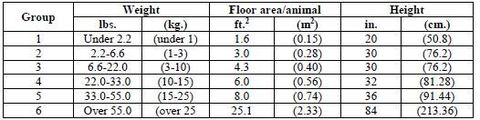
- 68What is the minimum floor space of an enclosure used to house a primate? What does the Act say about psychological enrichment for primates?Group 3—macaques and African species.Group 4—male macaques and large African species.
Enrichment???? - 69What is the maximum number of primates that can be shipped together?One, unless a female with baby, an established male and female pair or a compatible pair of juveniles that have not reached puberty
- 70What does the Animal Welfare Act say about multiple major survival surgery in animals?That multiple major survival surgeries in a single animal are not allowed unless required in order to conduct the study (and approved by the IACUC) or not related to a project and simply indicated as part of routine veterinary care.
- 71According to the Animal Welfare Act, under what conditions may a police officer enter your animal facility?If the officer has a written physical description of a specific animal.
- 72According to the Animal Welfare Act, what are the requirements concerning identification of dogs and cats? For how long do identification tags used for dogs or cats need to be maintained? What are the requirements concerning the identification of other species?Dogs and cats are required to be identified by a tattoo number that is unique to each animal or a USDA-issued tag that attaches to the animal’s collar; the tags need to be maintained for one year; other species do not have specific identification requirements
- 73Relative to the PHS Policy, how similar are the requirements in the Animal Welfare Act concerning the IACUC?They are very similar except that unlike the PHS Policy, who requires five members on the IACUC, the AWA only requires three.
- 74In brief and broad terms, what are the record keeping requirements of a research facility?All activities conducted at a research facility must be documented; if something is not documented, it did not occur.
- 75How long must an institution maintain the records described above?Three years upon completion
- 76For which animals are specific acquisition and disposition records required to be maintained? Why do you suppose the maintenance of such records are limited to those species?Dogs and cats; because those are the species that the public is most concerned about.
- 77Do animals that are to be shipped from or to a research facility need a health certificate? If so, the transportation of which animals requires the health certificate and what information is required to be on the certificate?Yes; it be issued by a licensed veterinarian state that the animal (any dog, cat or nonhuman primate) was inspected on a specific date (this date must be within 10 days prior to delivery of the animal for transport), it must state that the animal appeared to be free of any infectious disease or physical abnormality that would endanger the animal, other animals or the general public
- 78How often does USDA inspect research facilities? When they inspect a facility, how much notice must they provide before arriving?Once a year; the inspections are required to be unannounced
- 79To what kinds of studies do the GLP regulations apply?Non-clinical studies conducted for the assessment of the safety of chemicals to humans, animals and the environment
- 80Why were the GLP regulations developed?To make uniform the way those studies are conducted and require a degree of documentation and oversight of those studies that would make it essentially impossible to not actually perform the study.
- 81What aspects of these non-clinical safety studies are regulated by the GLP regulations? What is a QUA? Would you describe the animal care aspects of the GLP regulations as rigorous or more cursory when compared to the other sets of regulations covered in this packet?How the studies are planned, performed, monitored, recorded, reported and archived; a QUA is a quality assurance unit; the animal care regulations are much more cursory than those in the other regulations we’ve discussed
- 82Is it accurate to say that the FDA and EPA expect those institutions conducting studies covered by the GLP regulations to create SOP’s for pretty much every activity that could be conducted as part of that study?Yes
- 83A fundamental aspect of the GLP regulations is the generation and storage of records. For how long must those records be kept?Records must be kept for five years after study completion if they support a research or marketing permit that was not approved and for two years after study completion if the study is not submitted for a marketing permit or is discontinued
- 84Which regulatory agency regulates the use of biohazardous pathogens?Center for Disease Control (CDC)
- 85What federal organization is responsible for oversight of the use of controlled drugs by an animal facility? How would you summarize what that oversight requires of the facility relative to the use of controlled drugs?Drug Enforcement Agency (DEA); that the facility register with the DEA and that the storage, record-keeping and disposal of the drugs be in keeping the DEA requirements.
- 86List each of the organizations and agencies that have a say in the transportation of laboratory animals and what aspect of transportation they each address.USDA, PHS (requires compliance with the ILAR Guide), CDC (the transportation of animals with zoonotic potential), FDA (animals that may care zoonotic diseases), DOT Pipeline and Hazardous Materials Safety Administration, US Department of Fish and Wildlife, Endangered Species Act.
- 87What does HCS stand for and what is it? For what areas does it set forth guidelines? What is the most important component of the program and what are the key elements of that component?Hazard Communication Standard; employees who may be exposed to hazards have a right to know about those hazards and the right to protect themselves; am employee training and information program is the most important aspect and that includes the nature of the hazards, instruction regarding safe work practices, protective measures, MSDS’s and a hazard communication policy.
- 88Who at a facility has the primary responsibility for the monitoring and handling of radioactive materials? What federal organization regulates the use of such materials?Radiation Safety Officer; Nuclear Regulatory Commission (NRC)
- 89How many half-lives must you allow radioactive waste to pass before it can be disposed of as nonradioactive waste?10
- 90What does the Medical Waste Tracking Act of 1988 define medical waste as being?Any solid waste that is generated in the diagnosis, treatment or immunization of humans or animals or in research pertaining to or in the production of testing of biologics.
- 91Is it really true that most medical waste is infectious as defined by the EPA? What is the ultimate disposition of most infectious medical waste?No; incineration
- 92Once an animal has been euthanized, the AVMA euthanasia guidelines recommend that death be confirmed. How is this commonly accomplished? Do USDA, OLAW and AAALAC all require adherence to these guidelines?Verification of death is accomplished by observing a lack of pulse, breathing, corneal reflex and response to firm toe pinch, inability to hear respiratory sounds and heart beat by use of a stethoscope, graying of the mucous membranes and rigor mortis; yes
- 93Of the different sets of regulations we covered in this packet, which one most thoroughly covers the transportation of research animals?USDA Animal Welfare Act
- 94What is the name of the agreement between countries that provides a structure for those countries to regulate the international trade of animals to prevent their endangerment or extinction? What Act in the United States implements that agreement? What government organization is responsible for enforcing the laws passed to support that Act? And lastly, what government organization wrote the Guidelines for the Humane Transportation of Research Animals?Convention on International Trade in Endangered Species of Wild Fauna and Flora; the Endangered Species Act; the United States Fish and Wildlife Service is responsible for enforcing the Act, the National Research Council wrote the Guidelines for the Humane Transportation of Research Animals
- 95ILAR published the Guide for the Care and Use of Laboratory Animals. Did they also publish the Occupational Health and Safety in the Care and Use of Research Animals guidelines? By the way, what does ILAR stand for?Yes; Institute of Laboratory Animal Research
- 96What are the BMBL guidelines?Biosafety in Microbiological and Biomedical Laboratories, which describe a set of guidelines established by the CDC and NIH for the safe handling and containment of biological agents in a laboratory setting
- 97When biohazards are used as part of a research project, a risk assessment must be done. What is a risk assessment and in this context, who is involved in doing it? Also, relative to biohazards, there are four biosafety levels that they are categorized into. How do the four categories differ? And what is the difference between the four BSL levels and the four ABSL levels?Principal investigators, laboratory directors, facility directors, the Biosafety Committee, the IACUC, biological safety professionals and lab animal veterinarians perform a risk assessment of each infections agent or material used in the facility based on its potential to be hazardous to humans and how it will be used in the laboratory; the four categories differ based on how virulent and pathogenic the organisms are and how they are spread; the ABSL levels are designed for infectious work conducted with animals and provides guidance related to physical containment, preventative measures and waste management and disposal
Information
- Description
- LATG Laboratory Animal Technologist Flashcards on Lesson 2, created by Louise Sorensen on 10/11/2016.
- Created by
- Louise Sorensen
- Views
- 11
- Rating