
7024593
Description

Flashcards by Lisza Neumeier, updated more than 1 year ago

|
Created by Lisza Neumeier
about 9 years ago
|
|
| Question | Answer |
| Semantics is the study of... | meaning |
| word meaning is __ and __. | conventional and arbitrary |
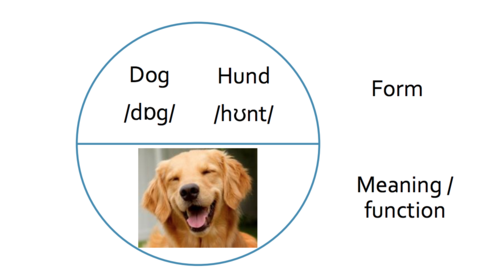
| Arbitrary | There is no natural link between the form and the meaning of a word |
| Conventional | We ‘agree’ on a meaning; we create the link and this meaning is set within our speech community (cf. different languages) |
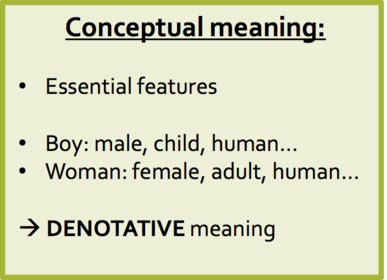
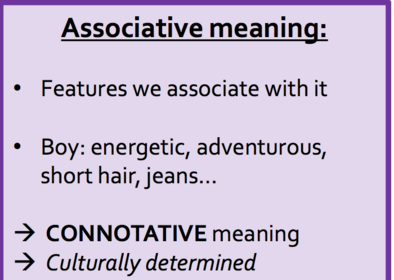
| We distinguish between ___ and ____ meaning | conceptual and associative |
| Conceptual | |
| Associative | |
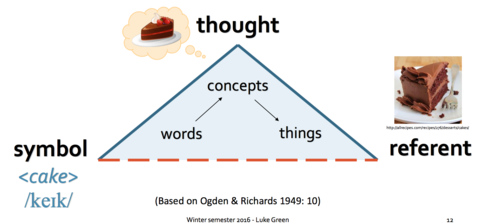
| Words are names for things | Meaning is the relation between a linguistic expression and a mental category that is used to classify objects, i.e. a concept. (Plag et al. 2015) |
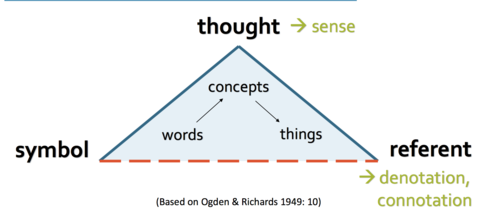
| The semiotic triangle | |
| semiotic triangle + 'synonyms' | |
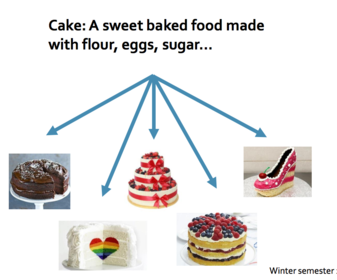
| sense | The descriptive meaning or concept of an expression/word (A sweet baked food made with flour, eggs, sugar...) |
| Denotation | The potential referents of a word/expression |
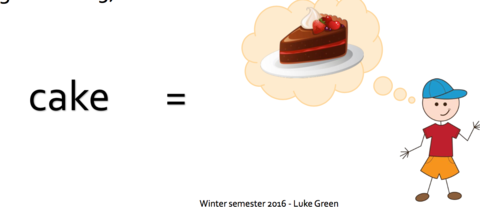
| Connotation | The qualities associated with those referents (Tasty, soft, celebratory, impressive, unhealthy...) |
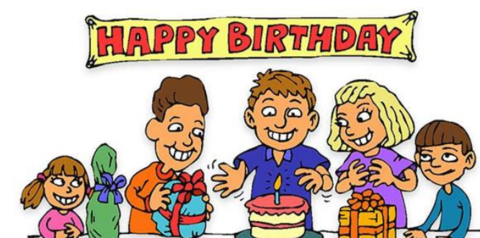
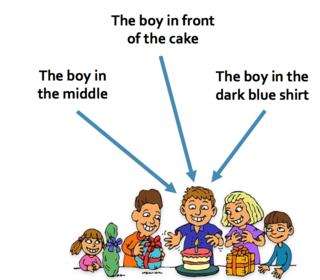
| Dimensions of meaning Whose birthday is it? | • The boy in the middle • The boy in front of the cake • The boy in the dark blue shirt --> These have different senses (mean different things) --> They have the same referent (refer to the same entity)) |
| one sense can refer to different referents | |
| different senses can refer to the same thing | |
| Word meaning theories Categorisation How do we categorize? | The classification of entities into mental categories • Atoms of meaning: Semantic features • Fuzzy concepts: Prototype theory |
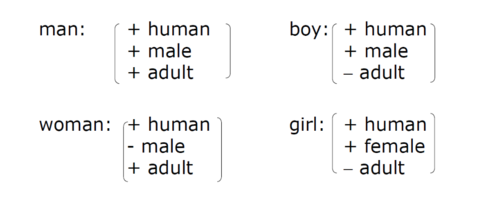
| semantic features | |
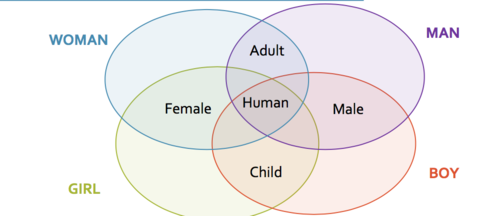
| semantic features circle | |
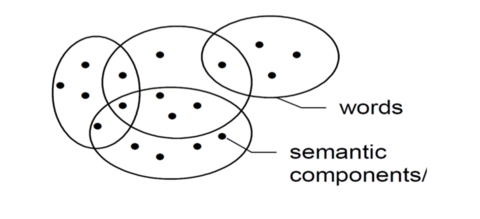
| semantic features lecture diagram | |
| problem/thing with semantic features | eg. Bachelor: +human +male +adult -married those semantic features apply to a bachelor but also to the pope and tarzan who are no bachelors |
| Semantic features advantages | • Convenient explanation for meaning overlap • Represents similarities and differences among semantically- related words • Allows parallelism between sound/meaning structure • Seeks to find basic components for defining word meaning |
| semantic features drawbacks | • Some features are not atomic • Componential analysis does not always grasp all there is to word meaning (e.g. bachelor / spinster) • Which features are essential? Which should be listed? • Sometimes impossible to find core attributes |
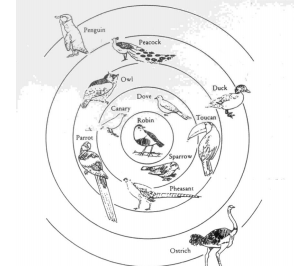
| Prototypes | We can speak of things as being ‘prototypical’, i.e. the ‘best example’ of something: concentric cycle |
| Multiple meanings | He hit his head on the doorframe. She is the head of the finance department. Are you going to the ball? Can you throw me the ball? --> one word can have multiple meanings |
| Polysemy | He hit his head on the doorframe. She is the head of the finance department. If one form has related meanings, we call this polysemy --> one dictionary entry for polysemous words |
| Homonymy | Are you going to the ball? Can you throw me the ball? If one form has multiple unrelated meanings, we call this homonymy -> separate dictionary entries for homonymous words |
| What is homophony? | --> When two or more words have different forms (i.e. different spellings), but are pronounced the same: • Sun, son • Beach, beech • Through, threw •... --> special case of homonymy |
| Synonymy | What is synonymy? -->When two or more words have different forms, but have the same meaning: • She appeared/seemed to be a little distracted. • I phoned/called her last week. • He’s a nice/pleasant guy. |
| Synonymy Problem? | Problem: Do the words really mean exactly the same thing? • He’s a nice/pleasant guy. Problem: Do the words mean the same thing in different contexts? • She appeared/seemed to be a little distracted. • The mirage suddenly appeared/*seemed in front of me. Only one meaning of polysemous words can have a synonym. -Only one meaning of polysemous words can have a synonym. --> Head: The head of the team. The leader of the team. (...) I hit my head on the door. I hit my leader on the door?? If we are really precise, we can conclude that there are no true synonyms, only “near-synonyms”. Cf. “He’s a nice/pleasant guy.” ->Subtle differences in meaning |
| See you tomorrow, bye! I want to buy myself a sandwich. what? | Homophony |
| Could you turn on the light? This parcel is rather light. | Homonymy |
| If you’re tired, you could lie on the sofa. Don’t trust him, he will only lie to you. | Homonymy |
| You did a great job there! My mother’s recently got a new job. | Polysemy |

Want to create your own Flashcards for free with GoConqr? Learn more.