
Flashcards
Science
Cards in this deck (29)
- 1what are some of the celestial bodies visible in the sky?stars, sitting stars, moon, planets
- 2Can you describe the movements of the Earth, Moon and SunThe Earth rotates.
It also orbits the sun which takes about one year. The moon orbits the Earth in about one month. - 3Distinguish between a celestial object's Rotation and OrbitA rotation is a motion about an axis or another object.
An orbit describes rotation around the sun. - 4Distinguish between a Solar and a Lunar eclipse using words and diagramsLunar Eclipse: when the Earth passes between the moon and the sun
Solar Eclipse:
when the moon passes between the Earth and the sun - 5which objects in our solar system produce light?stars, moon, sun, planets
- 6what is produced in the sun that is vital for life on Earth?the sun produces heat, light, energy in the form of hydrogen
- 7how are the inner planets different from the outer planets?inner planets (mercury,
, and rockier, made of heavy minerals like iron, and have no or few moons
outer planets (jupiter, saturn, uranus, neptune) are much bigger and made up of gas - 8how is the boundary of the solar system defined/determined?the solar system extends as far as the sun's influence; either the sun's light, its gravitational field, or of its magnetic field
- 9Can you explain why we have different seasons in the Northern/Southern hemispheres?The northern and southern hemispheres always experience opposite seasons because when the northern part of the Earth is closest to the sun, the southern is furthest
- 10The Earth is tilted relative to what?The Earth is tilted towards its own orbital plane
- 11What is Insolationthe solar radiation that reaches the Earth's surface
- 12What will be different if the Earth were not tilted?we would have no seasons as one part of the Earth would always be tilted towards the sun with the other being tilted away from the sun
- 13Can you list some characteristics of the Moon?1/4 the diameter of the Earth
it's gravity affects the Earth's tides
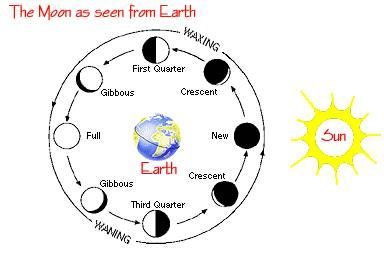
it has craters on its surface which are visible to the naked eye - 14Why do we always see the same side/face of the moon?the moon rotates the Earth at the same speed that it orbits the Earth so we always see the same side
- 15Describe the phases of the moon?full
gibbous
first quarter
crescent
new (not visible on Earth)
crescent
third quarter
gibbous - 16What is a stara ball of gas (hydrogen and helium) held together by its own gravity
- 17What is the closest star to our Solar system?the sun is closest to the Earth and alpha Centauri is closest to our sun
- 18What are constellationsa group of stars forming a recognizable pattern
- 19What is Nuclear fusion and where does it occur?a chemical reaction where multiple atoms combine to form a single more massive atom
it takes place in the interior of the sun - 20What properties are used to distinguish stars?Lumosity: total energy emitted
chemical composition
brightness
radius
temperature - 21Describe the spectral classes of stars?O class - blue, very bright
B class - blue
A class - blue
F class - blue/white
G class - white/yellow
K class - orange/red
M class - red, very faint - 22What spectral class does our Sun fall intoG class
- 23List the steps to how we believe Stars are formed1. Begins as a Giant Molecular Cloud - large cloud of gas
2. a Protostar is formed as gas particles run into each other
3. In the T-Tauri stage, the star will produce strong winds
4. A Main Sequence Star will take a solid shape
5. The star becomes a Giant once all the hydrogen is converted to helium
6. At the Core Fusion stage, iron begins to form in the core
7. The star's core explodes at the Supernova stage - 24What determines how a star will live its lifeA star's life cycle is determined by its mass; the larger it's mass, the shorter its life cycle
- 25How do stars die?When a star burns all of its hydrogen fuel, it becomes a Red Giant. It then explodes in a supernova and the elements are scattered throughout the universe
- 26What will happen when our Sun dies?It will begin to emit tremendous heat so that all life on earth will die
It will start to expand and probably swallow the inner planets
The core will lose its energy and become a white dwarf slowly cooling - 27What are some benefits of space exploration?job creation
spinoff technologies
education
search for extra-terrestrial life and alternative hospitable planets - 28What are some of the Spin-off products from Space exploration?Memory foam
MRI technology
Smoke detection - 29What are some concerns/dangers about space exploration?1. very costly
2. our ships are too slow
3. there are many objects and debris in space that can cause damage
4. we do not have any reliable navigational tools
5. space radiation is deadly
6. no food and water available
7. Zero gravity injures the human body
Information
- Description
- Flashcards on Science, created by Anne Marie Bianchi on 19/04/2017.
- Created by
- Anne Marie Bianchi
- Views
- 23
- Tags
- Rating