
Flashcards
FC 2A- Eukaryotic Cellular Composition
Cards in this deck (45)
- 1NucleusContains and protects DNA, site of replication/transcription/splicing, and responsible for the partial assembly of ribosomes
- 2MitochondriaProduce ATP through the Krebs Cycle & Oxid Phosph. Self-replicating; have own DNA & ribosomes that replicates independently, doesn't share the same genome with its host, supporting the endosymbiosis theory (functional unit in cell). Intermembrane space is high in protons H+.
- 3RibosomesSynthesize proteins; mRNA, rRNA, tRNA
- 4Rough ERSynthesize, fold, export, and modify secretory, membrane-bound, and organelle proteins. Site of post-translational modifications.
- 5Smooth ERDetoxification and glycogen breakdown in the liver; steroid synthesis in gonads
- 6Golgi ApparatusModification (and some synthesis for secretion) and sorting/sending of proteins made in RER
- 7LysosomesContains acid hydrolases which digest various substances. Things you want to digest gets into a vacuole by endocytosis or phagocytosis, and then the vacuole fuses with the lysosome. Anything inside gets digested by the hydrolytic enzymes.
- 8PeroxisomesMetabolize lipids and toxins with hydrogen peroxide (H2O2) to prevent peroxide damage or oxygen radicals
- 9NucleolusInside the nucleus responsible for transcribing rRNA
- 10Nuclear Envelope/Nuclear MembraneDouble membrane system made of an outer and an inner membrane
- 11Nuclear PoresHoles in the nuclear envelope where things can pass into and out of the nucleus. Transcription occurs in the nucleus, and those transcribed RNA need to pass out of the nucleus. Things like transcription factors need to pass into the nucleus where they can access the DNA to be transcribed.
- 12Rough ER Secretory PathwayThere is a signaling sequence early in translation that pushes the polypeptide into the RER for it to complete translation then a vesicle wrapped around it buds off and moves into Golgi (cis stack -> medial stack -> trans stack) which then buds off and goes to designated location via exocytosis.
- 13Endoplasmic Reticulum Double MembraneThe ER membrane is joined with the outer nuclear membrane in places, meaning that the space within the nuclear membrane is continuous with the interior of ER (lumen).
- 14Ribosomes and RERFree Ribosomes- proteins translated here will go to peroxisomes, mitochondria, nucleus, or stay in cytoplasm.
RER- proteins translated here will go to extracellular space, plasma membrane, or membrane/interior of ER/golgi/lysosome. - 15Smooth ERSynthesizes lipids that become part of cell membrane and those secreted from cell (i.e. steroids), metabolizes carbs, and detoxifies drugs/toxins.
- 16Membrane Fluidity1) SATURATED FATTY ACIDS- no =, so packed tightly together with STRONG van der Waals forces between side chains
2) UNSATURATED FATTY ACIDS- contain =, so packed loosely meaning more fluidity
3) CHOLESTEROL- hydrophobic - 17Phospholipid BilayerContains phospholipids which are amphipathic composed fatty acid (sat or unsat) hydrophobic tail and phosphate + glycerol hodrophillic head
- 18Plasma Membrane Proteins1) Integral- within membrane; hydrophobic interactions
2) Peripheral- stuck to integral proteins; H+ bonding and electrostatic interactions
3) Transmembrane- membrane crossing - 19Membrane Dynamics1) OUTER LEAFLET- phospholipids that border extracellular environment
2) INNER LEAFLET- phospholipids that border intracellular environment - 20Membrane Dynamics- Movement1) TRANSBILATERAL DIFFUSION- uncatalyzed; where outer leaflet moves to inner leaflet or vice versa, very slow.
2) LATERAL DIFFUSION- catalyzed; any movement not moving leaflets, very fast.
-Flippase (outer -> inner) *ATP
-Floppase (inner -> outer) *ATP
-Scramblase (both) *no ATP - 21Electrolytes1) STRONG ELECTROLYTES- solutes that dissociate completely (like ionic substances)
2- WEAK ELECTROLYTES- solutes that remain somewhat ion-paired
3) NONELECTROLYTES- covalent compounds that don't dissociate into ions - 22van't Hoff Ionizability Factori; how many ions 1 unit of a substance will produce in a solution
ex: C6H12O6; nonelectrolyte i=1
ex: NaCl -> Na + Cl; i=2
ex: CaCl2 -> Ca + 2Cl; i=3 - 23Colligative PropertiesDepend on the NUMBER of solute particles in solution NOT THE TYPE; the same no matter what the size, type, or charge; change in 1 is change in all.
-VP Depression, BP Elevation, FP Depression, Osmotic Pressure - 24Vapor-Pressure DepressionPressure exerted from the gas phase of a liquid
*Weaker intermolecular forces means higher VP and more easily evaporated and considered VOLATILE - 25Boiling-Point ElevationWhen liquid boils because the energy of the liquid molecules overcame the intermolecular forces -> GAS; the increase in BP relates to the #particles in solution and solvent type; more solute particles = higher BP
/_\T = k(solvent's bp constant) i m - 26Freezing-Point DepressionLiquid is less able to achieve a solid state when a solute is present thus lowering FPD
/_\T = -k(solvent's bp constant) i m - 27Common Molecular PassageHYDROPHILIC/POLAR- cannot pass
ex: ions, carbs, AA
HYDROPHOBIC/NONPOLAR- can pass
ex: CO2, O2, steroid hormones
WATER- through aquaporin channel - 28Diffusion vs OsmosisDIFFUSION- solute moves to <->
*membrane permeable to solute & solvent
OSMOSIS- solvent moves to <->
*membrane impermeable to solvent
WATER MOVES TOWARDS PARTICLES - 29Osmotic PressurePressure it takes to stop osmosis from occurring
|-| = MiR(0.0821 L-atm/K-mol)T - 30Passive TransportNo E required; movement of solute down a gradient
1) SIMPLE DIFFUSION- no protein needed
2) FACILITATED DIFFUSION- either channel or carrier protein needed - 31Membrane ChannelsIon channels are gated if the channel is open in response to some stimuli.
1) VOLTAGE-GATED: open 2/2 change in electrical potential
2) LIGAND-GATED: open 2/2 change in binding of a specific molecule (such as a neurotransmitter)
*ALL cells have K+ channels - 32Carrier ProteinsBind to the molecule then undergo conformational change to move across the membrane.
1) UNIPORTS- transport only 1 molecule at a time
2) SYMPORTS- carry 2 molecules in the same direction
3) ANTIPORTS- carry 2 molecules in opposite directions - 33PoresA large non-selective tube through membrane formed by polypeptides known as porins that only has a size restriction.
***Not in eukaryotic PM - 34Active TransportE required; movement of solute against a gradient
1) PRIMARY ACTIVE TRANSPORT: transport molecule directly coupled to ATP hydrolysis
2) SECONDARY ACTIVE TRANSPORT: transport indirectly coupled to ATP hydrolysis (ATP makes gradient to drive) - 35Sodium-Potassium Pump (Na+/K+ ATPase)Primary Active Transport that helps maintain resting potential in the cell. Energy released from hydrolysis of ATP pumps 3 Na+ out and 2 K+ into the cell.
1) Osmotic balance
2) Establish resting membrane potential
3) Na+ gradient to drive secondary active - 36ExocytosisProcess that transports material out of the cell when a vesicle in cytoplasm fuses with PM and vesicle contents expel into extracellular space
- 37EndocytosisMaterials taken into cell via invagination of PM to form vesicle (endosome)
1) PHAGOCYTOSIS: cell eating
2) PINOCYTOSIS: cell drinking
3) RECEPTOR-MEDIATED ENDOCYTOSIS: very specific (ex: atherosclerosis if cell doesn't remove cholesterol brought in from lipoproteins via RME) - 38Membrane PotentialWhen K+ leaves the cell via K+ Leak Channels, an electrical potential is created with a net - charge inside.
- 39Membrane ReceptorsMany ligands (hormones & neurotransmitters) can't cross the plasma membrane, so they bind to membrane receptors on the outside that triggers a signal transduction of second messengers which cause a change inside the cell (via protein kinase cascade).
- 40Intercellular Junctions-GAP JUNCTIONS: connects 2 cells, and allows stuff to flow between them.
-TIGHT JUNCTIONS: glues 2 cells to not allow flow in between; a series effectively forms an impermeable barrier.
-DESMOSOMES: connects 2 cells together by linking cytoskeletons for mechanical strength, not an impermeable barrier. - 41CytoskeletonStructural support supplied by bacteria, fungi, & plant cell wall which allows movement of cell and transport of substances within the cell.
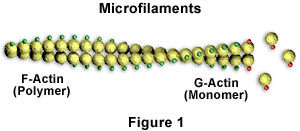
Contains microtubules, intermediate filaments, & microfilament proteins. - 42Microfilaments*Made of actin
-Cleavage & contractility (cytokinesis)
-Amoeboid movement of entire cell
-Bears tension to support cell shape - 43Microtubules*Made of tubulin
-Mitotic spindle, cilia/flagella,
-Intracellular transport of organelles
-Bears compression to support cell shape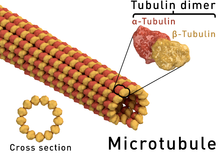
- 44Intermediate Filaments*Varied composition
-Supports cell shape by bearing tension
-A centriole is 9 microtubule triplets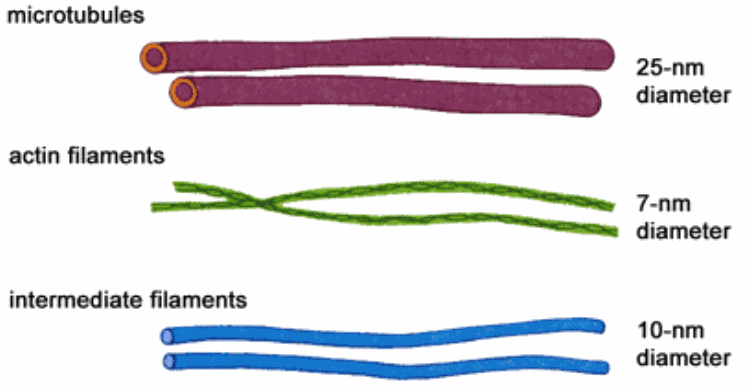
- 45Cilia and Flagella"9 + 2" microtubule arrangement bound by dynein & anchored to PM by basal body
Flagellum(moving) larger than cilia (moving, sensory, or sweeping mucus)
*Prokaryotic flagellum is different
Information
- Description
- Complete Flashcards on FC 2A- Eukaryotic Cellular Composition, created by Victoria Whitfield on 02/05/2017.
- Created by
- Victoria Whitfield
- Views
- 0
- Rating