
Flashcards
Module 1 (Wk 1 & 2)
Cards in this deck (65)
- 1What is effective communication?Since communication channels are always changing, staying "effective" means changing communication style
- 2What is EMC – virtual ‘life’?Emotion-focused coping:
- behavioural and cognitive methods employed to try and control emotional response to a stressor
(i.e. behavioural: slowing down breathing by counting to 10/seeking support/watching television/walking to distract from problem) - 3What is service delivery?Terminology for people who deliver health services - contrast with service users: clients
- 4Does changing self-presentation lead to changing self perception?[CONFIRM]
Yes - this is the perspective taken when you focus on the needs of other person rather than yourself, through active listening, self-awareness, reflection.
How we organise and interpret the information in our
environment determines how we communicate about
that information and the environment. - 5Role of culture in effective communication?Global communication needs culturally competent communication
- 6Why is effective communication important?- vital for psychological & physical health
- appears to be 'common sense' but difficult to do in practice - 7Most important skill in effective communication?Being a reflective practitioner
- 8Essential elements of effective communication? (4)- Context
- Meaning
- Other-orientated
- Entire body –verbal and non-verbal - 9Context?-Overarching physical/psychological environment that guides how a message will be interpreted.
- Right situation? Right place?
- Different depending on how perceive problem and situation
- Especially when a person is not able to speak
- How to help solve problem and understanding - 10MeaningWhat you are trying to convey (1st) to the person (2nd)
- 11Other-orientated- A perspective that is taken during communication where your focus is on the needs or wants of the other person and not on your own needs or wants.
- Accepting that having equal responsibility does not mean equal say in conversation
- Communication suggests primary focus/area of concern is the other person - 12Being a reflective practitionerContemplation of your skills as a communicator
Aim of improving accuracy and effectiveness of this communication - 13Model of communication
- 14What does 'reflection' mean?Reflection: Higher-order learning style - student questions/critiques their learning to integrate their understanding with their own practice
- Contemplation of your skills as a communication with the aim of improving accuracy and effectiveness of this communication
Critical reflection: Incorporates AND moves beyond by questioning their assumptions, altering their perception to potentially change their future behaviour - 15What does 'listening' mean?Psychological as well as physical - involves eyes, heart, and understanding of the other person; hearing is simply physical process
- 16What does Johari's Window mean?Jaharas Window: NOT known to you, but others; NOT others, only you; NOT known to anyone → Stress/trauma and first experiences will bring it out - hopes/dreams from window
- 17What does 'noise' mean?- Noise: Physical or psychological interference that can impact how accurately a message is sent/received
- Inferring? What interferes with the message, where the client will not have the same noise-level as us - multi-modal input (i.e. air-conditioner)
- Trauma, disability, sound, grieving process
- Can tune in and out easily
- Noise level experienced differently esp in new environment - 18What is the only thing common to all of our communication?Ourself
- 19Contributors of our sense of self?Our families, our peers, our experiences, and self-awareness
- 20What drives our self-concept?Self-esteem (evaluation of who we perceive ourselves to be) & self-awareness (understanding of who we are)
- 21How do those things fit together?All of these things therefore also contribute to how effectively we communicate with others
- 22What is self-esteem?- Informs everything - your worth, the way you perceive yourself and weigh the positives and negatives to determine the person
-About self-worth
Levels
Low self-esteem = less risky, stay in boundary, distant mode
High self-esteem = more risky, test boundaries, intimate mode (more likely empathetic)
How you feel about yourself, both positively and negatively
‘Self’ - Your values, beliefs and attitudes
‘Esteem’ - Worth or weighting you ascribe to each of these parts yourself
Reflection of how much weight or importance you put on various aspects of your self-concept - how important these are for where you are going - 23Self-perception?- Notion of where to put yourself - i.e. what to wear in what community
- Face value on yourself
- Informed by self-esteem: How you want everyone else to see you
- How do you see yourself?
-Evaluation of self by others
- ‘Face': How dress, where eat, etc.
- Self-perception → Self-concept - 24Self-Concept?- Both things that you know about yourself + things you didn’t know
- Differentiation self-concept and self-esteem: latter is about worth.
- ALL of the positives and negatives skills, strengths, weaknesses
- The ‘fuller’ picture of the self-perception → Skills, where to go, where you have been. - 25Self-regulation- Monitor emotions - stresses in my life so I can attend to the client/patient appropriately
I.e. Annoyed, angry with client that left → How can I not bring that into the next session?
- Allows you monitor your behaviour, identify if any changes are necessary to reach your goals, and set about making those changes
- Capacity not to trigger others
- Evident during conflict or potential conflict
- Identity management is more than self-presentation: it's more self-representation (txtbook?)
- Capacity to monitor your goal-directed behaviour, identify if any changes are necessary to reach your goals, and set about making those changes. - 26Emotional intelligence?Competence in expressing emotion and in listening and responding
- Capacity to regulate their emotions, discriminate among them, appraise and express emotion both verbally and non-verbally, and use this information to guide subsequent thoughts and actions. - 27How does emotion affect your communication?- Low emotional intelligence means less empathetic
- High emotional intelligence means less likely to be anxious about something out of one’s control - 28Role of personality in communication?Personality (defn): Relatively stable enduring patterns of thoughts, feelings, motivation and behaviour that are distinct and consistent
- Personality affects how and why we communicate - 29What does 'humour' mean?Gallows humour: Break the tension between counsellor and client
- 30What does 'attachment' mean?Attachment style: cognitive, behavioural and emotional system employed when participating in the relationships you have with people in your life
Anxious - Very comfortable with people getting close to them/depending on them, but feel nervous about them spending time away, perhaps because they fear being alone (negative model of self; positive model of others)
Dismissive avoidant - Believes themselves to be ‘better off’ without inconveniences that come with intimacy (positive model of self; negative model of others)
Fearful avoidant - recognises importance of relating to others, but not trusting other people to provide what they need (negative model of others and self)
Secure - Confident in relationships, comfortable with other’s dependence, able to tolerate periods of separation with knowledge the relationship with continue. (positive model of others and self) - 31What does 'Personality' mean? (Big 5; 5 Factor Model of Personality)- Neuroticism v.s. Emotional stability
- Introvert v.s. Extrovert (extrovert: more likely to strike up a conversation)
- Openness to experience (open to other group members' style)
- Agreeable v.s. Antagonism (straightforward, not that modest, not overly trusting, etc.)
- Conscientious (organised, likes structure) - 32Communication in health professions?- transfer of information
- between a source and a receiver
- sharing of health-related information between a patient and a [health
professional]
- both participants as sources and receivers- The information may be verbal or nonverbal, written or spoken, personal
or impersonal, issue‐specific, or even relationship‐oriented” - 33What is Health communication?“symbolic processes by which people,
individually and collectively, understand, shape, and accommodate
health and illness” - 34Clinical communication?- interaction you have when you
communicate with your patients and not to your patients.
-
Typically involves a dyadic, reciprocal process
- Can be both verbal and non‐verbal - 35What does (clinical) communication involve? (With patients)-Understanding a patient and their problem, from his or her
perspective
-
Allowing the patient to narrate their own story in their own
words
-
Demonstrating interest, empathy, and respect
-
Explaining procedures, discussing treatment options and their
effects to patients (Abraham, 2011) - 36What does (clinical) communication involve? (With colleagues) Respectful communication
Assertive communication
Being listened to and listening to others
Sharing important patient‐centred information
Checking understanding of important information - 37Principles of effective communication: Emotional aspects?Be aware of feelings: your own, and the other person’s; express emotions in a
constructive manner.
Own your feelings and opinions: be aware of when you are expressing your own opinions,
feelings or ideas. When you express an opinion, feeling or idea, say so – use ‘I’ language.
Describing feelings: It is really important to appropriately communicate feelings in your
relationships. Communicating feelings is useful for self‐disclosure and to teach people
how to treat you. - 38Principles of effective communication: Eliciting and clarifying information? Questioning: Questions help you to increase your understanding of a message that has
been conveyed to you, or to gain more information.
Paraphrasing: Paraphrasing involves conveying your understanding of another person’s
message through reflecting back the underlying meaning of the message as you
understood it. - 39Principles of effective communication: Be clear? Make sure the message you are trying to convey is delivered to your listener by providing
clear information.
Adapt the language you use to your audience, avoid jargon, slang or other words or
information your audience will not understand.
Use concrete examples - 40Principles of effective communication: Take turns? In any communication it is important to engage in appropriate
turn taking. Look for cues that it is your turn or that the other
person has something to add and make sure you take your share
of turns and that the other person gets their share.
Avoid interrupting others when they are speaking. - 41Principles of effective communication: Non‐verbals? Be conscious of your non‐verbal behaviour.
Use appropriate eye contact; eliminate the impediments to you
providing clear non‐verbal communication e.g. distractions that
might take your attention away from the other person. - 42Principles of effective communication: Assertiveness? Being assertive involves communicating your personal rights,
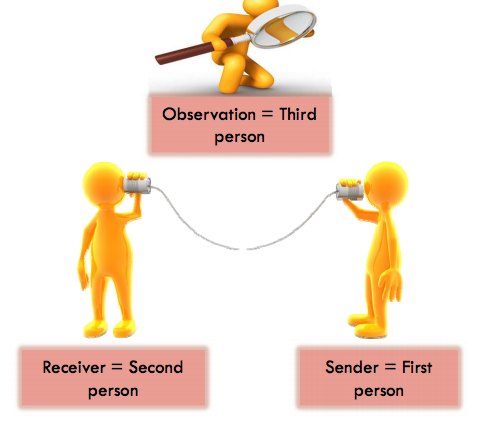
while respecting the rights of others. - 43Sender/1?Sender = sends information to
people / encodes message for delivery
First person = giving information
to other people - 44Receiver/2?Receiver = listens to others, aim to
get others to share information/decodes message for delivery
with them.
Second person = retrieving
information from other people - 45Observer/3?Observer = monitor interaction
Third person = watching over the
conversation from an objective,
outside perspective - 46Simple model of communication

- 47Barriers to effective communication? Language barriers
context
meaning
Lack of reflective practice
Filters, stereotyping
Interrupting
Inappropriate advice giving
Hearing but not listening
Jumping to conclusions (assuming you know what’s coming next, zoning
out of the conversation)
Not knowing who you are speaking to
- It's not always the explicit conversation - true problem can be the implied meaning - 48Connotative v Denotative meaning?Connotative: Subjective meaning of a word, impacted upon by personality, past experience, context, or personal circumstances
Denotative: The objective, dictionary definition of a word - 49Active listening?Form of listening where the listener makes verbal & non-verbal contributions to the conversation with the intention of understanding the speaker's message.
- 50Filters, stereotypingStereotype: Abbreviated/simplified perceptions of people that are often misleading/inaccurate.
Filter: Unconscious blocking of parts of a message to only process info that confirms your point of view - potentially results in biased listening - 51Personal agencyClient's belief in ability to successfully manage their environment and hurdles they are presented with
- 52 How do self‐esteem and empathy relate? Perspective taking (PT) displays a consistent though modest
relationship with self‐esteem
PT is associated with better social functioning; self‐esteem
is enhanced by satisfying social relationships, therefore
expect to see these two related
Relationship between empathic concern (EC) and self‐
esteem largely non‐existent
• Maybe it’s about how you disclose these feelings of warmth,
compassion or concern rather than just having them? - 53How is attachment linked to communication?Anxious/avoidant - People who display more rejection in their communication and less self-disclosure - predict greater use of criticism, coercive communication, and blaming
- 54How is attachment linked to communication? Self‐disclosure (Mikulincer & Nachshon, 1991)
Leadership capacity (Popper & Amit, 2009)
Burnout, trust and teamwork (Simmons, 2009)
Feedback (Hepper & Carnelley, 2012) - 55 Insecure attachment in at least one communication partner is related to higher levels of: Partner withdrawal
Verbal aggression
Nagging
Whining
Defensiveness
Avoidance
Nonverbal negative affect
Criticism
Rejection
Low self‐disclosure - 56Emotional intelligence and communicationEmotion affects your communication – influences
how we talk to others and how others hear what
we say
Emotional intelligence = competence in expressing
emotion and in listening and responding to the
emotional communication of others (Goleman,
1995)
Communication skills are thought to be central to
emotional intelligence (or EI) - 57EI in an allied health contextSmith et al. (2012)
Low EI predicted increased worry in patients newly
diagnosed with cancer
Martins et al. (2010)
EI was positively correlated with physical, mental and
psychosomatic health
Libbrecht et al. (2014)
Considered role of emotional intelligence in trainee doctors;
EI predicted performance in courses on communication and
interpersonal sensitivity (i.e. like PYB007) but not in the
medically‐oriented courses; was deemed important for
providing good ‘bedside manner’ - 58Self‐regulation & communication Self‐regulation = your capacity to monitor your
behaviour, identify if any changes are necessary to
reach your goals, and set about making those changes
The “capacity for altering one's own responses,
especially to bring them into line with standards such
as ideals, values, morals, and social expectancies, and
to support the pursuit of long‐term goals” (Baumeister
et al., 2007)
Particularly useful for behaviour change programs (e.g.
smoking cessation, weight management, risky
practices, nutritional plans, cookie eating…)
Particularly relevant for conflict or highly emotional
communication
Having self‐regulation is what stops you from saying
“that” thing that will push the situation over the edge
People with good self‐regulation will monitor their
interactions (good third person communication skills)
and will be able to tell if things need ‘tweaking’.
If a conversation isn’t going the way you want it to,
people higher in self‐regulation can review the
situation, identify their communication goal and
modify their communication behaviour to achieve this
goal - 59Personality and communication - 5 factors of personalityEmotional stability (versus neuroticism)
Extraversion (versus introversion)
Openness to experience
Agreeableness (versus antagonism)
Conscientiousness - 60Johari's window

- 61What is a 'message'?The information that is encoded during an interaction
- 62Habitual actionLower-order learning style based on rote-learning information without really stopping to think how that information intetrates into your world view
- 63Understanding:Lower-order learning style - questioning and comprehending information without further thought into a topic
- 64Individual differencesAny aspect relating to who you are that makes you distinguishable from someone else e.g. age personality traits beliefs attitudes
- 65Personal controlFeeling that you can make a difference in attaining your desired goals or outcomes, or avoid unwanted outcomes
Information
- Description
- PYB007 Flashcards on Module 1 (Wk 1 & 2), created by Ramisa Raya on 24/06/2017.
- Created by
- Ramisa Raya
- Views
- 11
- Rating