
Flowchart
Mary I
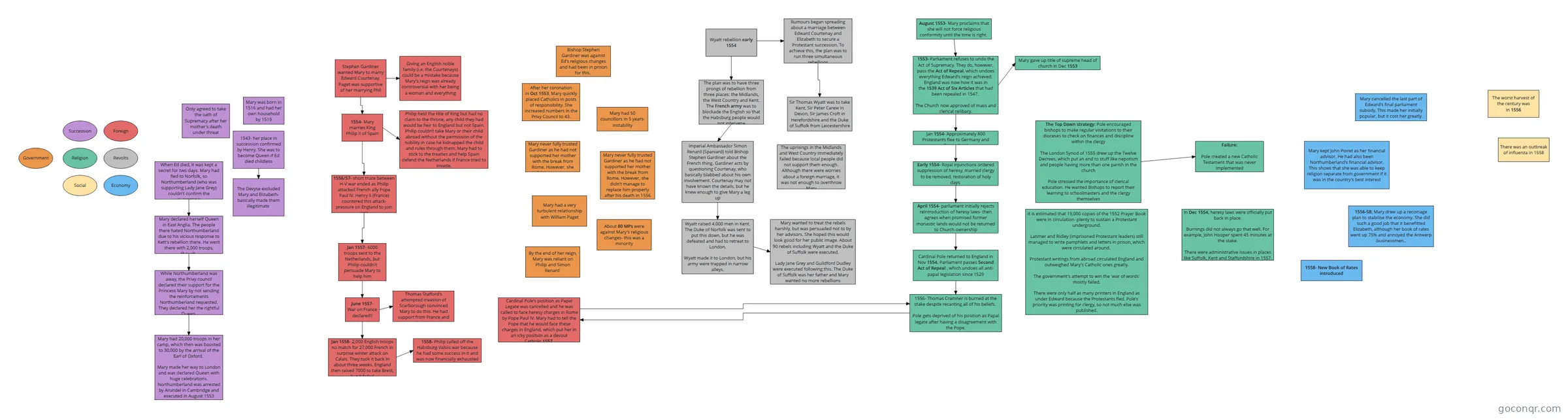
Flowchart: Mary I
Flowchart content
Succession
Religion
Foreign
Revolts
Social
Economy
Mary was born in 1516 and had her own household by 1519
Government
Only agreed to take the oath of Supremacy after her mother's death under threat
1543- her place in succession confirmed by Henry. She was to become Queen if Ed died childless
The Devyse excluded Mary and Elizabeth- basically made them illegitimate
1554- Mary marries King Philip II of Spain
Stephen Gardiner wanted Mary to marry Edward Courtenay. Paget was supportive of her marrying Phil
Giving an English noble family (i.e. the Courtenays) could be a mistake because Mary's reign was already controversial with her being a woman and everything
Philip held the title of King but had no claim to the throne, any child they had would be heir to England but not Spain. Philip couldn’t take Mary or their child abroad without the permission of the nobility in case he kidnapped the child and rules through them. Mary had to stick to the treaties and help Spain defend the Netherlands if France tried to invade.
Jan 1557- 6000 troops sent to the Netherlands, but Philip couldn't persuade Mary to help him
When Ed died, it was kept a secret for two days. Mary had fled to Norfolk, so Northumberland (who was supporting Lady Jane Grey) couldn't confirm the succession
Mary declared herself Queen in East Anglia. The people there hated Northumberland due to his vicious response to Kett's rebellion there. He went there with 2,000 troops, though.
While Northumberland was away, the Privy council declared their support for the Princess Mary by not sending the reinforcements Northumberland requested. They declared her the rightful Queen.
Mary had 20,000 troops in her camp, which then was boosted to 30,000 by the arrival of the Earl of Oxford.
Mary made her way to London and was declared Queen with huge celebrations. Northumberland was arrested by Arundel in Cambridge and executed in August 1553
Bishop Stephen Gardiner was against Ed's religious changes and had been in prison for this.
June 1557- War on France declared!!
1556/57- short truce between H-V war ended as Philip attacked French ally Pope Paul IV. Henry II (France) countered this attack- pressure on England to join war
Cardinal Pole's position as Papal Legate was cancelled and he was called to face heresy charges in Rome by Pope Paul IV. Mary had to tell the Pope that he would face these charges in England, which put her in an icky position as a devout Catholic 1557
Jan 1558- 2,000 English troops no match for 27,000 French in surprise winter attack on Calais. They took it back in about three weeks. England then raised 7000 to take Brest, but it failed
1558- Philip called off the Habsburg-Valois war because he had some success in it and was now financially exhausted
Thomas Stafford's attempted invasion of Scarborough convinced Mary to do this. He had support from France and the Pope
Wyatt rebellion early 1554
Rumours began spreading about a marriage between Edward Courtenay and Elizabeth to secure a Protestant succession. To achieve this, the plan was to run three simultaneous rebellions
Sir Thomas Wyatt was to take Kent, Sir Peter Carew in Devon, Sir James Croft in Herefordshire and the Duke of Suffolk from Leicestershire
After her coronation in Oct 1553, Mary quickly placed Catholics in posts of responsibility. She increased numbers in the Privy Council to 43.
Mary had 50 councillors in 5 years-instability
The plan was to have three prongs of rebellion from three places: the Midlands, the West Country and Kent. The French army was to blockade the English so that the Habsburg people would not intervene
Imperial Ambassador Simon Renard (Spaniard) told Bishop Stephen Gardiner about the French thing. Gardiner acts by questioning Courtenay, who basically blabbed about his own involvement. Courtenay may not have known the details, but he knew enough to give Mary a leg up
The uprisings in the Midlands and West Country immediately failed because local people did not support them enough. Although there were worries about a foreign marriage, it was not enough to overthrow Mary
Wyatt raised 4,000 men in Kent. The Duke of Norfolk was sent to put this down, but he was defeated and had to retreat to London.
Wyatt made it to London, but his army were trapped in narrow alleys.
Mary wanted to treat the rebels harshly, but was persuaded not to by her advisors. She hoped this would look good for her public image. About 90 rebels including Wyatt and the Duke of Suffolk were executed.
Lady Jane Grey and Guildford Dudley were executed following this. The Duke of Suffolk was her father and Mary wanted no more rebellions
August 1553- Mary proclaims that she will not force religious conformity until the time is right.
1553- Parliament refuses to undo the Act of Supremacy. They do, however, pass the Act of Repeal, which undoes everything Edward's reign achieved. England was now how it was in the 1539 Act of Six Articles that had been repealed in 1547.
The Church now approved of mass and clerical celibacy.
Mary gave up title of supreme head of church in Dec 1553
Jan 1554- Approximately 800 Protestants flee to Germany and Switzerland
Early 1554- Royal injunctions ordered suppression of heresy, married clergy to be removed, restoration of holy days.
April 1554- parliament initially rejects reintroduction of heresy laws- then agrees when promised former monastic lands would not be returned to Church ownership
Cardinal Pole returned to England in Nov 1554. Parliament passes Second Act of Repeal , which undoes all anti-papal legislation since 1529
1556- Thomas Cramner is burned at the stake despite recanting all of his beliefs.
Pole gets deprived of his position as Papal legate after having a disagreement with the Pope.
The Top Down strategy: Pole encouraged bishops to make regular visitations to their dioceses to check on finances and discipline within the clergy
The London Synod of 1555 drew up the Twelve Decrees, which put an end to stuff like nepotism and people having more than one parish in the church
Pole stressed the importance of clerical education. He wanted Bishops to report their learning to schoolmasters and the clergy themselves
Failure:
Pole created a new Catholic Testament that was never implemented
It is estimated that 19,000 copies of the 1552 Prayer Book were in circulation- plenty to sustain a Protestant underground.
Latimer and Ridley (imprisoned Protestant leaders) still managed to write pamphlets and letters in prison, which were circulated around.
Protestant writings from abroad circulated England and outweighed Mary's Catholic ones greatly.
The government's attempt to win the 'war of words' mostly failed.
There were only half as many printers in England as under Edward because the Protestants fled. Pole's priority was printing for clergy, so not much else was published.
Mary kept John Poiret as her financial advisor. He had also been Northumberland's financial advisor. This shows that she was able to keep religion separate from government if it was in the country's best interest
Mary never fully trusted Gardiner as he had not supported her mother with the break from Rome. However, she didn't manage to replace him properly after his death in 1556
Mary cancelled the last part of Edward's final parliament subsidy. This made her initially popular, but it cost her greatly.
1556-58: Mary drew up a recoinage plan to stabilise the economy. She did such a good job that it benefitted Elizabeth, although her book of rates went up 75% and annoyed the Antwerp businessmen..
1558- New Book of Rates introduced
The worst harvest of the century was in 1556
Mary never fully trusted Gardiner as he had not supported her mother with the break from Rome. However, she didn't manage to replace him properly after his death in 1556
There was an outbreak of influenza in 1558
Mary had a very turbulent relationship with William Paget
About 80 MPs were against Mary's religious changes- this was a minority
By the end of her reign, Mary was reliant on Philip and Simon Renard
In Dec 1554, heresy laws were officially put back in place.
Burnings did not always go that well. For example, John Hooper spent 45 minutes at the stake.
There were administrative issues in places like Suffolk, Kent and Staffordshire in 1557.
Information
- Description
- A level History (Tudors) (Mary I) Flowchart on Mary I, created by Lucy Voakes on 04/05/2023.
- Created by
- Lucy Voakes
- Views
- 0
- Rating