
Mind map
Defining and Non-defining clauses
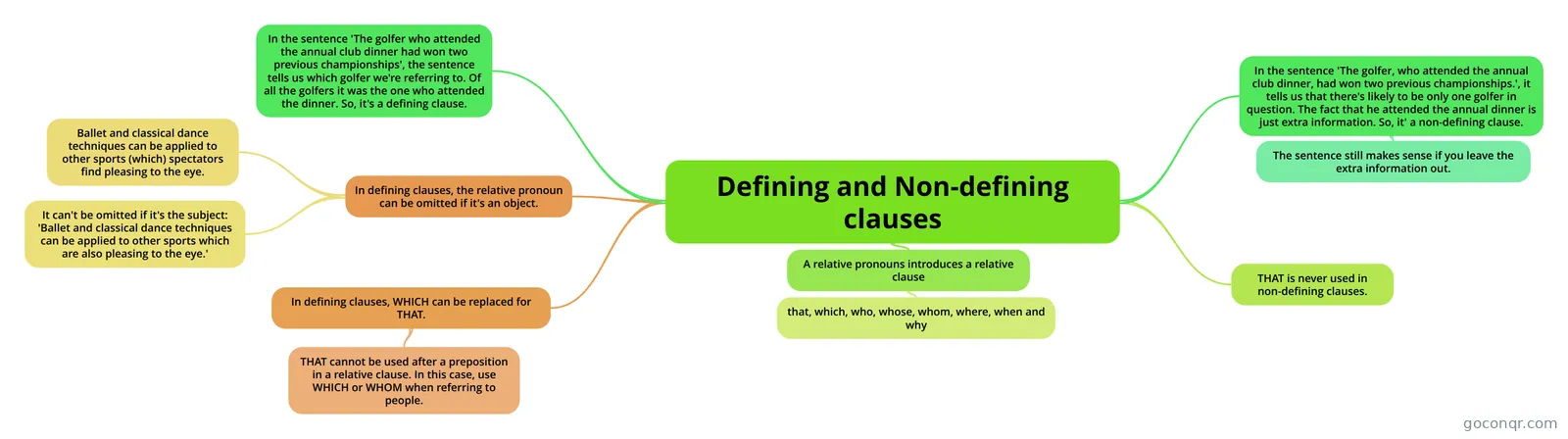
Mind map: Defining and non-defining relative clauses
Map content
Defining and Non-defining clauses
A relative pronouns introduces a relative clause
- that, which, who, whose, whom, where, when and why
In the sentence 'The golfer who attended the annual club dinner had won two previous championships', the sentence tells us which golfer we're referring to. Of all the golfers it was the one who attended the dinner. So, it's a defining clause.
In the sentence 'The golfer, who attended the annual club dinner, had won two previous championships.', it tells us that there's likely to be only one golfer in question. The fact that he attended the annual dinner is just extra information. So, it' a non-defining clause.
- The sentence still makes sense if you leave the extra information out.
In defining clauses, the relative pronoun can be omitted if it's an object.
- Ballet and classical dance techniques can be applied to other sports (which) spectators find pleasing to the eye.
- It can't be omitted if it's the subject: 'Ballet and classical dance techniques can be applied to other sports which are also pleasing to the eye.'
In defining clauses, WHICH can be replaced for THAT.
- THAT cannot be used after a preposition in a relative clause. In this case, use WHICH or WHOM when referring to people.
THAT is never used in non-defining clauses.
Information
- Description
- CPE Proficiency - Cambridge English Mind Map on Defining and Non-defining clauses, created by Meiry Costa on 13/06/2014.
- Created by
- Meiry Costa
- Views
- 628
- Tags
- Rating
More on Defining and Non-defining Relative Clauses