
Relative Clauses
596 resources created by 515 users
This Relative Clauses page on GoConqr gathers community-made quizzes, mind maps, flashcards, slide sets and notes, from defining and non-defining clauses to relative pronouns, adverbs and reduced relative clauses. It's built for school students practising who, which, whose and whom, and for teachers after ready-made material. There are over 500 resources here, including more than 50 quizzes, over 400 mind maps and more than 20 flashcard decks, almost all at secondary level. Pick a quiz to find your gaps, then check the maps.
Top Relative Clauses resources
-
10 questionsReduced relative clauses How could you reduce this sentence? Mark the CORRECT sentence "We sent them a report which was checked by t...
-
16 cardsRelative Clauses The doctor was sick (I wanted to see the doctor)
-
10 cardsDEFINING RELATIVE CLAUSES I saw a match last night. It was fantastic! The match...
-
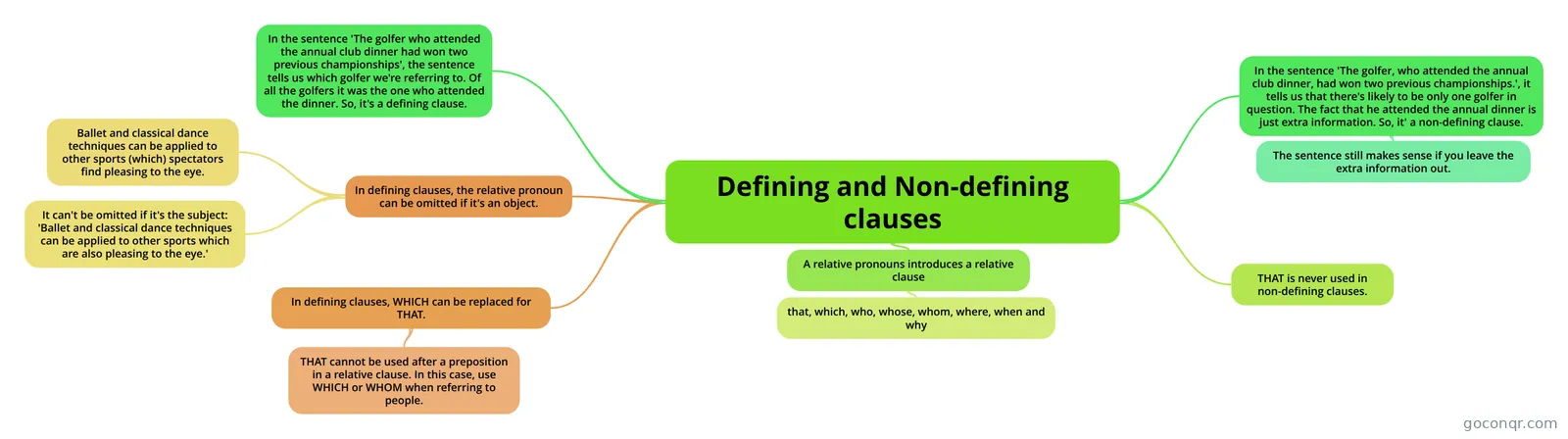 Mind map Defining and Non-defining clauses
-
15 questionsRelative Clauses EnglishB2
-
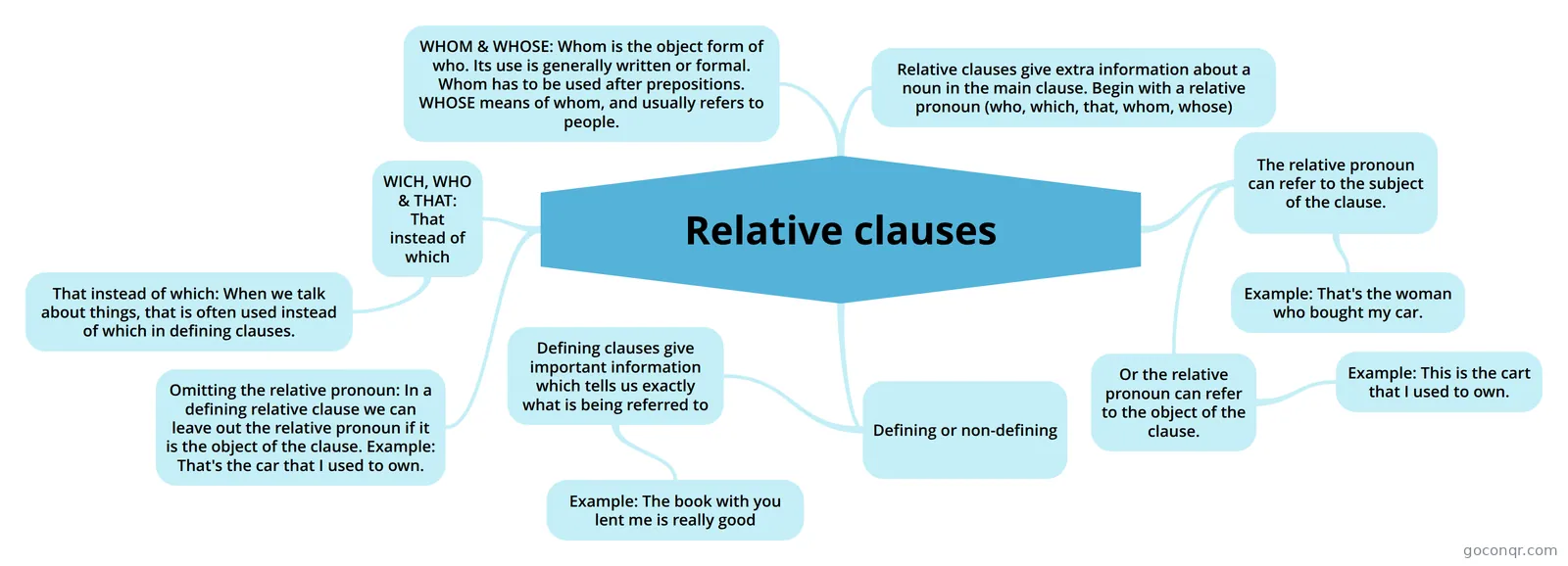 Mind map Relative clauses SUBJECT OR NON-DEFINNING , OMITTING THE RELATIVE PRONOUN, WHICH, WHO & THAT
-
10 questionsUnit 7-Quiz?? Choose the correct relative pronoun. Check the next example. 0. I’ve broken my mum’s favourite vase, which ...
-
10 questionsUnit 7-Quiz?? Choose the correct relative pronoun. Check the next example. 0. I’ve broken my mum’s favourite vase, which ...
Quizzes
See all 62 quizzes-
10 questionsReduced relative clauses How could you reduce this sentence? Mark the CORRECT sentence "We sent them a report which was checked by t...
-
15 questionsRelative Clauses EnglishB2
-
10 questionsUnit 7-Quiz?? Choose the correct relative pronoun. Check the next example. 0. I’ve broken my mum’s favourite vase, which ...
-
10 questionsUnit 7-Quiz?? Choose the correct relative pronoun. Check the next example. 0. I’ve broken my mum’s favourite vase, which ...
-
15 questionsRelatives
-
20 questionsRELATIVE CLAUSES MODIFYING OBJECTS In which of the sentences the function of relative pronoun is object of preposition?
-
15 questionsRelative Adverb Clauses 1. Which of the following is the head noun of the sentence below? A hardware store where we can get gardeni...
-
10 questionsdefining relative clauses There are two trains to London from Manchester. One leaves at 9.00 am, and stops at Macclesfield and Crewe....
Mind maps
See all 464 mind maps-
Defining and Non-defining clauses
-
Relative clauses SUBJECT OR NON-DEFINNING , OMITTING THE RELATIVE PRONOUN, WHICH, WHO & THAT
-
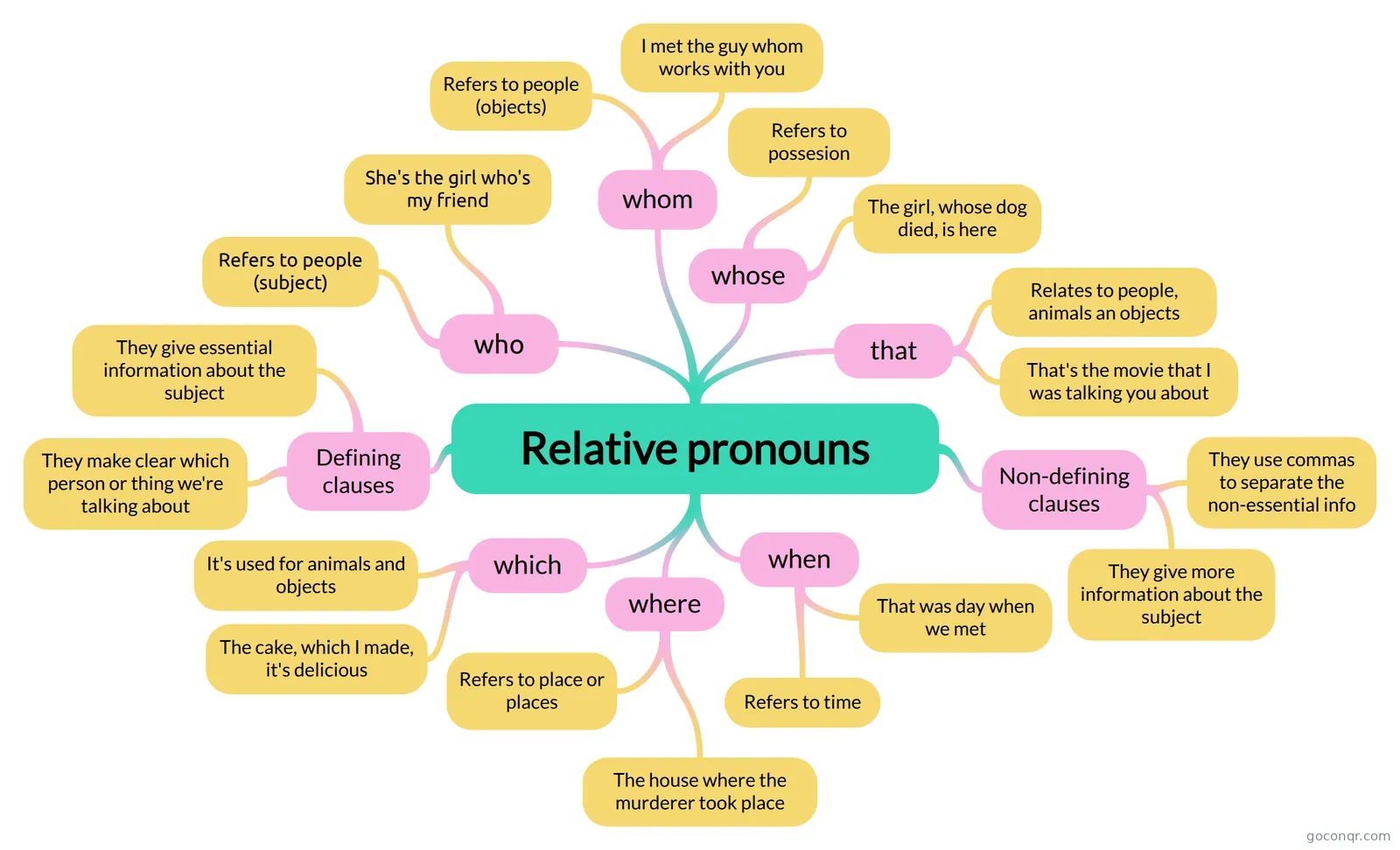 Relative pronouns Relative pronouns; uses and examples Defining and non-defining clauses; uses.
-
Defining & non-defining
-
Adjective Clauses
-
RELATIVE-CONCESSIVE CLAUSES AND LINKING WORDS
-
Relative, Concessive Clauses and Linking words.
-
UNIT 2: GOING PLACES
Flashcards
See all 32 flashcards-
16 cardsRelative Clauses The doctor was sick (I wanted to see the doctor)
-
10 cardsDEFINING RELATIVE CLAUSES I saw a match last night. It was fantastic! The match...
-
10 cardsDefining relative clauses Exercises I saw a match last night. It was fantastic! The match...
-
13 cardsRelative Clauses
-
10 cardsidentifying and non identifying clause George Washington, the 1st president of the United States, was born in 1732.
-
10 cardsRELATIVES
-
4 cardsRelative Clauses Defining relative clauses pt.1
-
8 cardsWa1-cl13-adjective clauses Falling in love with Guanajuato, it´s easy. With its amazing quaint places full of colour and history, its ...
Flowcharts
See all 12 flowcharts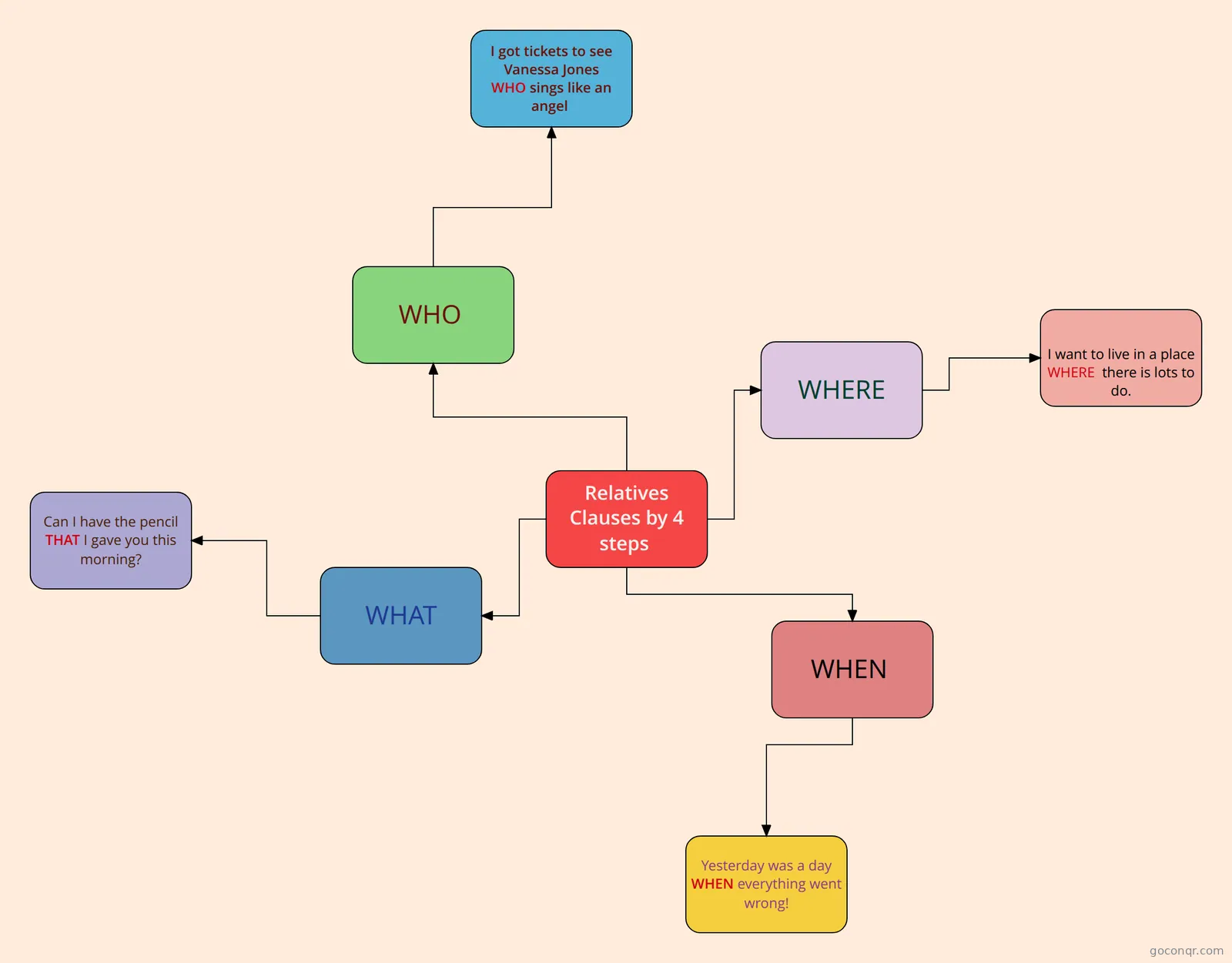
Notes
See all 17 notes-
Relative Clauses Apuntes Defining relative clauses In the sentence: The woman who lives in that house is French. (La mujer que vive en aquella casa es francesa.)The basic sentence is: The woman is French. (La mujer es francesa.)And in order t...
-
RELATIVE CLAUSES Defining relative clauses In the sentence: The woman who lives in that house is French. (La mujer que vive en aquella casa es francesa.)The basic sentence is: The woman is French. (La mujer es francesa.)And in order t...
-
relative pronouns 1. The relative pronouns: The relative pronouns are: Subject: who, which, that Object: whom, who, which, that Possessive: whose We use who and whom for people, and&nbs...
-
exam Certainly! Here's a concise set of notes to study the main distinctions between restrictive and nonrestrictive adjective clauses: **Restrictive Clauses:** - **Definition:** Essential for identifying the noun; without ...
-
Relative Clauses - creado desde un Mapa Mental They are most often used to define or identify the noun that precedes them. Relative clauses are clauses starting with the relative pronouns who, that, which, whose, where, when EXAMPLES
-
Relatives Pronouns - created from Mind Map Concept two types of relative clauses Relative pronouns are used to join two or more clauses, thus forming what we call “relative clauses”.
-
Relative clauses - creado desde un Mapa Mental Dan más información en la frase Defining relative clauses Non - defining clauses
-
Unit 2 "Information, please" Lesson 1 Unit 2 " Information, please" Lesson 1 1. Read the following excerpt from famous books. Notice the information highlighted. "The Ministry of Truth, which concerned itself with news, entertainment, education and the fi...
Slides
Topics in Relative Clauses
More English language topics
About Relative Clauses
GoConqr OriginalWhat the page covers
The resources here all circle one idea: a relative clause gives extra information about a noun. The mind map called Relative clauses opens with exactly that point, then lists the relative pronouns who, which, that, whom and whose. Other maps such as Relative pronouns separate the pronouns used for people, for animals and objects, for places and for time.
Where to start
Begin with the maps, because they give you the pattern in a few lines. The Defining and Non-defining clauses map explains how a clause introduced by a relative pronoun works. The slide set Relative clauses and relative pronouns adds a useful rule: in a defining clause, if you remove it the sentence usually stops making sense, and there are no commas.
- Read a mind map on relative pronouns.
- Go through the slide set on defining clauses.
- Test yourself with the quiz Relative Clauses, a gap-fill where you choose words like who and that.
- Try the quiz Reduced relative clauses once the basics feel steady.
Using quizzes and maps together
Take a quiz first and note which answers you missed. Then open a map on that point, such as the ones on object adjective clauses, and read it again. Retake the quiz afterwards. The flashcard deck DEFINING RELATIVE CLAUSES works well for short bursts. It gives you two ideas to join, like a match you saw and how fantastic it was.
Teachers can use the quizzes as quick starters and the flowcharts and slide sets as ready-made explanations. Everything was made by GoConqr users, so styles vary and some titles are in Spanish or other languages.
Where it sits
This unit belongs to the strand Grammar: Words and Sentences, in English language. It sits alongside other grammar topics that deal with how words build sentences.
Choose a resource that suits your level today and see how far a few minutes of practice takes you.
Frequently asked questions
Which resource should I open first?
Start with the mind map Relative clauses. It explains that these clauses add extra information about a noun and lists who, which, that, whom and whose. After that, try the quiz Relative Clauses, where you fill in the missing pronoun in each sentence.
What do the mind maps cover?
The maps cover defining and non-defining clauses, relative pronouns and adverbs, and adjective clauses with object pronouns. Some also deal with who and whom, or link relative clauses with concessive clauses and linking words. They are short, so they suit quick revision.
Is there anything on reduced relative clauses?
Yes. The quiz Reduced relative clauses asks you to reduce a sentence and mark the correct option. One example starts from a report that was checked by an analyst. It is a good next step once you are happy with ordinary relative clauses.
Are the resources free to use?
Yes. Every resource on this page is free to open, study and take, with no account needed. A free account also saves your quiz scores and lets you make your own quizzes, mind maps, flashcards and notes if you want to build a set.
Who made these resources and what level are they?
They were made by GoConqr users, not by GoConqr itself. Almost all are at secondary level, so they suit school students and the teachers who plan lessons for them. Quality and style vary, so try a few before choosing.
What if I can't find what I need?
Try a nearby title. The topic appears as relatives, adjective clauses, defining clauses and relative pronouns, so a different name may lead to what you want. You can also make your own quiz or flashcards on the exact point you need.