
Mind map
Hedonistic eating questions
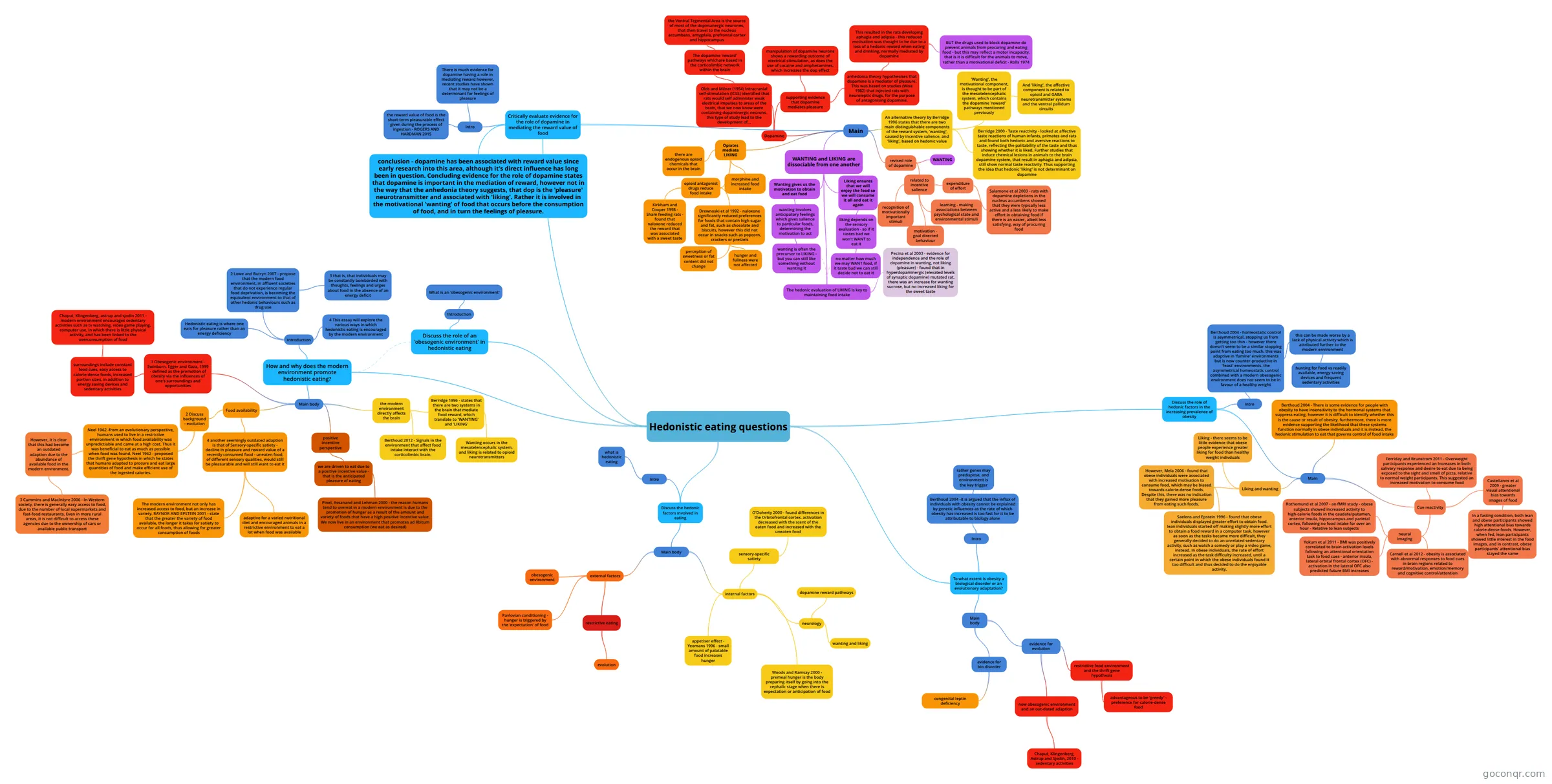
Mind map: Hedonistic eating questions
Map content
Hedonistic eating questions
How and why does the modern environment promote hedonistic eating?
- Introduction
- 2 Lowe and Butryn 2007 - propose that the modern food environment, in affluent societies that do not experience regular food deprivation, is becoming the equivalent environment to that of other hedonic behaviours such as drug use
- 3 that is, that individuals may be constantly bombarded with thoughts, feelings and urges about food in the absence of an energy deficit
- 4 This essay will explore the various ways in which hedonistic eating is encouraged by the modern environment
- Hedonistic eating is where one eats for pleasure rather than an energy deficiency
- 2 Lowe and Butryn 2007 - propose that the modern food environment, in affluent societies that do not experience regular food deprivation, is becoming the equivalent environment to that of other hedonic behaviours such as drug use
- Main body
- 1 Obesogenic environment - Swinburn, Egger and Gaza, 1999 - defined as the promotion of obesity via the influences of one's surroundings and opportunities
- surroundings include constant food cues, easy access to calorie-dense foods, increased portion sizes, in addition to energy saving devices and sedentary activities
- Chaput, Klingenberg, astrup and sjodin 2011 - modern environment encourages sedentary activities such as tv watching, video game playing, computer use, in which there is little physical activity, and has been linked to the overconsumption of food
- surroundings include constant food cues, easy access to calorie-dense foods, increased portion sizes, in addition to energy saving devices and sedentary activities
- Food availability
- 2 Discuss background - evolution
- Neel 1962 -from an evolutionary perspective, humans used to live in a restrictive environment in which food availability was unpredictiable and came at a high cost. Thus it was beneficial to eat as much as possible when food was found. Neel 1962 - proposed the thrift gene hypothesis in which he states that humans adapted to procure and eat large quantities of food and make efficient use of the ingested calories.
- However, it is clear that this had become an outdated adaption due to the abundance of available food in the modern envronment.
- 3 Cummins and MacIntyre 2006 - In Western society, there is generally easy access to food, due to the number of local supermarkets and fast-food restaurants. Even in more rural areas, it is not difficult to access these agencies due to the ownership of cars or available public transport
- However, it is clear that this had become an outdated adaption due to the abundance of available food in the modern envronment.
- Neel 1962 -from an evolutionary perspective, humans used to live in a restrictive environment in which food availability was unpredictiable and came at a high cost. Thus it was beneficial to eat as much as possible when food was found. Neel 1962 - proposed the thrift gene hypothesis in which he states that humans adapted to procure and eat large quantities of food and make efficient use of the ingested calories.
- 4 another seemingly outdated adaption is that of Sensory-specific satiety - decline in pleasure and reward value of a recently consumed food - uneaten food, of different sensory qualities, would still be pleasurable and will still want to eat it
- The modern environment not only has increased access to food, but an increase in variety. RAYNOR AND EPSTEIN 2001 - state that the greater the variety of food available, the longer it takes for satiety to occur for all foods, thus allowing for greater consumption of foods
- adaptive for a varied nutritional diet and encouraged animals in a restrictive environment to eat a lot when food was available
- 2 Discuss background - evolution
- the modern environment directly affects the brain
- Berridge 1996 - states that there are two systems in the brain that mediate food reward, which translate to 'WANTING' and 'LIKING'
- Wanting occurs in the mesotelencephalic system, and liking is related to opioid neurotransmitters
- Berthoud 2012 - Signals in the environment that affect food intake interact with the corticolimbic brain.
- Berridge 1996 - states that there are two systems in the brain that mediate food reward, which translate to 'WANTING' and 'LIKING'
- positive incentive perspective
- we are driven to eat due to a positive incentive value - that is the anticipated pleasure of eating
- Pinel, Assanand and Lehman 2000 - the reason humans tend to overeat in a modern environment is due to the promotion of hunger as a result of the amount and variety of foods that have a high positive incentive value. We now live in an environment that promotes ad libitum consumption (we eat as desired)
- we are driven to eat due to a positive incentive value - that is the anticipated pleasure of eating
- 1 Obesogenic environment - Swinburn, Egger and Gaza, 1999 - defined as the promotion of obesity via the influences of one's surroundings and opportunities
- Introduction
Discuss the role of an 'obesogenic environment' in hedonistic eating
- Introduction
- What is an 'obesogenic environment'
- Introduction
To what extent is obesity a biological disorder or an evolutionary adaptation?
- Intro
- Berthoud 2004 -it is argued that the influx of individuals with obesity cannot be explained by genetic influences as the rate of which obesity has increased is too fast for it to be attributable to biology alone
- rather genes may predispose, and environment is the key trigger
- Berthoud 2004 -it is argued that the influx of individuals with obesity cannot be explained by genetic influences as the rate of which obesity has increased is too fast for it to be attributable to biology alone
- Main body
- evidence for bio disorder
- congenital leptin deficiency
- evidence for evolution
- restrictive food environment and the thrift gene hypothesis
- advantageous to be 'greedy' - preference for calorie-dense food
- now obesogenic environment and an out-dated adaption
- Chaput, Klingenberg, Astrup and Sjodin, 2010 - sedentary activities
- restrictive food environment and the thrift gene hypothesis
- evidence for bio disorder
- Intro
Discuss the hedonic factors involved in eating
- Intro
- what is hedonistic eating
- Main body
- external factors
- Pavlovian conditioning - hunger is triggered by the 'expectation' of food
- obesogenic environment
- restrictive eating
- evolution
- internal factors
- neurology
- dopamine reward pathways
- wanting and liking
- Woods and Ramsay 2000 - premeal hunger is the body preparing itself by going into the cephalic stage when there is expectation or anticipation of food
- appetiser effect - Yeomans 1996 - small amount of palatable food increases hunger
- sensory-specific satiety
- O'Doherty 2000 - found differences in the Orbitofrontal cortex. activation decreased with the scent of the eaten food and increased with the uneaten food
- neurology
- external factors
- Intro
Critically evaluate evidence for the role of dopamine in mediating the reward value of food
- Intro
- the reward value of food is the short-term pleasurable effect given during the process of ingestion - ROGERS AND HARDMAN 2015
- There is much evidence for dopamine having a role in mediating reward however, recent studies have shown that it may not be a determinant for feelings of pleasure
- Main
- An alternative theory by Berridge 1996 states that there are two main distinguishable components of the reward system, 'wanting', caused by incentive salience, and 'liking', based on hedonic value
- 'Wanting', the motivational component, is thought to be part of the mesotelencephalic system, which contains the dopamine 'reward' pathways mentioned previously
- And 'liking', the affective component is related to opioid and GABA neurotransmitter systems and the ventral pallidum circuits
- Berridge 2000 - Taste reactivity - looked at affective taste reactions of human infants, primates and rats and found both hedonic and aversive reactions to taste, reflecting the palitability of the taste and thus showing whether it is liked. Further studies that induce chemical lesions in animals to the brain dopamine system, that result in aphagia and adipsia, still show normal taste reactivity. Thus supporting the idea that hedonic 'liking' is not determinant on dopamine
- 'Wanting', the motivational component, is thought to be part of the mesotelencephalic system, which contains the dopamine 'reward' pathways mentioned previously
- Dopamine
- Olds and Milner (1954) Intracranial self-stimulation (ICSS) identified that rats would self administer weak electrical impulses to areas of the brain, that we now know were containing dopaminergic neurons. this type of study lead to the development of...
- The dopamine 'reward' pathways whichare based in the corticolimbic network within the brain
- the Ventral Tegmental Area is the source of most of the dopimanergic neurones, that then travel to the nucleus accumbens, amygdala, prefrontal cortex and hippocampus
- The dopamine 'reward' pathways whichare based in the corticolimbic network within the brain
- supporting evidence that dopamine mediates pleasure
- anhedonia theory hypothesises that dopamine is a mediator of pleasure. This was based on studies (Wise 1982) that injected rats with neuroleptic drugs, for the purpose of antagonising dopamine.
- This resulted in the rats developing aphagia and adipsia - this reduced motivation was thought to be due to a loss of a hedonic reward when eating and drinking, normally mediated by dopamine
- BUT the drugs used to block dopamine do prevent animals from procuring and eating food - but this may reflect a motor incapacity, that is it is difficult for the animals to move, rather than a motivational deficit - Rolls 1974
- This resulted in the rats developing aphagia and adipsia - this reduced motivation was thought to be due to a loss of a hedonic reward when eating and drinking, normally mediated by dopamine
- manipulation of dopamine neurons shows a rewarding outcome of electrical stimulation, as does the use of cocaine and amphetamines, which increases the dop effect
- anhedonia theory hypothesises that dopamine is a mediator of pleasure. This was based on studies (Wise 1982) that injected rats with neuroleptic drugs, for the purpose of antagonising dopamine.
- Olds and Milner (1954) Intracranial self-stimulation (ICSS) identified that rats would self administer weak electrical impulses to areas of the brain, that we now know were containing dopaminergic neurons. this type of study lead to the development of...
- revised role of dopamine
- related to incentive salience
- expenditure of effort
- Salamone et al 2003 - rats with dopamine depletions in the nucleus accumbens showed that they were typically less active and a less likely to make effort in obtaining food if there is an easier, albeit less satisfying, way of procuring food
- motivation - goal directed behaviour
- recognition of motivationally important stimuli
- learning - making associations between psychological state and environmental stimuli
- expenditure of effort
- WANTING
- related to incentive salience
- Opiates mediate LIKING
- morphine and increased food intake
- opioid antagonist drugs reduce food intake
- Drewnoski et al 1992 - naloxone significantly reduced preferences for foods that contain high sugar and fat, such as chocolate and biscuits, however this did not occur in snacks such as popcorn, crackers or pretzels
- perception of sweetness or fat content did not change
- hunger and fullness were not affected
- Kirkham and Cooper 1998 - Sham feeding rats - found that naloxone reduced the reward that was associated with a sweet taste
- Drewnoski et al 1992 - naloxone significantly reduced preferences for foods that contain high sugar and fat, such as chocolate and biscuits, however this did not occur in snacks such as popcorn, crackers or pretzels
- there are endogenous opioid chemicals that occur in the brain
- WANTING and LIKING are dissociable from one another
- Wanting gives us the motivation to obtain and eat food
- wanting involves anticipatory feelings which gives salience to particular foods, determining the motivation to act
- wanting is often the precursor to LIKING - but you can still like something without wanting it
- wanting involves anticipatory feelings which gives salience to particular foods, determining the motivation to act
- Liking ensures that we will enjoy the food so we will consume it all and eat it again
- liking depends on the sensory evaluation - so if it tastes bad we won't WANT to eat it
- no matter how much we may WANT food, if it taste bad we can still decide not to eat it
- liking depends on the sensory evaluation - so if it tastes bad we won't WANT to eat it
- The hedonic evaluation of LIKING is key to maintaining food intake
- Pecina et al 2003 - evidence for independence and the role of dopamine in wanting, not liking (pleasure) - found that in hyperdopaminergic (elevated levels of synaptic dopamine) mutated rat, there was an increase for wanting sucrose, but no increased liking for the sweet taste
- Wanting gives us the motivation to obtain and eat food
- An alternative theory by Berridge 1996 states that there are two main distinguishable components of the reward system, 'wanting', caused by incentive salience, and 'liking', based on hedonic value
- conclusion - dopamine has been associated with reward value since early research into this area, although it's direct influence has long been in question. Concluding evidence for the role of dopamine states that dopamine is important in the mediation of reward, however not in the way that the anhedonia theory suggests, that dop is the 'pleasure' neurotransmitter and associated with 'liking'. Rather it is involved in the motivational 'wanting' of food that occurs before the consumption of food, and in turn the feelings of pleasure.
- Intro
Discuss the role of hedonic factors in the increasing prevalence of obesity
- Intro
- Berthoud 2004 - homeostatic control is asymmetrical, stopping us from getting too thin - however there doesn't seem to be a similar stopping point from eating too much. this was adaptive in 'famine' environments but is now counter-productive in 'feast' environments. the asymmetrical homeostatic control combined with a modern obesogenic environment does not seem to be in favour of a healthy weight
- this can be made worse by a lack of physical activity which is attributed further to the modern environment
- hunting for food vs readily available, energy saving devices and frequent sedentary activities
- this can be made worse by a lack of physical activity which is attributed further to the modern environment
- Berthoud 2004 - homeostatic control is asymmetrical, stopping us from getting too thin - however there doesn't seem to be a similar stopping point from eating too much. this was adaptive in 'famine' environments but is now counter-productive in 'feast' environments. the asymmetrical homeostatic control combined with a modern obesogenic environment does not seem to be in favour of a healthy weight
- Main
- Berthoud 2004 - There is some evidence for people with obesity to have insensitivity to the hormonal systems that suppress eating, however it is difficult to identify whether this is the cause or result of obesity. furthermore, there is more evidence supporting the likelihood that these systems function normally in obese individuals and it is instead, the hedonic stimulation to eat that governs control of food intake
- Liking and wanting
- However, Mela 2006 - found that obese individuals were associated with increased motivation to consume food, which may be biased towards calorie-dense foods. Despite this, there was no indication that they gained more pleasure from eating such foods.
- Saelens and Epstein 1996 - found that obese individuals displayed greater effort to obtain food. lean individuals started off making slightly more effort to obtain a food reward in a computer task, however as soon as the tasks became more difficult, they generally decided to do an unrelated sedentary activity, such as watch a comedy or play a video game, instead. In obese individuals, the rate of effort increased as the task difficulty increased, until a certain point in which the obese individuals found it too difficult and thus decided to do the enjoyable activity.
- Liking - there seems to be little evidence that obese people experience greater liking for food than healthy weight indivduals
- However, Mela 2006 - found that obese individuals were associated with increased motivation to consume food, which may be biased towards calorie-dense foods. Despite this, there was no indication that they gained more pleasure from eating such foods.
- Cue reactivity
- Ferriday and Brunstrom 2011 - Overweight participants experienced an Increases in both salivary response and desire to eat due to being exposed to the sight and smell of pizza, relative to normal weight participants. This suggested an increased motivation to consume food
- Castellanos et al 2009 - greater visual attentional bias towards images of food
- In a fasting condition, both lean and obese participants showed high attentional bias towards calorie-dense foods. However, when fed, lean participants showed little interest in the food images, and in contrast, obese participants' attentional bias stayed the same
- neural imaging
- Carnell et al 2012 - obesity is associated with abnormal responses to food cues in brain regions related to reward/motivation, emotion/memory and cognitive control/attention
- Yokum et al 2011 - BMI was positively correlated to brain activation levels following an attentional orientation task to food cues - anterior insula, lateral orbital frontal cortex (OFC) - activation in the lateral OFC also predicted future BMI increases
- Rothemund et al 2007 - an fMRI study - obese subjects showed increased activity to high-calorie foods in the caudate/putamen, anterior insula, hippocampus and parietal cortex, following no food intake for over an hour - Relative to lean subjects
- Intro
Information
- Description
- Psyc209 Psychology (Eating) Mind Map on Hedonistic eating questions, created by Katie Gemmell on 26/12/2017.
- Created by
- Katie Gemmell
- Views
- 0
- Rating