
Mind map
Pollution
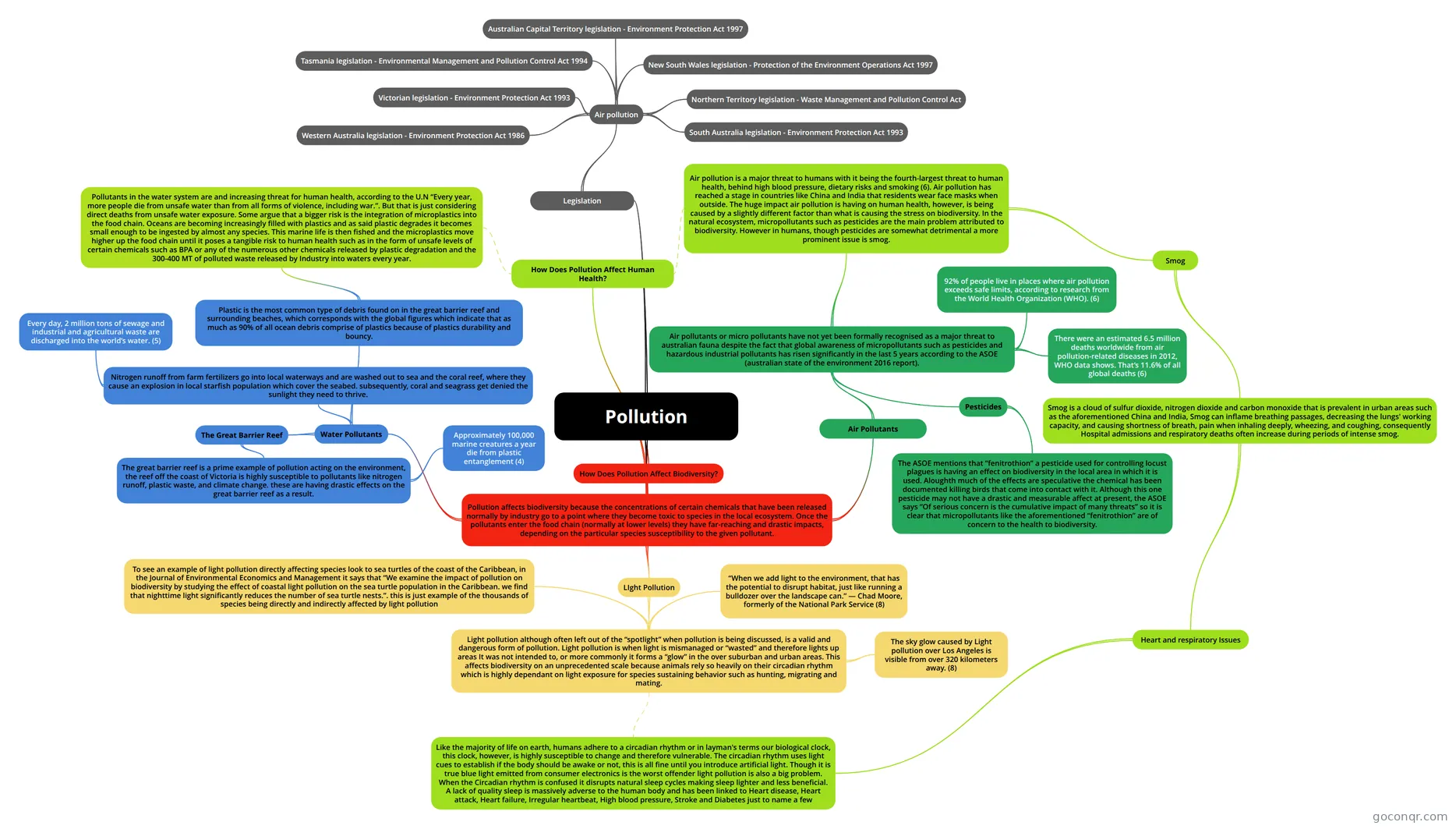
Mind map: Pollution and biodiversity
Map content
Pollution
Pollution affects biodiversity because the concentrations of certain chemicals that have been released normally by industry go to a point where they become toxic to species in the local ecosystem. Once the pollutants enter the food chain (normally at lower levels) they have far-reaching and drastic impacts, depending on the particular species susceptibility to the given pollutant.
- Air Pollutants
- Air pollutants or micro pollutants have not yet been formally recognised as a major threat to australian fauna despite the fact that global awareness of micropollutants such as pesticides and hazardous industrial pollutants has risen significantly in the last 5 years according to the ASOE (australian state of the environment 2016 report).
- Pesticides
- The ASOE mentions that “fenitrothion” a pesticide used for controlling locust plagues is having an effect on biodiversity in the local area in which it is used. Aloughth much of the effects are speculative the chemical has been documented killing birds that come into contact with it. Although this one pesticide may not have a drastic and measurable affect at present, the ASOE says “Of serious concern is the cumulative impact of many threats” so it is clear that micropollutants like the aforementioned “fenitrothion” are of concern to the health to biodiversity.
- 92% of people live in places where air pollution exceeds safe limits, according to research from the World Health Organization (WHO). (6)
- There were an estimated 6.5 million deaths worldwide from air pollution-related diseases in 2012, WHO data shows. That’s 11.6% of all global deaths (6)
- Air pollution is a major threat to humans with it being the fourth-largest threat to human health, behind high blood pressure, dietary risks and smoking (6). Air pollution has reached a stage in countries like China and India that residents wear face masks when outside. The huge impact air pollution is having on human health, however, is being caused by a slightly different factor than what is causing the stress on biodiversity. In the natural ecosystem, micropollutants such as pesticides are the main problem attributed to biodiversity. However in humans, though pesticides are somewhat detrimental a more prominent issue is smog.
- Smog
- Smog is a cloud of sulfur dioxide, nitrogen dioxide and carbon monoxide that is prevalent in urban areas such as the aforementioned China and India, Smog can inflame breathing passages, decreasing the lungs' working capacity, and causing shortness of breath, pain when inhaling deeply, wheezing, and coughing, consequently Hospital admissions and respiratory deaths often increase during periods of intense smog.
- Heart and respiratory Issues
- Like the majority of life on earth, humans adhere to a circadian rhythm or in layman's terms our biological clock, this clock, however, is highly susceptible to change and therefore vulnerable. The circadian rhythm uses light cues to establish if the body should be awake or not, this is all fine until you introduce artificial light. Though it is true blue light emitted from consumer electronics is the worst offender light pollution is also a big problem. When the Circadian rhythm is confused it disrupts natural sleep cycles making sleep lighter and less beneficial. A lack of quality sleep is massively adverse to the human body and has been linked to Heart disease, Heart attack, Heart failure, Irregular heartbeat, High blood pressure, Stroke and Diabetes just to name a few
- Heart and respiratory Issues
- Smog is a cloud of sulfur dioxide, nitrogen dioxide and carbon monoxide that is prevalent in urban areas such as the aforementioned China and India, Smog can inflame breathing passages, decreasing the lungs' working capacity, and causing shortness of breath, pain when inhaling deeply, wheezing, and coughing, consequently Hospital admissions and respiratory deaths often increase during periods of intense smog.
- Smog
- Pesticides
- Air pollutants or micro pollutants have not yet been formally recognised as a major threat to australian fauna despite the fact that global awareness of micropollutants such as pesticides and hazardous industrial pollutants has risen significantly in the last 5 years according to the ASOE (australian state of the environment 2016 report).
- Water Pollutants
- The Great Barrier Reef
- The great barrier reef is a prime example of pollution acting on the environment, the reef off the coast of Victoria is highly susceptible to pollutants like nitrogen runoff, plastic waste, and climate change. these are having drastic effects on the great barrier reef as a result.
- Approximately 100,000 marine creatures a year die from plastic entanglement (4)
- The great barrier reef is a prime example of pollution acting on the environment, the reef off the coast of Victoria is highly susceptible to pollutants like nitrogen runoff, plastic waste, and climate change. these are having drastic effects on the great barrier reef as a result.
- Plastic is the most common type of debris found on in the great barrier reef and surrounding beaches, which corresponds with the global figures which indicate that as much as 90% of all ocean debris comprise of plastics because of plastics durability and bouncy.
- Pollutants in the water system are and increasing threat for human health, according to the U.N “Every year, more people die from unsafe water than from all forms of violence, including war.”. But that is just considering direct deaths from unsafe water exposure. Some argue that a bigger risk is the integration of microplastics into the food chain. Oceans are becoming increasingly filled with plastics and as said plastic degrades it becomes small enough to be ingested by almost any species. This marine life is then fished and the microplastics move higher up the food chain until it poses a tangible risk to human health such as in the form of unsafe levels of certain chemicals such as BPA or any of the numerous other chemicals released by plastic degradation and the 300-400 MT of polluted waste released by Industry into waters every year.
- Nitrogen runoff from farm fertilizers go into local waterways and are washed out to sea and the coral reef, where they cause an explosion in local starfish population which cover the seabed. subsequently, coral and seagrass get denied the sunlight they need to thrive.
- Every day, 2 million tons of sewage and industrial and agricultural waste are discharged into the world’s water. (5)
- The Great Barrier Reef
- LIght Pollution
- Light pollution although often left out of the “spotlight” when pollution is being discussed, is a valid and dangerous form of pollution. Light pollution is when light is mismanaged or “wasted” and therefore lights up areas It was not intended to, or more commonly it forms a “glow” in the over suburban and urban areas. This affects biodiversity on an unprecedented scale because animals rely so heavily on their circadian rhythm which is highly dependant on light exposure for species sustaining behavior such as hunting, migrating and mating.
- To see an example of light pollution directly affecting species look to sea turtles of the coast of the Caribbean, in the Journal of Environmental Economics and Management it says that “We examine the impact of pollution on biodiversity by studying the effect of coastal light pollution on the sea turtle population in the Caribbean. we find that nighttime light significantly reduces the number of sea turtle nests.”. this is just example of the thousands of species being directly and indirectly affected by light pollution
- “When we add light to the environment, that has the potential to disrupt habitat, just like running a bulldozer over the landscape can.” — Chad Moore, formerly of the National Park Service (8)
- The sky glow caused by Light pollution over Los Angeles is visible from over 320 kilometers away. (8)
- Light pollution although often left out of the “spotlight” when pollution is being discussed, is a valid and dangerous form of pollution. Light pollution is when light is mismanaged or “wasted” and therefore lights up areas It was not intended to, or more commonly it forms a “glow” in the over suburban and urban areas. This affects biodiversity on an unprecedented scale because animals rely so heavily on their circadian rhythm which is highly dependant on light exposure for species sustaining behavior such as hunting, migrating and mating.
- How Does Pollution Affect Human Health?
- Air Pollutants
How Does Pollution Affect Biodiversity?
Legislation
- Air pollution
- South Australia legislation - Environment Protection Act 1993
- Northern Territory legislation - Waste Management and Pollution Control Act
- New South Wales legislation - Protection of the Environment Operations Act 1997
- Australian Capital Territory legislation - Environment Protection Act 1997
- Tasmania legislation - Environmental Management and Pollution Control Act 1994
- Victorian legislation - Environment Protection Act 1993
- Western Australia legislation - Environment Protection Act 1986
- Air pollution
Information
- Description
- Mind Map on Pollution, created by Tate Edwards-Young on 27/03/2018.
- Created by
- Tate Edwards-Young
- Views
- 4
- Rating