
Mind map
Legislation
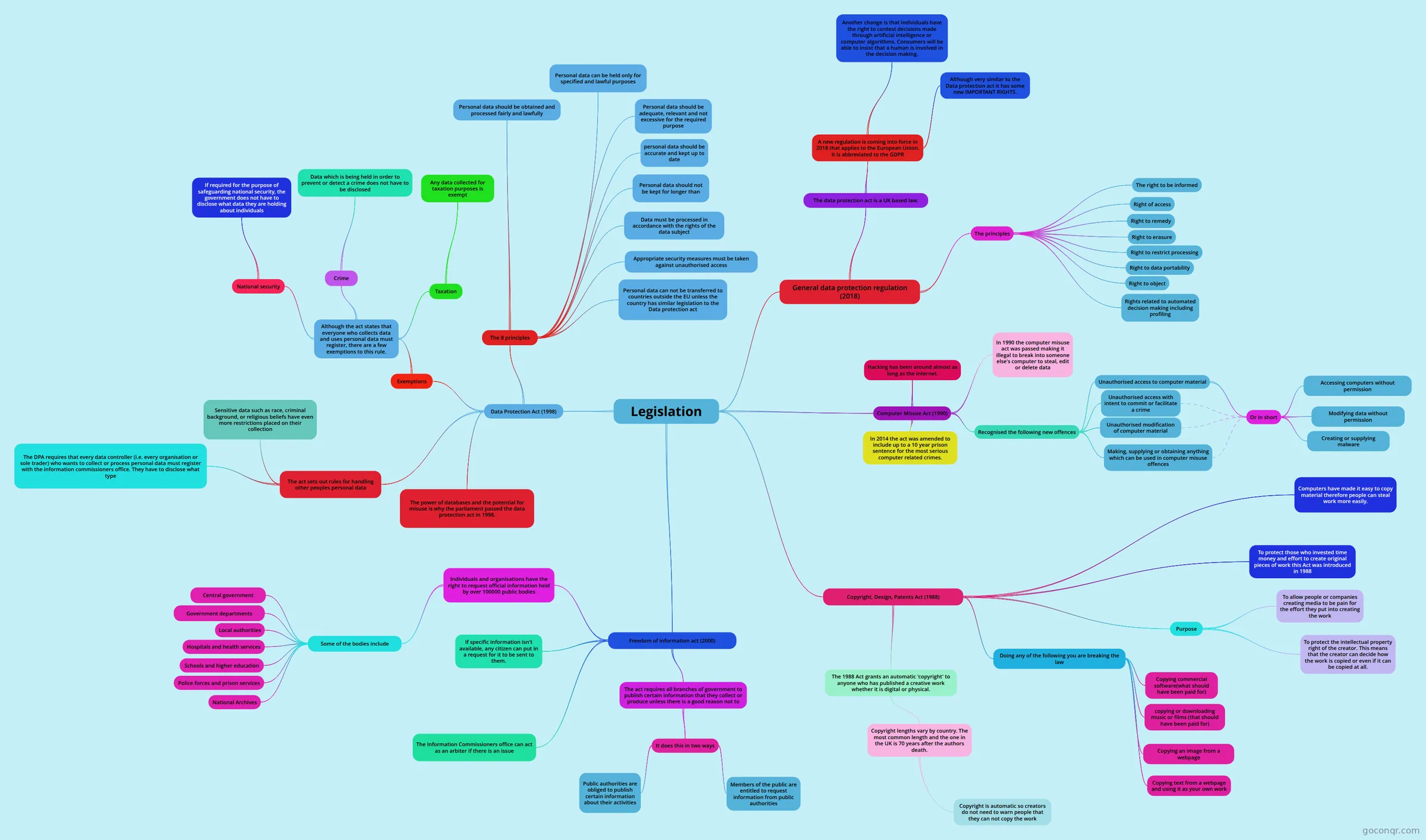
Mind map: Legislation
Map content
Legislation
Data Protection Act (1998)
- The power of databases and the potential for misuse is why the parliament passed the data protection act in 1998.
- The act sets out rules for handling other peoples personal data
- The DPA requires that every data controller (i.e. every organisation or sole trader) who wants to collect or process personal data must register with the information commissioners office. They have to disclose what type
- Sensitive data such as race, criminal background, or religious beliefs have even more restrictions placed on their collection
- Exemptions
- Although the act states that everyone who collects data and uses personal data must register, there are a few exemptions to this rule.
- National security
- If required for the purpose of safeguarding national security, the government does not have to disclose what data they are holding about individuals
- Crime
- Data which is being held in order to prevent or detect a crime does not have to be disclosed
- Taxation
- Any data collected for taxation purposes is exempt
- National security
- Although the act states that everyone who collects data and uses personal data must register, there are a few exemptions to this rule.
- The 8 principles
- Personal data should be obtained and processed fairly and lawfully
- Personal data can be held only for specified and lawful purposes
- Personal data should be adequate, relevant and not excessive for the required purpose
- personal data should be accurate and kept up to date
- Personal data should not be kept for longer than
- Data must be processed in accordance with the rights of the data subject
- Appropriate security measures must be taken against unauthorised access
- Personal data can not be transferred to countries outside the EU unless the country has similar legislation to the Data protection act
General data protection regulation (2018)
- The data protection act is a UK based law.
- A new regulation is coming into force in 2018 that applies to the European Union. It is abbreviated to the GDPR
- Although very similar to the Data protection act it has some new IMPORTANT RIGHTS.
- Another change is that individuals have the right to contest decisions made through artificial intelligence or computer algorithms. Consumers will be able to insist that a human is involved in the decision making.
- A new regulation is coming into force in 2018 that applies to the European Union. It is abbreviated to the GDPR
- The principles
- The right to be informed
- Right of access
- Right to remedy
- Right to erasure
- Right to restrict processing
- Right to data portability
- Right to object
- Rights related to automated decision making including profiling
- The data protection act is a UK based law.
Computer Misuse Act (1990)
- Hacking has been around almost as long as the internet.
- In 1990 the computer misuse act was passed making it illegal to break into someone else's computer to steal, edit or delete data
- Recognised the following new offences
- Unauthorised access to computer material
- Or in short
- Accessing computers without permission
- Modifying data without permission
- Creating or supplying malware
- Or in short
- Unauthorised access with intent to commit or facilitate a crime
- Unauthorised modification of computer material
- Making, supplying or obtaining anything which can be used in computer misuse offences
- Unauthorised access to computer material
- In 2014 the act was amended to include up to a 10 year prison sentence for the most serious computer related crimes.
Copyright, Design, Patents Act (1988)
- Computers have made it easy to copy material therefore people can steal work more easily.
- To protect those who invested time money and effort to create original pieces of work this Act was introduced in 1988
- Purpose
- To allow people or companies creating media to be pain for the effort they put into creating the work
- To protect the intellectual property right of the creator. This means that the creator can decide how the work is copied or even if it can be copied at all.
- The 1988 Act grants an automatic 'copyright' to anyone who has published a creative work whether it is digital or physical.
- Copyright lengths vary by country. The most common length and the one in the UK is 70 years after the authors death.
- Copyright is automatic so creators do not need to warn people that they can not copy the work
- Copyright lengths vary by country. The most common length and the one in the UK is 70 years after the authors death.
- Doing any of the following you are breaking the law
- Copying commercial software(what should have been paid for)
- copying or downloading music or films (that should have been paid for)
- Copying an image from a webpage
- Copying text from a webpage and using it as your own work
Freedom of information act (2000)
- Individuals and organisations have the right to request official information held by over 100000 public bodies
- Some of the bodies include
- Central government
- Government departments
- Local authorities
- Hospitals and health services
- Schools and higher education
- Police forces and prison services
- National Archives
- Some of the bodies include
- The act requires all branches of government to publish certain information that they collect or produce unless there is a good reason not to
- It does this in two ways
- Public authorities are obliged to publish certain information about their activities
- Members of the public are entitled to request information from public authorities
- It does this in two ways
- If specific information isn't available, any citizen can put in a request for it to be sent to them.
- The Information Commissioners office can act as an arbiter if there is an issue
- Individuals and organisations have the right to request official information held by over 100000 public bodies
Information
- Description
- Year 10 Computing Mind Map on Legislation, created by Holly Bailey on 07/04/2018.
- Created by
- Holly Bailey
- Views
- 2
- Rating
More on Data protection and privacy