
Mind map
Co-Evolution
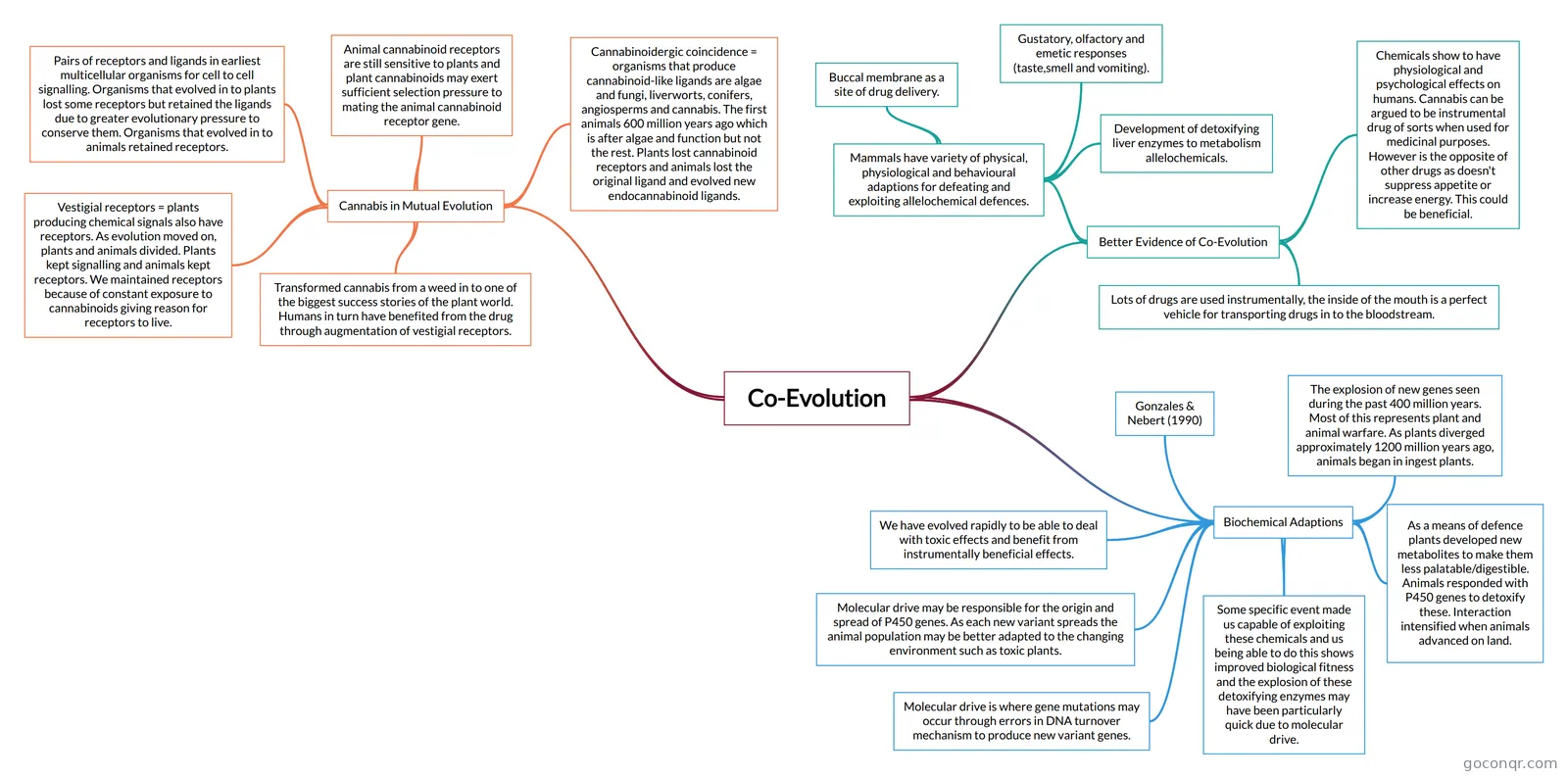
Mind map: Co-Evolution
Map content
Co-Evolution
Cannabis in Mutual Evolution
- Transformed cannabis from a weed in to one of the biggest success stories of the plant world. Humans in turn have benefited from the drug through augmentation of vestigial receptors.
- Vestigial receptors = plants producing chemical signals also have receptors. As evolution moved on, plants and animals divided. Plants kept signalling and animals kept receptors. We maintained receptors because of constant exposure to cannabinoids giving reason for receptors to live.
- Pairs of receptors and ligands in earliest multicellular organisms for cell to cell signalling. Organisms that evolved in to plants lost some receptors but retained the ligands due to greater evolutionary pressure to conserve them. Organisms that evolved in to animals retained receptors.
- Animal cannabinoid receptors are still sensitive to plants and plant cannabinoids may exert sufficient selection pressure to mating the animal cannabinoid receptor gene.
- Cannabinoidergic coincidence = organisms that produce cannabinoid-like ligands are algae and fungi, liverworts, conifers, angiosperms and cannabis. The first animals 600 million years ago which is after algae and function but not the rest. Plants lost cannabinoid receptors and animals lost the original ligand and evolved new endocannabinoid ligands.
Better Evidence of Co-Evolution
- Mammals have variety of physical, physiological and behavioural adaptions for defeating and exploiting allelochemical defences.
- Buccal membrane as a site of drug delivery.
- Gustatory, olfactory and emetic responses (taste,smell and vomiting).
- Development of detoxifying liver enzymes to metabolism allelochemicals.
- Chemicals show to have physiological and psychological effects on humans. Cannabis can be argued to be instrumental drug of sorts when used for medicinal purposes. However is the opposite of other drugs as doesn't suppress appetite or increase energy. This could be beneficial.
- Lots of drugs are used instrumentally, the inside of the mouth is a perfect vehicle for transporting drugs in to the bloodstream.
- Mammals have variety of physical, physiological and behavioural adaptions for defeating and exploiting allelochemical defences.
Biochemical Adaptions
- Gonzales & Nebert (1990)
- The explosion of new genes seen during the past 400 million years. Most of this represents plant and animal warfare. As plants diverged approximately 1200 million years ago, animals began in ingest plants.
- As a means of defence plants developed new metabolites to make them less palatable/digestible. Animals responded with P450 genes to detoxify these. Interaction intensified when animals advanced on land.
- Some specific event made us capable of exploiting these chemicals and us being able to do this shows improved biological fitness and the explosion of these detoxifying enzymes may have been particularly quick due to molecular drive.
- Molecular drive is where gene mutations may occur through errors in DNA turnover mechanism to produce new variant genes.
- Molecular drive may be responsible for the origin and spread of P450 genes. As each new variant spreads the animal population may be better adapted to the changing environment such as toxic plants.
- We have evolved rapidly to be able to deal with toxic effects and benefit from instrumentally beneficial effects.
Information
- Description
- Mind Map on Co-Evolution, created by Ella Kimmings on 13/05/2018.
- Created by
- Ella Kimmings
- Views
- 0
- Rating