
Mind map
0 Statistics 0
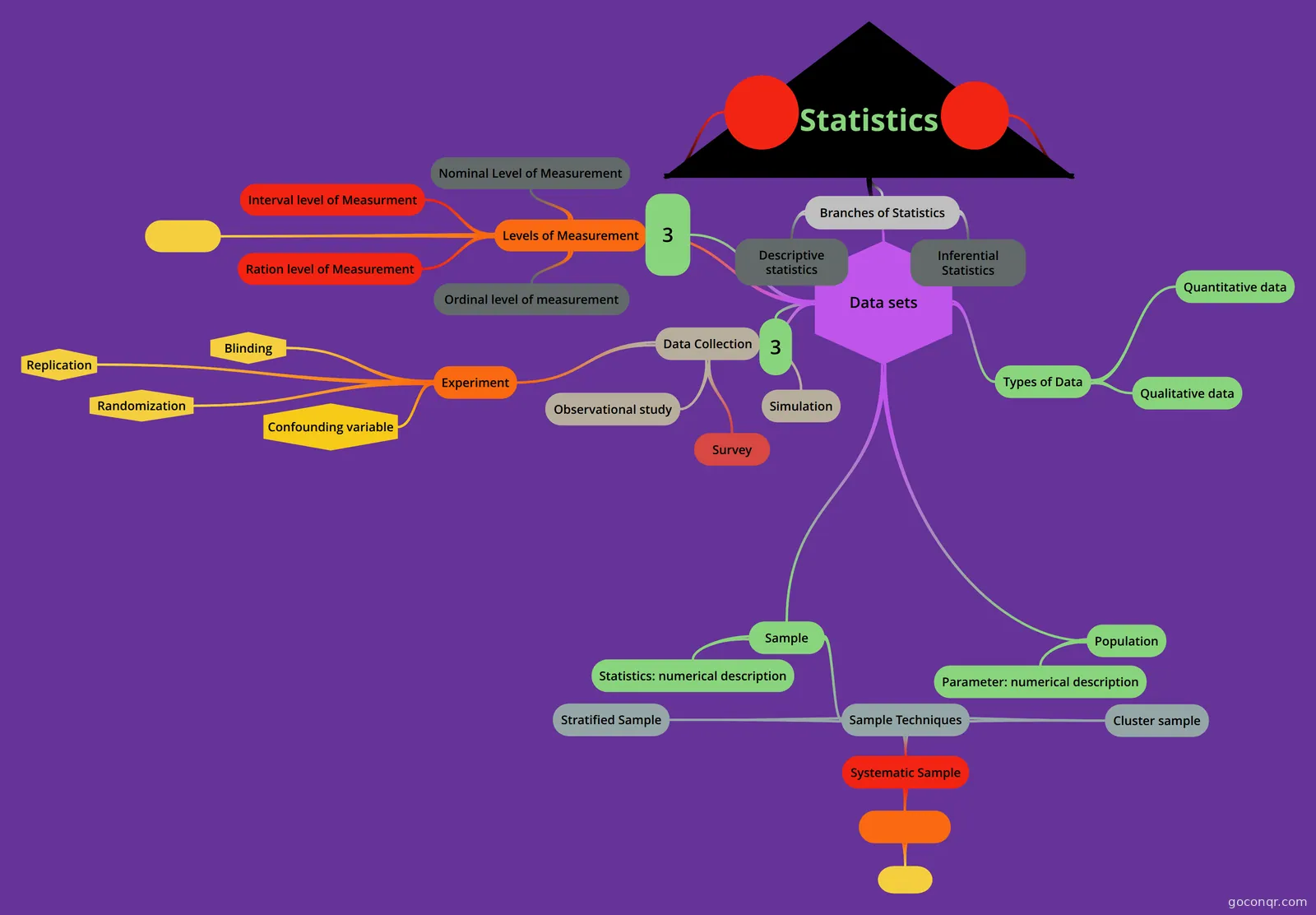
Mind map: statistics
Map content
0 Statistics 0
Data sets
- Population
- Parameter: numerical description
- Sample
- Statistics: numerical description
- Sample Techniques
- Stratified Sample
- Members or the population are divided into two or more subsets, then a sample is randomly selected from each subset.
- Cluster sample
- When the population naturally falls into subgroups, then divide into clusters.
- Systematic Sample
- Each member of the population is assigned a number, then they are ordered in some way and a random number is selected, then members are selected through regular intervals.
- Stratified Sample
- Types of Data
- Qualitative data
- Attributes, labels, or nonnumerical entries.
- Quantitative data
- Numerical measurements or counts
- Qualitative data
- Levels of Measurement
- Nominal Level of Measurement
- Qualitative only.
- Ordinal level of measurement
- Qualitative or Quantitative
- Interval level of Measurment
- can be ordered, meaningful differences between data entries can be calculated.
- Ration level of Measurement
- zero entry is an inherent zero
- Nominal Level of Measurement
- Data Collection
- Observational study
- Researcher observes but does not change the existing conditions.
- Experiment
- A Treatment is applied to a part of the population and responses are observed.
- Confounding variable
- Occurs when an experimenter cannot tell the difference between the effects of different factors on a variable.
- Blinding
- The subjects do not know whether they are receiving a treatment or a placebo.
- Randomization
- Is a process of randomly assigning subjects to different treatment groups.
- Replication
- Repetition of experiment.
- Simulation
- Mathematical or Physical model to reproduce the conditions of a situation or process.
- Survey
- Investigation of one or more characteristics of a population.
- Observational study
- 3
- 3
- Population
Branches of Statistics
- Descriptive statistics
- organization, summarization, and display of data
- Inferential Statistics
- involves using a sample to draw conclusions about a population.
- Descriptive statistics
Information
- Description
- science of collecting and interpreting data for a use
- Created by
- David Romero
- Views
- 11
- Rating