
Mind map
Matter
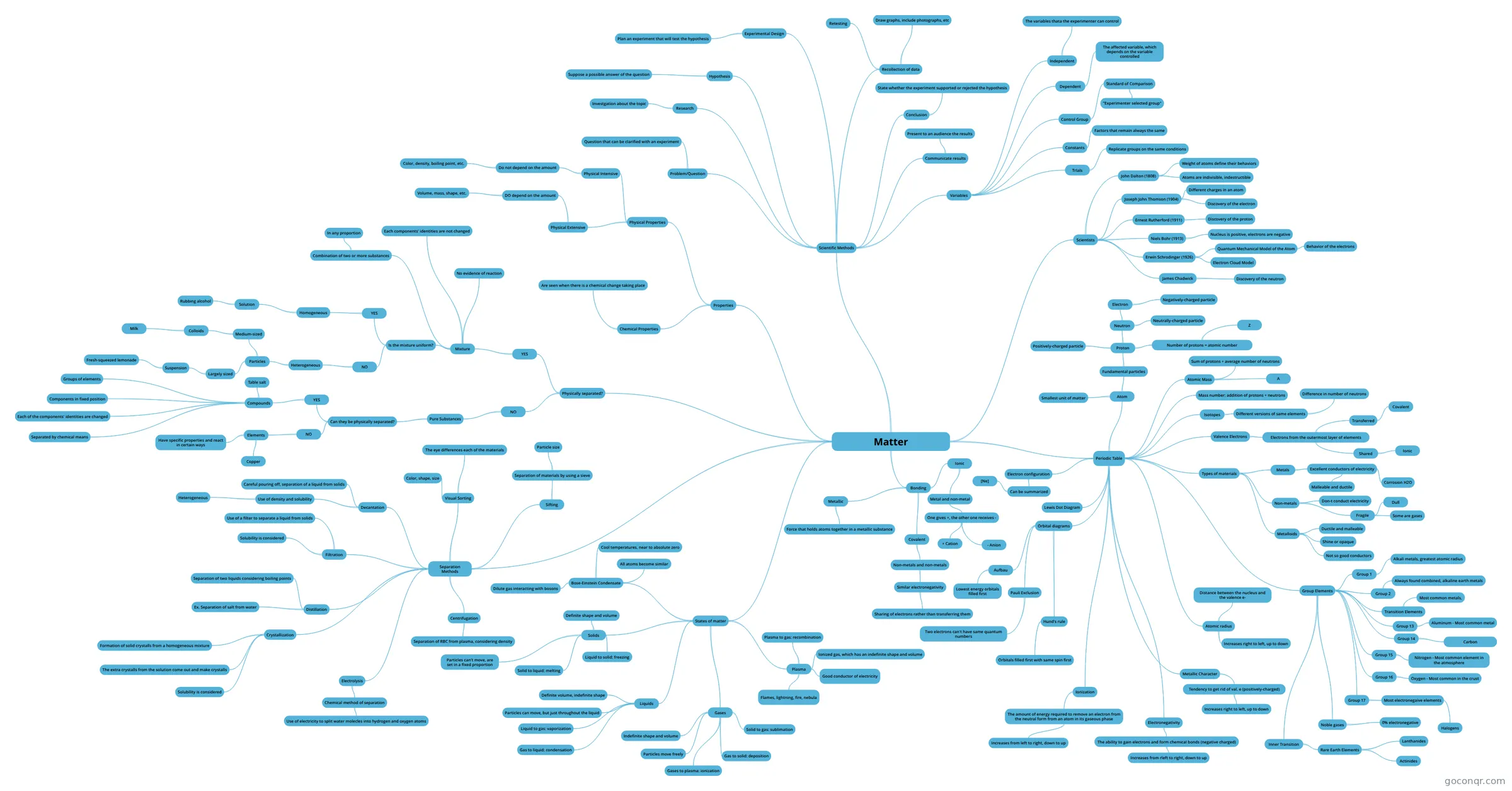
Mind map: Matter
Map content
Matter
States of matter
- Bose-Einstein Condensate
- Cool temperatures, near to absolute zero
- All atoms become similar
- Dilute gas interacting with bosons
- Solids
- Definite shape and volume
- Particles can't move, are set in a fixed proportion
- Solid to liquid: melting
- Liquid to solid: freezing
- Liquids
- Definite volume, indefinite shape
- Particles can move, but just throughout the liquid
- Liquid to gas: vaporization
- Gas to liquid: condensation
- Gases
- Indefinite shape and volume
- Particles move freely
- Gases to plasma: ionization
- Gas to solid: deposition
- Solid to gas: sublimation
- Plasma
- Plasma to gas: recombination
- Ionized gas, which has an indefinite shape and volume
- Good conductor of electricity
- Flames, lightning, fire, nebula
- Bose-Einstein Condensate
Separation Methods
- Sifting
- Separation of materials by using a sieve
- Particle size
- Separation of materials by using a sieve
- Visual Sorting
- Color, shape, size
- The eye differences each of the materials
- Decantation
- Careful pouring off, separation of a liquid from solids
- Use of density and solubility
- Heterogeneous
- Filtration
- Use of a filter to separate a liquid from solids
- Solubility is considered
- Distillation
- Separation of two liquids considering boiling points
- Ex. Separation of salt from water
- Crystallization
- Formation of solid crystalls from a homogeneous mixture
- The extra crystalls from the solution come out and make crystalls
- Solubility is considered
- Centrifugation
- Separation of RBC from plasma, considering density
- Electrolysis
- Chemical method of separation
- Use of electricity to split water molecles into hydrogen and oxygen atoms
- Chemical method of separation
- Sifting
Properties
- Chemical Properties
- Are seen when there is a chemical change taking place
- Physical Properties
- Physical Intensive
- Do not depend on the amount
- Color, density, boiling point, etc.
- Do not depend on the amount
- Physical Extensive
- DO depend on the amount
- Volume, mass, shape, etc.
- DO depend on the amount
- Physical Intensive
- Chemical Properties
Physically separated?
- YES
- Mixture
- Is the mixture uniform?
- YES
- Homogeneous
- Solution
- Rubbing alcohol
- Solution
- Homogeneous
- NO
- Heterogeneous
- Particles
- Medium-sized
- Colloids
- Milk
- Colloids
- Largely sized
- Suspension
- Fresh-squeezed lemonade
- Suspension
- Medium-sized
- Particles
- Heterogeneous
- YES
- Combination of two or more substances
- In any proportion
- Each components' identities are not changed
- No evidence of reaction
- Is the mixture uniform?
- Mixture
- NO
- Pure Substances
- Can they be physically separated?
- YES
- Compounds
- Groups of elements
- Table salt
- Components in fixed position
- Each of the components' identities are changed
- Separated by chemical means
- Compounds
- NO
- Elements
- Have specific properties and react in certain ways
- Copper
- Elements
- YES
- Can they be physically separated?
- Pure Substances
- YES
Scientific Methods
- Problem/Question
- Question that can be clarified with an experiment
- Research
- Investgation about the topic
- Hypothesis
- Suppose a possible answer of the question
- Experimental Design
- Plan an experiment that will test the hypothesis
- Recollection of data
- Retesting
- Draw graphs, include photographs, etc
- Conclusion
- State whether the experiment supported or rejected the hypothesis
- Communicate results
- Present to an audience the results
- Variables
- Independent
- The variables thata the experimenter can control
- Dependent
- The affected variable, which depends on the variable controlled
- Control Group
- Standard of Comparison
- "Experimenter selected group"
- Standard of Comparison
- Constants
- Factors that remain always the same
- TrIals
- Replicate groups on the same conditions
- Independent
- Problem/Question
Scientists
- John Dalton (1808)
- Weight of atoms define their behaviors
- Atoms are indivisible, indestructible
- Joseph John Thomson (1904)
- Discovery of the electron
- Different charges in an atom
- Ernest Rutherford (1911)
- Discovery of the proton
- Niels Bohr (1913)
- Nucleus is positive, electrons are negative
- Erwin Schrodinger (1926)
- Quantum Mechanical Model of the Atom
- Behavior of the electrons
- Electron Cloud Model
- Quantum Mechanical Model of the Atom
- James Chadwick
- Discovery of the neutron
- John Dalton (1808)
Periodic Table
- Atom
- Smallest unit of matter
- Fundamental particles
- Proton
- Neutron
- Electron
- Negatively-charged particle
- Neutrally-charged particle
- Electron
- Number of protons = atomic number
- Z
- Positively-charged particle
- Neutron
- Proton
- Atomic Mass
- Sum of protons + average number of neutrons
- A
- Mass number: addition of protons + neutrons
- Isotopes
- Different versions of same elements
- Difference in number of neutrons
- Different versions of same elements
- Valence Electrons
- Electrons from the outermost layer of elements
- Transferred
- Covalent
- Shared
- Ionic
- Transferred
- Electrons from the outermost layer of elements
- Types of materials
- Metals
- Excellent conductors of electricity
- Malleable and ductile
- Corrosion H2O
- Excellent conductors of electricity
- Non-metals
- Don-t conduct electricity
- Fragile
- Dull
- Some are gases
- Metalloids
- Ductile and malleable
- Not so good conductors
- Shine or opaque
- Metals
- Group Elements
- Group 1
- Alkali metals, greatest atomic radius
- Group 2
- Always found combined, alkaline earth metals
- Transition Elements
- Most common metals,
- Group 14
- Carbon
- Group 15
- Nitrogen - Most common element in the atmosphere
- Group 16
- Oxygen - Most common in the crust
- Group 17
- Most electronegaive elements
- Halogens
- Most electronegaive elements
- Noble gases
- 0% electronegative
- Inner Transition
- Rare Earth Elements
- Actinides
- Lanthanides
- Rare Earth Elements
- Group 13
- Aluminum - Most common metal
- Group 1
- Atomic radius
- Distance between the nucleus and the valence e-
- Increases right to left, up to down
- Metallic Character
- Tendency to get rid of val. e (positively-charged)
- Increases right to left, up to down
- Tendency to get rid of val. e (positively-charged)
- Electronegativity
- The ability to gain electrons and form chemical bonds (negative charged)
- Increases from rleft to right, down to up
- The ability to gain electrons and form chemical bonds (negative charged)
- Ionization
- The amount of energy required to remove an electron from the neutral form from an atom in its gaseous phase
- Increases from left to right, down to up
- The amount of energy required to remove an electron from the neutral form from an atom in its gaseous phase
- Electron configuration
- Can be summarized
- [Ne]
- Can be summarized
- Orbital diagrams
- Aufbau
- Lowest energy orbitals filled first
- Pauli Exclusion
- Two electrons can't have same quantum numbers
- Hund's rule
- Orbitals filled first with same spin first
- Aufbau
- Lewis Dot Diagram
- Atom
Bonding
- Ionic
- Metal and non-metal
- One gives +, the other one receives -
- + Cation
- - Anion
- One gives +, the other one receives -
- Metal and non-metal
- Covalent
- Non-metals and non-metals
- Similar electronegativity
- Sharing of electrons rather than transferring them
- Similar electronegativity
- Non-metals and non-metals
- Metallic
- Force that holds atoms together in a metallic substance
- Ionic
Information
- Description
- Mind Map on Matter, created by Daniel Muzza on 13/09/2018.
- Created by
- Daniel Muzza
- Views
- 0
- Rating