
Mind map
MODAL VERBS
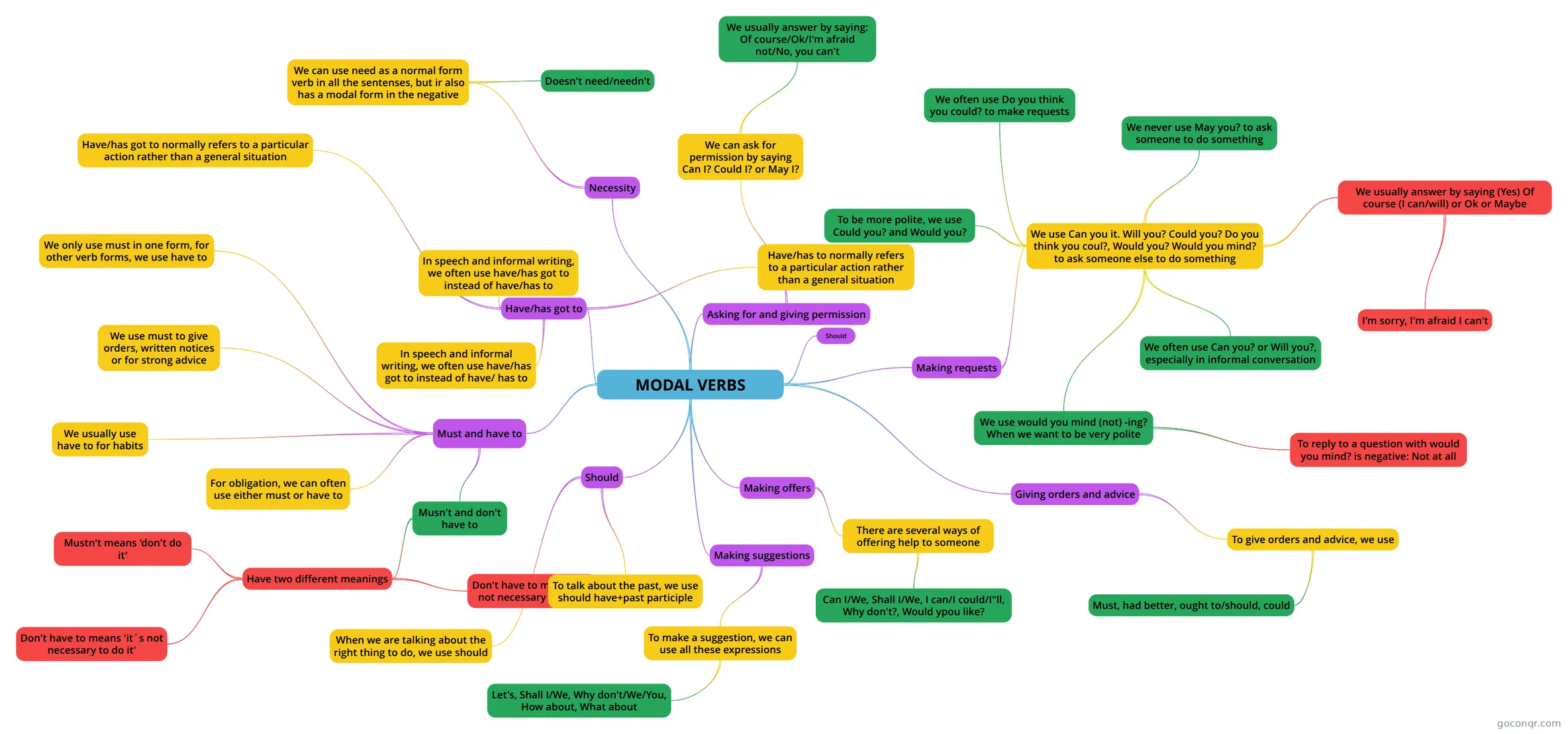
Mind map: Modal verbs
Map content
MODAL VERBS
Must and have to
- For obligation, we can often use either must or have to
- We use must to give orders, written notices or for strong advice
- We usually use have to for habits
- We only use must in one form, for other verb forms, we use have to
- Musn't and don't have to
- Have two different meanings
- Mustn't means 'don't do it'
- Don't have to means 'it's not necessary to do it'
- Don't have to means 'it´s not necessary to do it'
- Have two different meanings
Have/has got to
- In speech and informal writing, we often use have/has got to instead of have/has to
- Have/has to normally refers to a particular action rather than a general situation
- In speech and informal writing, we often use have/has got to instead of have/ has to
- Have/has got to normally refers to a particular action rather than a general situation
Should
Making requests
- We use Can you it. Will you? Could you? Do you think you coul?, Would you? Would you mind? to ask someone else to do something
- We often use Can you? or Will you?, especially in informal conversation
- To be more polite, we use Could you? and Would you?
- We usually answer by saying (Yes) Of course (I can/will) or Ok or Maybe
- I'm sorry, I'm afraid I can't
- We often use Do you think you could? to make requests
- We never use May you? to ask someone to do something
- We use would you mind (not) -ing? When we want to be very polite
- To reply to a question with would you mind? is negative: Not at all
- We use Can you it. Will you? Could you? Do you think you coul?, Would you? Would you mind? to ask someone else to do something
Making suggestions
- To make a suggestion, we can use all these expressions
- Let's, Shall I/We, Why don't/We/You, How about, What about
- To make a suggestion, we can use all these expressions
Should
- When we are talking about the right thing to do, we use should
- To talk about the past, we use should have+past participle
Necessity
- We can use need as a normal form verb in all the sentenses, but ir also has a modal form in the negative
- Doesn't need/needn't
- We can use need as a normal form verb in all the sentenses, but ir also has a modal form in the negative
Asking for and giving permission
- We can ask for permission by saying Can I? Could I? or May I?
- We usually answer by saying: Of course/Ok/I'm afraid not/No, you can't
- We can ask for permission by saying Can I? Could I? or May I?
Making offers
- There are several ways of offering help to someone
- Can I/We, Shall I/We, I can/I could/I"ll, Why don't?, Would ypou like?
- There are several ways of offering help to someone
Giving orders and advice
- To give orders and advice, we use
- Must, had better, ought to/should, could
- To give orders and advice, we use
Information
- Description
- Mind Map on MODAL VERBS, created by diana luis on 30/09/2018.
- Created by
- diana luis
- Views
- 2
- Rating