
Mind map
Fluid and Electrolyte Balance
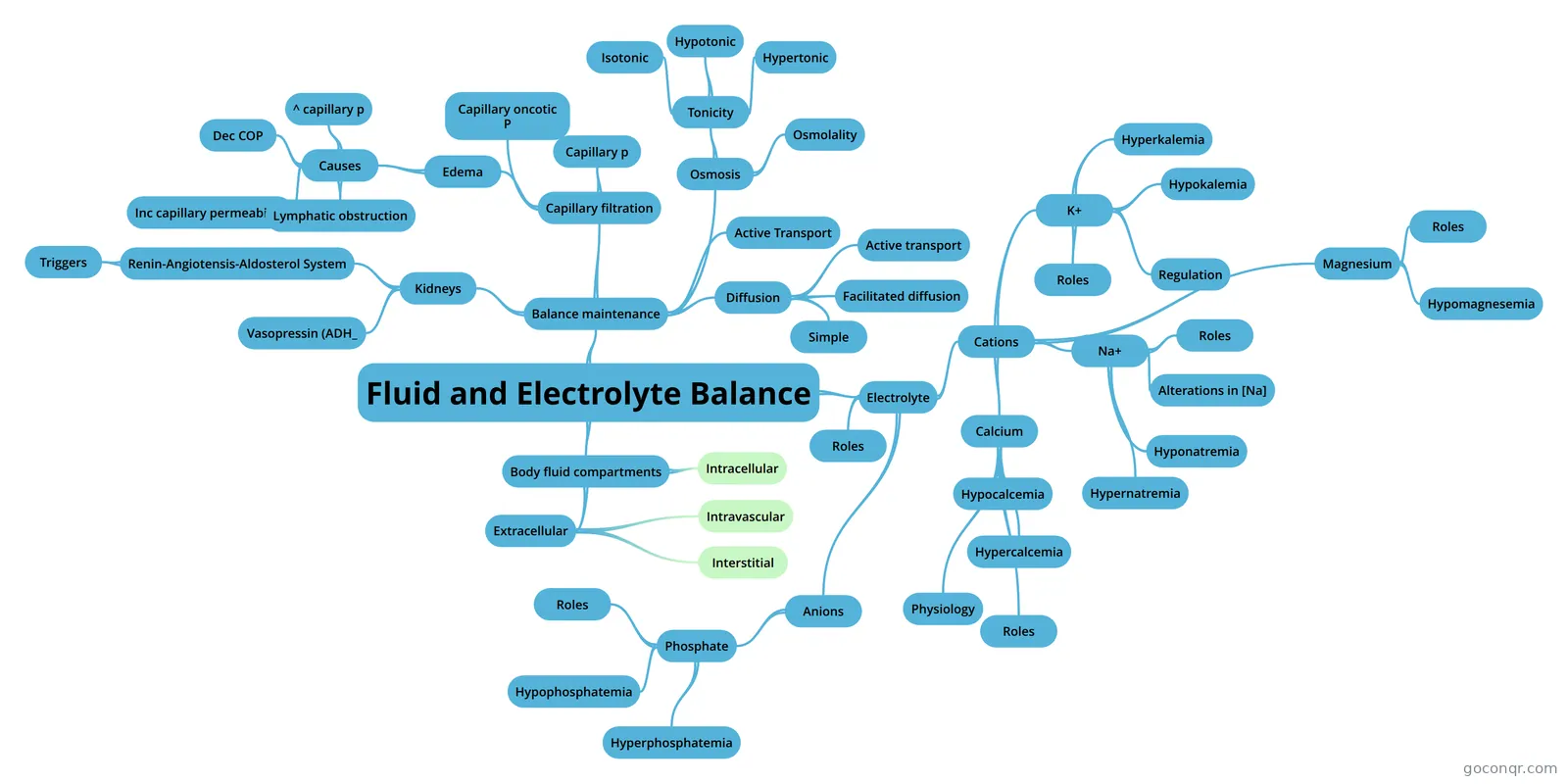
Mind map: Fluid and electrolyte balance
Map content
Fluid and Electrolyte Balance
- -Almost all disease process and ther interve
Body fluid compartments
- Separated by semipermiable membranes
- Intracellular
- -Fluid within cells -28/40L in body, 40% body weight
- Extracellular
- Intravascular
- Fluid in blood vessels
- Interstitial
- -Between body cells, more like gel -10L (14%)
- Intravascular
Electrolyte
- -Add up to electrical neutrality within compartments
- Cations
- Major: H+, Na+, K+, Ca2+, Mg2+
- K+
- Extracellular: 4 mEq/L Intracelluar: 150 mEq/L There's more IN the cell
- Roles
- -Maintains intracellular osmolality -Neuromuscular contraction
- Regulation
- -Kidneys play most important part (where excreted) -Na/K pump -Insulin (trainsport to intracelluar) -pH
- Hypokalemia
- -Causes: inadequate intake -s/s: don't develop until severe -Heart irritable when not enough K+ (delayed repolarization)
- Hyperkalemia
- -Unable to excrete K+ (renal failure), ACE inhibitors, crushing injury
- Na+
- Extracellular: 140 mEq/L Intracelluar: 10 mEq/L More OUT of the cell
- Roles
- Alterations in [Na]
- Hyponatremia
- Causes: excessive loss of Na or dilutional from water gain -Cells swell
- Hypernatremia
- -Causes: net loss of H20, excess intake of Na+
- Calcium
- -Regulated by parathyroid hormone and vitamin D
- Roles
- Physiology
- Hypocalcemia
- -Causes: renal failure, inadequate intake
- Hypercalcemia
- -Causes: increased bone breakdown from neoplasm, hyperparathyroidism, drugs
- Magnesium
- -
- Roles
- Hypomagnesemia
- Anions
- Major anions: PO4-, Cl-, HCO3-
- Phosphate
- Roles
- Hypophosphatemia
- Hyperphosphatemia
- -Causes: renal failure, hypoparathyroidism -S/S: same as hypocalcemia
- Roles
Balance maintenance
- -Constant exchange and replacement
- Diffusion
- Movement of particles in response to [ ] gradient
- Simple
- greater to lower concentration
- Facilitated diffusion
- Movement from greater to lower concentration gradient using a carrier protein or channel
- Active transport
- Against [ ] gradient (low to high concentration) using ATP
- Active Transport
- Osmosis
- Movement of water toward area of higher concentration
- Osmolality
- Number of particles per unit of water [ ] of particles in fluid Osmolality = 2 [Na] + Glu/18 + BUN/2.8
- Tonicity
- -aka Osmolarity of fluid (refers to fluids outside of body) -Osmotic pressure equivalent of a fluid compared to serum osmolality
- Isotonic
- -Equal to normal serum osmolality -Ex: Normal saline
- Hypotonic
- Less than normal serum osmolality .5% NaCl
- Hypertonic
- -Greater than normal osmolality -Ex: 3% NaCl
- Capillary filtration
- -Where fluids move in and out of blood vessels -Net outward force at arterial end of capillary -arterial capillary --> Interstitial space --> cells --> interstitial space --> venous capillary -Extra fluid goes into lymphatic channels
- Capillary p
- Capillary hydrostatic pressure Arterial capillary: 30mmHg going out -Hydrostatic pressure greater here Venous capillary: 10mmHg going out
- Capillary oncotic P
- Capillary colloid osmotic P created by plasma proteins (mainly albumin) -Creates a net inward force on venous end
- Edema
- -Excess fluid in interstitial space usually drains to lymphatic vessels -When there's extra fluid in interstitial space --> edema
- Causes
- ^ capillary p
- -Increased capillary hydrostatic pressure -Leads to more fluid moving into interstitial space
- Dec COP
- -Decreased colloid osmotic pressure -Less albumin, decreases amount of fluid going back into the vascular system (capillaries)
- Inc capillary permeability
- Lymphatic obstruction
- ^ capillary p
- Kidneys
- Renin-Angiotensis-Aldosterol System
- -Renin released from kidneys -LUNGS: Renin causes Angiotensinogen --> Angiotensin 1 -Release of Angiotensen 2 (potent vasoconstrictor --> raise BP) -
- Triggers
- -Low blood volume -Low renal blood flow -Low serum Na+ -High serum K+ -Physiological stress
- Vasopressin (ADH_
- -Enhances reabsorption of H2O by kidneys -Overall result: increase in water tension and volume
- Renin-Angiotensis-Aldosterol System
Information
- Description
- Mind Map on Fluid and Electrolyte Balance, created by Sasha Guimary on 26/01/2019.
- Created by
- Sasha Guimary
- Views
- 1
- Rating