
Mind map
Full-Wave Rectifier
Map content
Full-Wave Rectifier
Current
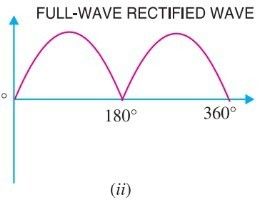
- Flows through the load in the same direction for both half-cycles of input AC voltage
- Can be achieved with two diodes working alternately
- Flows through the load in the same direction for both half-cycles of input AC voltage
Utilises both -cycles of input AC voltage to produce DC output
Circuits
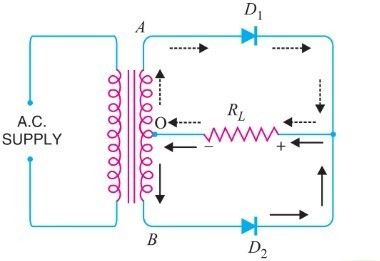
- Centre-Tap full-Wave rectifier
- Employs two diodes
- D1
- AC voltage appearing across the upper half (OA)of secondary winding for rectification
- AC voltage appearing across the upper half (OA)of secondary winding for rectification
- D2
- Uses the lower half winding OB.
- D1
- Employs two diodes
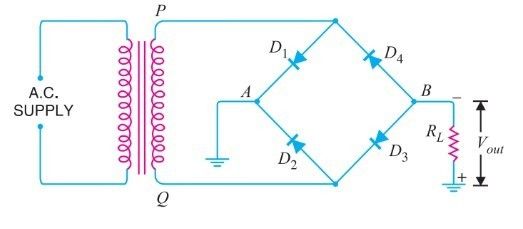
- Full-wave bridge rectifier
- It contains four diodes
- The a.c. supply to be rectified is applied to the diagonally opposite ends of the bridge through the transformer. Between other two ends of the bridge, the load resistance RL is connected.
- The a.c. supply to be rectified is applied to the diagonally opposite ends of the bridge through the transformer. Between other two ends of the bridge, the load resistance RL is connected.
- Advantages
- The need for centre-tapped transformer is eliminated.
- The output is twice that of the centre-tap circuit for the same secondary voltage.
- The PIV is one-half that of the centre-tap circuit (for same DC output).
- Disadvantages
- It requires four diodes.
- It contains four diodes
- Centre-Tap full-Wave rectifier
Output Frequency
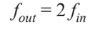
- Is the double the input frequency.
- Output frequency is twice the input frequency
- F out = 2 f in
- F out = 2 f in
- Output frequency is twice the input frequency
- Is the double the input frequency.
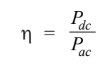
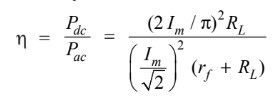
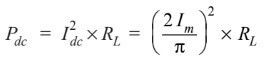
Efficiency
Images and files in the map
Information
- Description
- Mind Map on Full-Wave Rectifier, created by pablo a on 02/02/2019.
- Created by
- pablo a
- Views
- 0
- Rating