
Mind map
Amniotes
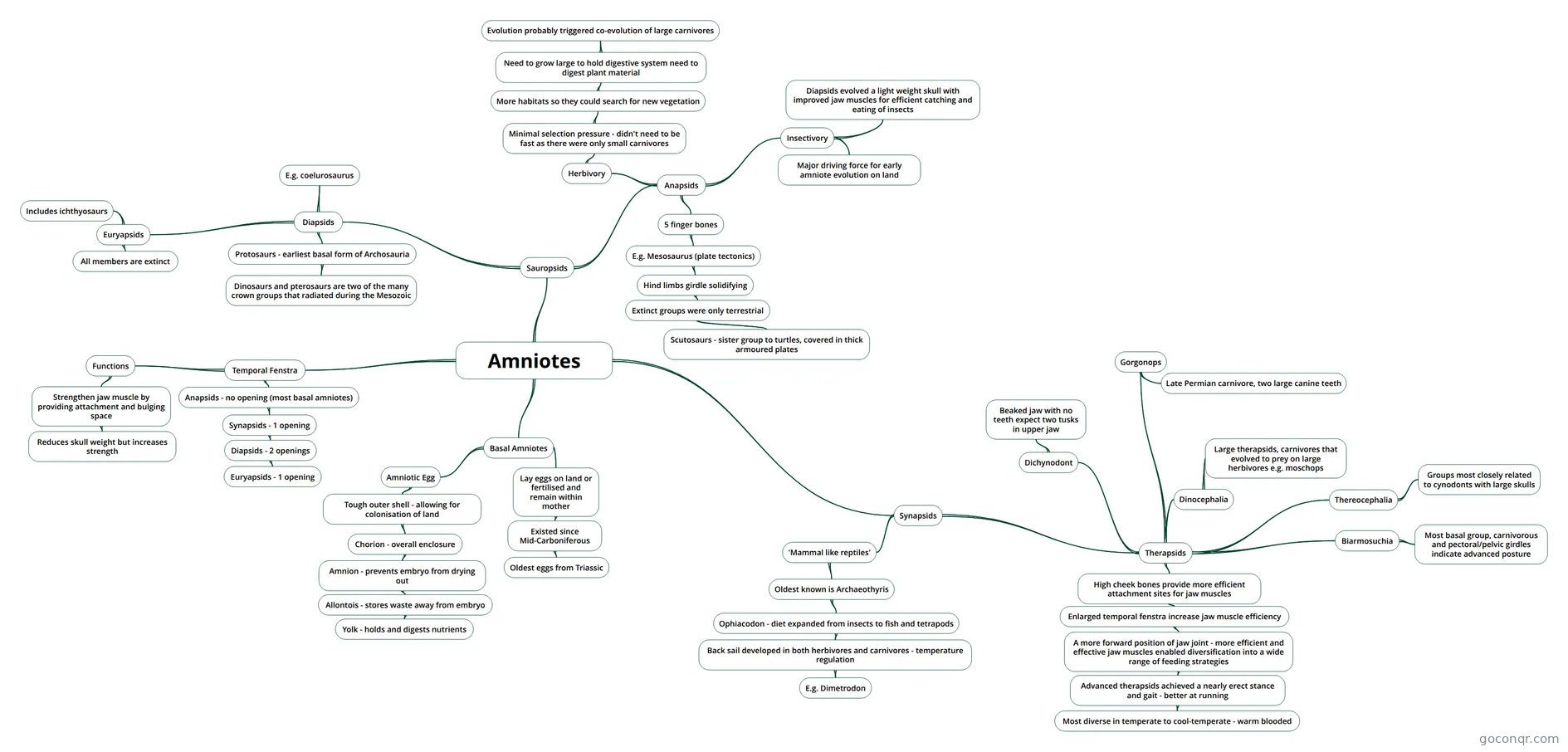
Mind map: Amniotes
Map content
Amniotes
Basal Amniotes
- Amniotic Egg
- Tough outer shell - allowing for colonisation of land
- Chorion - overall enclosure
- Amnion - prevents embryo from drying out
- Allontois - stores waste away from embryo
- Yolk - holds and digests nutrients
- Allontois - stores waste away from embryo
- Amnion - prevents embryo from drying out
- Chorion - overall enclosure
- Tough outer shell - allowing for colonisation of land
- Lay eggs on land or fertilised and remain within mother
- Existed since Mid-Carboniferous
- Oldest eggs from Triassic
- Existed since Mid-Carboniferous
- Amniotic Egg
Temporal Fenstra
- Anapsids - no opening (most basal amniotes)
- Synapsids - 1 opening
- Diapsids - 2 openings
- Euryapsids - 1 opening
- Diapsids - 2 openings
- Synapsids - 1 opening
- Functions
- Strengthen jaw muscle by providing attachment and bulging space
- Reduces skull weight but increases strength
- Strengthen jaw muscle by providing attachment and bulging space
- Anapsids - no opening (most basal amniotes)
Synapsids
- Therapsids
- Biarmosuchia
- Most basal group, carnivorous and pectoral/pelvic girdles indicate advanced posture
- Dinocephalia
- Large therapsids, carnivores that evolved to prey on large herbivores e.g. moschops
- Dichynodont
- Beaked jaw with no teeth expect two tusks in upper jaw
- Gorgonops
- Late Permian carnivore, two large canine teeth
- Thereocephalia
- Groups most closely related to cynodonts with large skulls
- High cheek bones provide more efficient attachment sites for jaw muscles
- Enlarged temporal fenstra increase jaw muscle efficiency
- A more forward position of jaw joint - more efficient and effective jaw muscles enabled diversification into a wide range of feeding strategies
- Advanced therapsids achieved a nearly erect stance and gait - better at running
- Most diverse in temperate to cool-temperate - warm blooded
- Advanced therapsids achieved a nearly erect stance and gait - better at running
- A more forward position of jaw joint - more efficient and effective jaw muscles enabled diversification into a wide range of feeding strategies
- Enlarged temporal fenstra increase jaw muscle efficiency
- Biarmosuchia
- 'Mammal like reptiles'
- Oldest known is Archaeothyris
- Ophiacodon - diet expanded from insects to fish and tetrapods
- Back sail developed in both herbivores and carnivores - temperature regulation
- E.g. Dimetrodon
- Back sail developed in both herbivores and carnivores - temperature regulation
- Ophiacodon - diet expanded from insects to fish and tetrapods
- Oldest known is Archaeothyris
- Therapsids
Sauropsids
- Anapsids
- Herbivory
- Minimal selection pressure - didn't need to be fast as there were only small carnivores
- More habitats so they could search for new vegetation
- Need to grow large to hold digestive system need to digest plant material
- Evolution probably triggered co-evolution of large carnivores
- Need to grow large to hold digestive system need to digest plant material
- More habitats so they could search for new vegetation
- Minimal selection pressure - didn't need to be fast as there were only small carnivores
- Insectivory
- Major driving force for early amniote evolution on land
- Diapsids evolved a light weight skull with improved jaw muscles for efficient catching and eating of insects
- 5 finger bones
- E.g. Mesosaurus (plate tectonics)
- Hind limbs girdle solidifying
- Extinct groups were only terrestrial
- Scutosaurs - sister group to turtles, covered in thick armoured plates
- Extinct groups were only terrestrial
- Hind limbs girdle solidifying
- E.g. Mesosaurus (plate tectonics)
- Herbivory
- Diapsids
- Euryapsids
- All members are extinct
- Includes ichthyosaurs
- E.g. coelurosaurus
- Protosaurs - earliest basal form of Archosauria
- Dinosaurs and pterosaurs are two of the many crown groups that radiated during the Mesozoic
- Euryapsids
- Anapsids
Information
- Description
- ES2266 Mind Map on Amniotes, created by Bayley Cooper on 12/02/2019.
- Created by
- Bayley Cooper
- Views
- 0
- Rating