
Mind map
Unit 1: Attachment
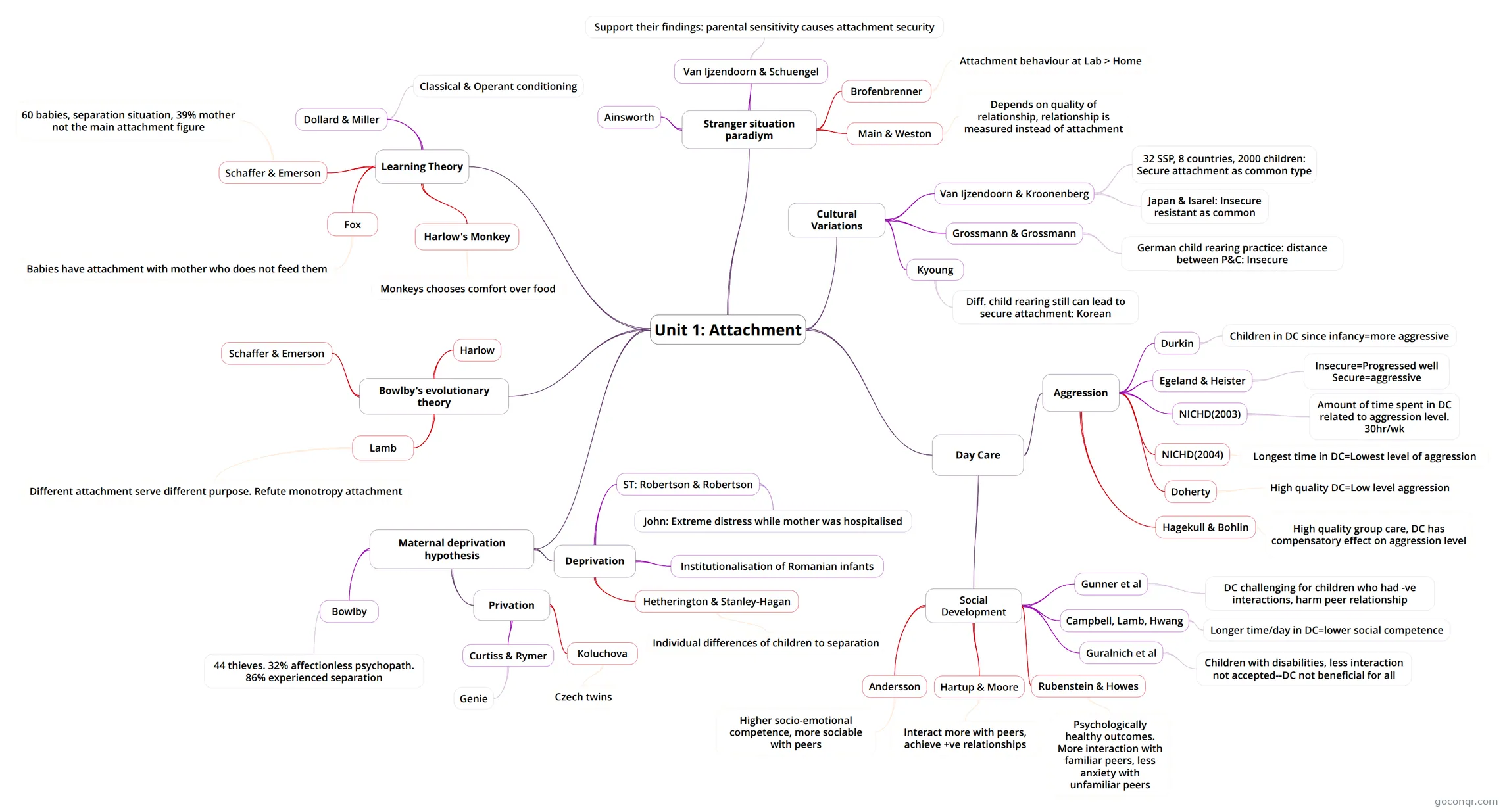
Mind map: attachment
Map content
Unit 1: Attachment
Learning Theory
- Dollard & Miller
- Classical & Operant conditioning
- Schaffer & Emerson
- 60 babies, separation situation, 39% mother not the main attachment figure
- Harlow's Monkey
- Monkeys chooses comfort over food
- Fox
- Babies have attachment with mother who does not feed them
- Dollard & Miller
Bowlby's evolutionary theory
- Harlow
- Schaffer & Emerson
- Lamb
- Different attachment serve different purpose. Refute monotropy attachment
Stranger situation paradiym
- Ainsworth
- Van Ijzendoorn & Schuengel
- Support their findings: parental sensitivity causes attachment security
- Brofenbrenner
- Attachment behaviour at Lab > Home
- Main & Weston
- Depends on quality of relationship, relationship is measured instead of attachment
Cultural Variations
- Van Ijzendoorn & Kroonenberg
- 32 SSP, 8 countries, 2000 children: Secure attachment as common type
- Japan & Isarel: Insecure resistant as common
- Kyoung
- Diff. child rearing still can lead to secure attachment: Korean
- Grossmann & Grossmann
- German child rearing practice: distance between P&C: Insecure
- Van Ijzendoorn & Kroonenberg
Maternal deprivation hypothesis
- Bowlby
- 44 thieves. 32% affectionless psychopath. 86% experienced separation
- Deprivation
- ST: Robertson & Robertson
- John: Extreme distress while mother was hospitalised
- Institutionalisation of Romanian infants
- Hetherington & Stanley-Hagan
- Individual differences of children to separation
- ST: Robertson & Robertson
- Privation
- Curtiss & Rymer
- Genie
- Koluchova
- Czech twins
- Curtiss & Rymer
- Bowlby
Day Care
- Aggression
- Durkin
- Children in DC since infancy=more aggressive
- Egeland & Heister
- Insecure=Progressed well Secure=aggressive
- NICHD(2003)
- Amount of time spent in DC related to aggression level. 30hr/wk
- NICHD(2004)
- Longest time in DC=Lowest level of aggression
- Doherty
- High quality DC=Low level aggression
- Hagekull & Bohlin
- High quality group care, DC has compensatory effect on aggression level
- Durkin
- Social Development
- Andersson
- Higher socio-emotional competence, more sociable with peers
- Hartup & Moore
- Interact more with peers, achieve +ve relationships
- Rubenstein & Howes
- Psychologically healthy outcomes. More interaction with familiar peers, less anxiety with unfamiliar peers
- Gunner et al
- DC challenging for children who had -ve interactions, harm peer relationship
- Campbell, Lamb, Hwang
- Longer time/day in DC=lower social competence
- Guralnich et al
- Children with disabilities, less interaction not accepted--DC not beneficial for all
- Andersson
- Aggression
Information
- Description
- AQA AS PsychologyA U1&2 Mind Map on Unit 1: Attachment, created by s13gwenchan on 03/12/2014.
- Created by
- s13gwenchan
- Views
- 7
- Rating