
Mind map
Week 5: Learning and Memory
Map content
Week 5: Learning and Memory
the adaptability of the sensory system, various classes of learning. mechanisms of synaptic modifications that underlie learning.
- brain approx stops learning @ 18 but neurogenesis will continue throughout adult life.
motor psychophysics = sequence learning. Pressing buttons in a particular order. when the sequence is predictable and replicates itself the RT decreases. Fast period of learning and continual reduction of RT
- when the sequence is random and prediction cannot occur, little learning takes place and RT remains stable
- simple tasks reveal important information regarding motor learning and memory. Interaction between implicit (procedural) and explicit (declarative) learning processes
- role of sleep, interference, consolidation, probabillistic learning
Motor consolidation: memories are consolidated over time (4-6hrs) Instead of RT, consider skill. The higher the skill the better you are at talk. Will performance improve over time until you attain some skill.
- if there was no consolidation or learning, each time you stop, learning would start from the beginning again.
- When you come back, you are at a higher level of skill that you would have been at from beginning- therefore, consolidated some aspects of the task
- Learning process + Consolidation process.
- OFFLINE LEARNING - coming back better than where you left off. Skills improve between practice sessions without doing anything. The performance of a task is improved after sleep
- INCREASE IN STABILITY - new memories are fragile as the consolidation period extends, they become more robust and resistant to interference. Old memories are robust. If you learn a skill then learn a 2nd skill- the motor memories for the 1st are disrupted.
- if there was no consolidation or learning, each time you stop, learning would start from the beginning again.
retrograde interference = rehearsal of a diff skill can impair performance. A then B will impair A- dropping back down to baseline on task A. NEW INFO IMPAIRS OLD
- Anterograde interference = After rehearsing sequence A, practice of sequence B is impaired. OLD INFO IMPAIRS NEW
- CONSOLIDATION = over period of several hours memory undergoes consolidation = resistant to interference. Now, learning a 2nd sequence does not disrupt the skills in 1st (retrograde interference).
- disrupting sleep affects consolidation
- RECONSOLIDATION = making the memory labile (unstable) again, can perform a task you are very good at (tennis serve) and return to continually improve it
- CONSOLIDATION = over period of several hours memory undergoes consolidation = resistant to interference. Now, learning a 2nd sequence does not disrupt the skills in 1st (retrograde interference).
- Anterograde interference = After rehearsing sequence A, practice of sequence B is impaired. OLD INFO IMPAIRS NEW
LTP - Non associative learning. Sensitisation/Habituation. Short term changes in S1
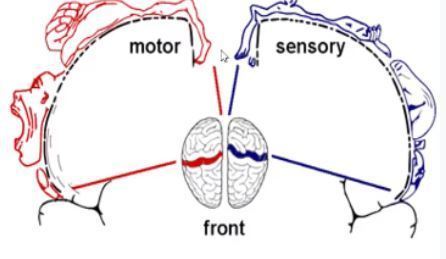
- Primary somatosensory cortex (S1) Main receptive area for the sense of touch. Contralaterally connected - just like the sensory cortex, has a map scaled by the amount of innervation coming from the body into the brain.
- The motor cortex is similar in hand, mouth, feet - tend to be close together in those maps. Scaled by number of neurons needed to move certain areas.
- general symmetry between the maps - one in front of the other, one in parietal = allows sufficient communication between motor and sensory.
- MAPS WITHIN THESE AREAS: Brodmann area 3A and 3B recieve sensory info via thalamic input. Brodmann area 1 mainly recieves info from 3B and defines texture. B2 defines shape and size w/input from area3
- Primary somatosensory cortex (S1) Main receptive area for the sense of touch. Contralaterally connected - just like the sensory cortex, has a map scaled by the amount of innervation coming from the body into the brain.
what would happen to area S1 if someone lost an arm? >> The map would reorganise based on altered use.
- RESIDUAL ARM MOVEMENTS - the stump is able to move but without the innervation of the hand/remaining arm. Increased activation to arm movement as they do not have the hand. Arm movement invades the hand area.
- Arm + Hand area become active during stump movements - despite no input from hand> spinal cord. OVERTAKEN BY NEIGHBOURING AREAS
- INTACT HAND MOVEMENTS: lose hand on the left hand, the right hand still activated in the left cortex- but can also activate the right cortex. loss of hand on one side can lead to increased activation on ipsilateral side of brain which is not the way the brain is usually wired up
- RESIDUAL ARM MOVEMENTS - the stump is able to move but without the innervation of the hand/remaining arm. Increased activation to arm movement as they do not have the hand. Arm movement invades the hand area.
remapping in the brain occur in use- use dependent plasticity - Correlations with usage MAKIN ET AL 2013- strong rels related to the amount of use of the residual arm and the fMRI activation during hand movements
- implies ongoing learning processes- relies on memory process. Behavioural skills - learning new skills or adjusting skills. Neural changes- change in connections between neurons and reflected in the representations in maps
3 forms of learning. NON-ASSOCIATIVE - changing the response in a way which is dependent on repeated exposure. Habituation/Sensitisation. Short term and reversible. Perceptual learning = increasing sensory discrimination.
- synpase efficacy - synapse enables one neuron to communicate with another- chemical synapses work with action potentials
- synapses have various features which can be altered = increasing the vesicle volume, amount of vesicles, increase release probability. On post-synaptic side = increased number of receptors. Synaptic cleft = reduce the reuptake mechanisms/ reduce the distance of the gap.
- Degree of variability which can be used to tune the cell so it can either be heightened or supressed in response to input.
- synapses have various features which can be altered = increasing the vesicle volume, amount of vesicles, increase release probability. On post-synaptic side = increased number of receptors. Synaptic cleft = reduce the reuptake mechanisms/ reduce the distance of the gap.
- HABITUATION- SEA SLUG. Gill withdrawal reflex. SIphon used to blow water through/ respiration. Defensive posture where if you touch the siphon,, the gil will retract. If you continously touch the siphon the gill will no longer retract so it can still breathe
- siphon ---- motor neuron driving gill ---- gill. continual input will reduce the efficacy of the synapses between the motor neuron and the gill. Repeatedly- this will induce long term effects related to the post synapitc side (HABITUATING)
- SENSITISATIONA- SEA SLUG. Applying weak electric shock on tail, pre-conditions animal to have a heightended response. This leads to strong gill withdrawal even from a light touch
- habituation and sensitisation occur due to presynaptic and postsynaptic processes. habituation = a loss of connections. Sensitisation = strong increase in connections. PHYSICAL CHANGES IN THE NEURON
- synpase efficacy - synapse enables one neuron to communicate with another- chemical synapses work with action potentials
associative = Conditioning, Pavlovian. Reward based learning. Behaviour learnt. Hebb's rule - fire together, wire together.
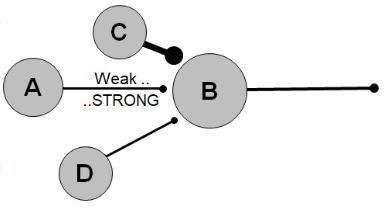
- A- gentle touch, B- weak electric shock, C- Gill withdrawal
- with associative learning, the electric shock occurs after the touch. forming a rels and pairing the 2 together, This differs from associative
- A- gentle touch, B- weak electric shock, C- Gill withdrawal
Somatosensory examples: Many different things can change our maps, Training can change maps --> Painist = more use of a finger representations in cortex over and above neighbouring areas
- Denervation - if de-nerve (stroke) or amputee these areas, the neighbouring areas will overtake as a competitive process.
- splint holding 2 fingers together = fusing maps in the cortex
- changes in the maps often long-term. Branching/pruning of dendritic connections, neurons appear to compete for space in cortex, unused gets taken over by other inputs. Imaging of mouse brain shows this growth is fast (days/weeks)
- hebbian learning best describes changes seen in somatosensory cortex
- changes in the maps often long-term. Branching/pruning of dendritic connections, neurons appear to compete for space in cortex, unused gets taken over by other inputs. Imaging of mouse brain shows this growth is fast (days/weeks)
Long Term Potentiation = an activity dependent persistent strengthening of synpases, Produce long-lasting increase in signal transmissions between 2 neurons
- Long Term Depression = an activity dependent reduction in efficacy of neuronal synapses. Produce long-lasting dereases in signal transmissions between 2 neurons
- sufficient excitation of post-synaptic cell will cause the magnesium to dislodge and cause more ions (sodium) into the cell and (calcium) which is very important to set off a cascade of events
- 1. Makes more AMPA receptors.
- 2. Next time the stimulus arrives- larger proportion of AMPA receptors responding and a larger response of the post synpatic cell
- 1. Makes more AMPA receptors.
- LTD = opposite, removing ION channels from the membrane. not blocked by NMDA receptor.
- sufficient excitation of post-synaptic cell will cause the magnesium to dislodge and cause more ions (sodium) into the cell and (calcium) which is very important to set off a cascade of events
- Long Term Depression = an activity dependent reduction in efficacy of neuronal synapses. Produce long-lasting dereases in signal transmissions between 2 neurons
3 key general principles: COOPERATIVELY- must receive input from many axons, ASSOCIATIVE = post and pre need to be excited SYNAPSE SPECIFIC = only synpases which are active at the time are going to be modifying their behaviour.
Images and files in the map
Information
- Description
- Neural Mind Map on Week 5: Learning and Memory, created by Katie gavriel on 14/04/2019.
- Created by
- Katie gavriel
- Views
- 0
- Rating