
Mind map
Coasts 2.4-
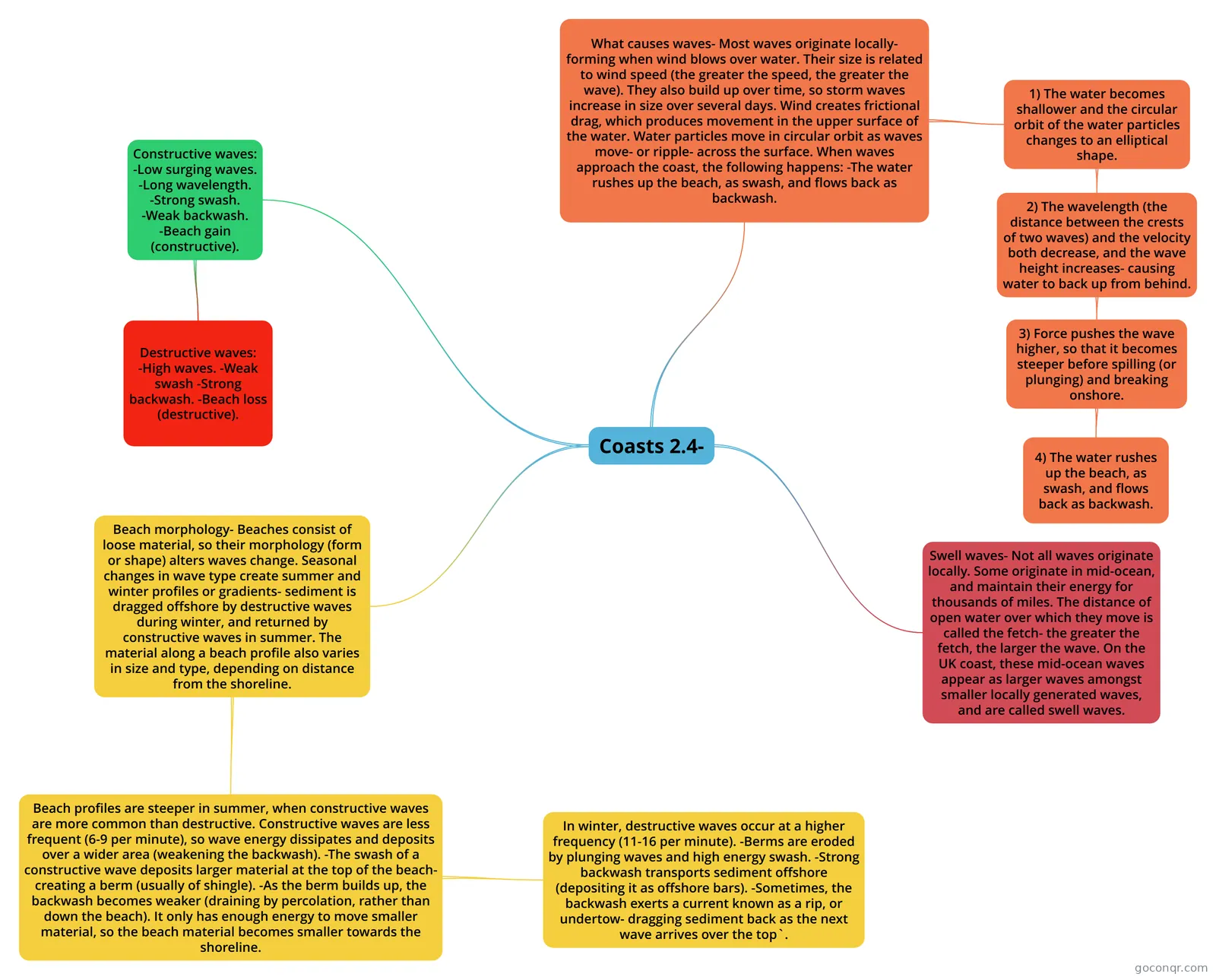
Mind map: Coasts waves and beaches
Map content
Coasts 2.4-
What causes waves- Most waves originate locally- forming when wind blows over water. Their size is related to wind speed (the greater the speed, the greater the wave). They also build up over time, so storm waves increase in size over several days. Wind creates frictional drag, which produces movement in the upper surface of the water. Water particles move in circular orbit as waves move- or ripple- across the surface. When waves approach the coast, the following happens: -The water rushes up the beach, as swash, and flows back as backwash.
- 1) The water becomes shallower and the circular orbit of the water particles changes to an elliptical shape.
- 2) The wavelength (the distance between the crests of two waves) and the velocity both decrease, and the wave height increases- causing water to back up from behind.
- 3) Force pushes the wave higher, so that it becomes steeper before spilling (or plunging) and breaking onshore.
- 4) The water rushes up the beach, as swash, and flows back as backwash.
- 3) Force pushes the wave higher, so that it becomes steeper before spilling (or plunging) and breaking onshore.
- 2) The wavelength (the distance between the crests of two waves) and the velocity both decrease, and the wave height increases- causing water to back up from behind.
- 1) The water becomes shallower and the circular orbit of the water particles changes to an elliptical shape.
Swell waves- Not all waves originate locally. Some originate in mid-ocean, and maintain their energy for thousands of miles. The distance of open water over which they move is called the fetch- the greater the fetch, the larger the wave. On the UK coast, these mid-ocean waves appear as larger waves amongst smaller locally generated waves, and are called swell waves.
Constructive waves: -Low surging waves. -Long wavelength. -Strong swash. -Weak backwash. -Beach gain (constructive).
- Destructive waves: -High waves. -Weak swash -Strong backwash. -Beach loss (destructive).
Beach morphology- Beaches consist of loose material, so their morphology (form or shape) alters waves change. Seasonal changes in wave type create summer and winter profiles or gradients- sediment is dragged offshore by destructive waves during winter, and returned by constructive waves in summer. The material along a beach profile also varies in size and type, depending on distance from the shoreline.
- Beach profiles are steeper in summer, when constructive waves are more common than destructive. Constructive waves are less frequent (6-9 per minute), so wave energy dissipates and deposits over a wider area (weakening the backwash). -The swash of a constructive wave deposits larger material at the top of the beach- creating a berm (usually of shingle). -As the berm builds up, the backwash becomes weaker (draining by percolation, rather than down the beach). It only has enough energy to move smaller material, so the beach material becomes smaller towards the shoreline.
- In winter, destructive waves occur at a higher frequency (11-16 per minute). -Berms are eroded by plunging waves and high energy swash. -Strong backwash transports sediment offshore (depositing it as offshore bars). -Sometimes, the backwash exerts a current known as a rip, or undertow- dragging sediment back as the next wave arrives over the top`.
- Beach profiles are steeper in summer, when constructive waves are more common than destructive. Constructive waves are less frequent (6-9 per minute), so wave energy dissipates and deposits over a wider area (weakening the backwash). -The swash of a constructive wave deposits larger material at the top of the beach- creating a berm (usually of shingle). -As the berm builds up, the backwash becomes weaker (draining by percolation, rather than down the beach). It only has enough energy to move smaller material, so the beach material becomes smaller towards the shoreline.
Information
- Description
- Mind Map on Coasts 2.4-, created by Jodie Caroline on 29/04/2019.
- Created by
- Jodie Caroline
- Views
- 0
- Rating