
Mind map
LEXICAL SEMANTICS
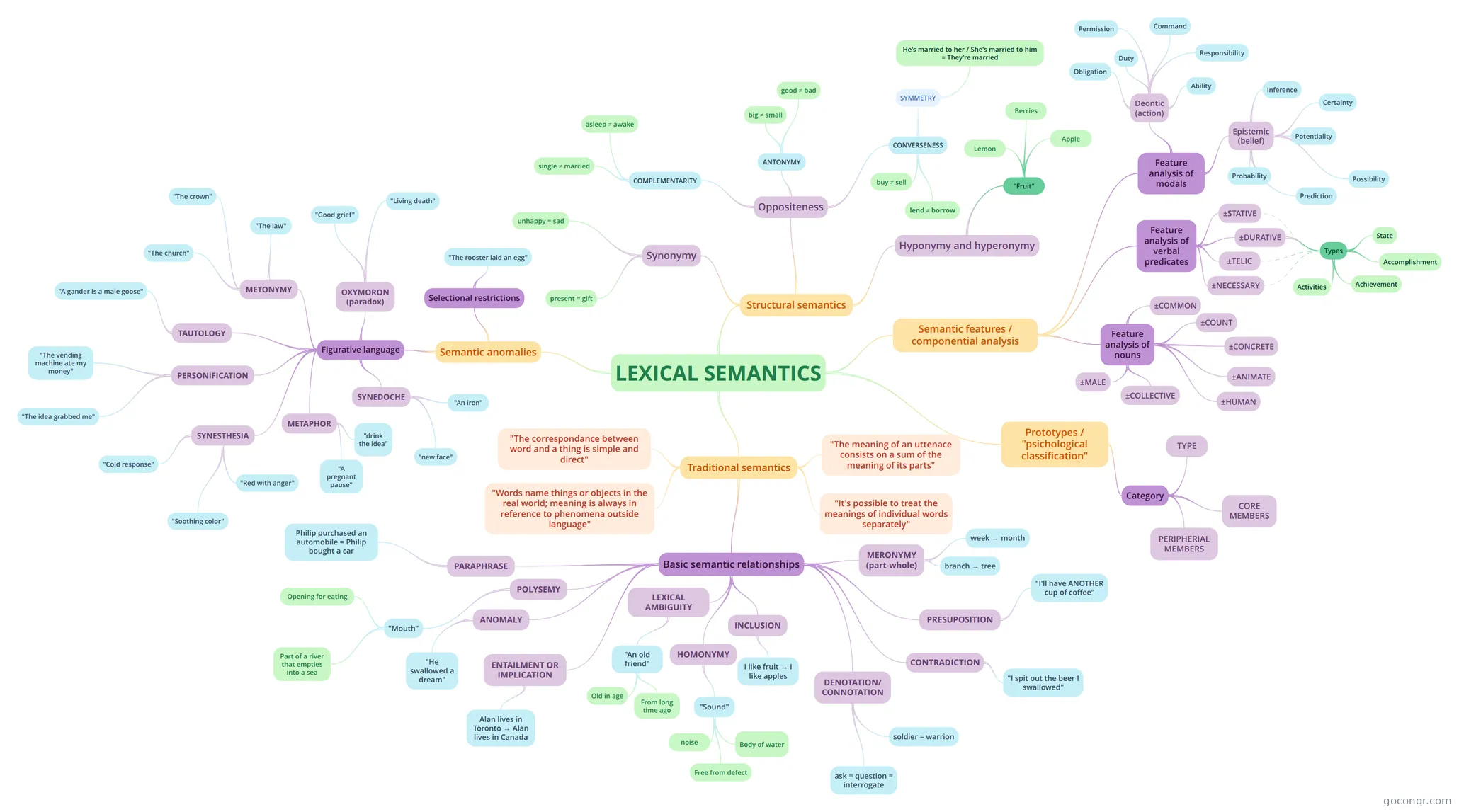
Mind map: Lexical semantics
Map content
LEXICAL SEMANTICS
Traditional semantics
- "The meaning of an uttenace consists on a sum of the meaning of its parts"
- "The correspondance between word and a thing is simple and direct"
- "Words name things or objects in the real world; meaning is always in reference to phenomena outside language"
- "It's possible to treat the meanings of individual words separately"
- Basic semantic relationships
- PARAPHRASE
- Philip purchased an automobile = Philip bought a car
- POLYSEMY
- "Mouth"
- Opening for eating
- Part of a river that empties into a sea
- "Mouth"
- ANOMALY
- "He swallowed a dream"
- ENTAILMENT OR IMPLICATION
- Alan lives in Toronto → Alan lives in Canada
- LEXICAL AMBIGUITY
- "An old friend"
- Old in age
- From long time ago
- "An old friend"
- HOMONYMY
- "Sound"
- noise
- Body of water
- Free from defect
- "Sound"
- INCLUSION
- I like fruit → I like apples
- MERONYMY (part-whole)
- week → month
- branch → tree
- DENOTATION/ CONNOTATION
- soldier = warrion
- ask = question = interrogate
- CONTRADICTION
- "I spit out the beer I swallowed"
- PRESUPOSITION
- "I'll have ANOTHER cup of coffee"
- PARAPHRASE
Structural semantics
- Oppositeness
- COMPLEMENTARITY
- single ≠ married
- asleep ≠ awake
- ANTONYMY
- big ≠ small
- good ≠ bad
- CONVERSENESS
- lend ≠ borrow
- buy ≠ sell
- SYMMETRY
- He's married to her / She's married to him = They're married
- COMPLEMENTARITY
- Hyponymy and hyperonymy
- "Fruit"
- Apple
- Lemon
- Berries
- "Fruit"
- Synonymy
- unhappy = sad
- present = gift
- Oppositeness
Semantic features / componential analysis
- Feature analysis of nouns
- ±COUNT
- ±COMMON
- ±ANIMATE
- ±HUMAN
- ±MALE
- ±CONCRETE
- ±COLLECTIVE
- Feature analysis of verbal predicates
- ±DURATIVE
- Types
- Achievement
- Accomplishment
- Activities
- State
- Types
- ±STATIVE
- ±NECESSARY
- ±TELIC
- ±DURATIVE
- Feature analysis of modals
- Deontic (action)
- Ability
- Permission
- Duty
- Responsibility
- Command
- Obligation
- Epistemic (belief)
- Probability
- Possibility
- Potentiality
- Certainty
- Inference
- Prediction
- Deontic (action)
- Feature analysis of nouns
Semantic anomalies
- Selectional restrictions
- "The rooster laid an egg"
- Figurative language
- METONYMY
- "The church"
- "The crown"
- "The law"
- PERSONIFICATION
- "The vending machine ate my money"
- "The idea grabbed me"
- OXYMORON (paradox)
- "Living death"
- "Good grief"
- SYNESTHESIA
- "Cold response"
- "Soothing color"
- "Red with anger"
- SYNEDOCHE
- "new face"
- "An iron"
- TAUTOLOGY
- "A gander is a male goose"
- METAPHOR
- "A pregnant pause"
- "drink the idea"
- METONYMY
- Selectional restrictions
Prototypes / "psichological classification"
- Category
- PERIPHERIAL MEMBERS
- CORE MEMBERS
- TYPE
- Category
Information
- Description
- A mind map that briefly explains the lexical semantics of modern English according to the book "The structure of modern english".
- Created by
- Diana Soto Linares
- Views
- 213
- Tags
- Rating