
Mind map
Waves
Map content
Waves
Wave definitions
- A wave is a movement of energy through a medium, which disturbs the medium without moving the medium itself
- Waves transfer energy and information, without transferring matter
- Waves are caused by a vibrating source
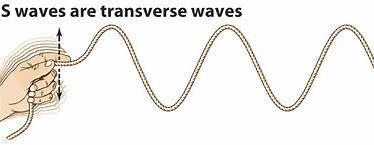
- Transverse waves=vibrations of the medium are perpendicular to the direction of wave travel, e.g all electromagnetic waves like light waves, water waves, waves on a stretched spring/string
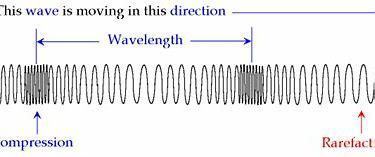
- Longitudinal waves=vibrations of the medium are parallel to direction of wave travel, e.g p-seismic waves, sound waves
Wave properties
- All waves can be reflected and refracted when changing medium
- Reflection
- Frequency, wavelength and speed stay the same, direction changes
- Refraction
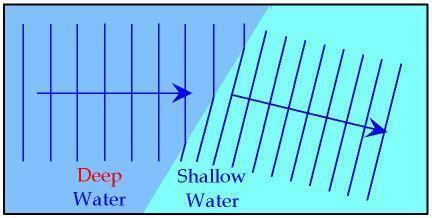
- Speed of the wave changes it when passes through a new/shallower medium
- Frequency stays the same, but wavelength and speed change
- If a wave meets a different medium at an angle, it changes direction as well
- Frequency stays the same, but wavelength and speed change
- Diagram
- Draw boundary between two materials and the normal (perpendicular to boundary)
- Draw an incident ray that meets the normal at the boundary
- Angle between the ray and normal is the angle of incidence
- Draw refracted ray on other side of boundary. If second material is denser than first, refracted ray bends towards the normal, and angle of refraction is smaller than the angle of incidence
- If second material is less dense, the angle of refraction is larger than the angle of incidence
- Draw refracted ray on other side of boundary. If second material is denser than first, refracted ray bends towards the normal, and angle of refraction is smaller than the angle of incidence
- Angle between the ray and normal is the angle of incidence
- Draw an incident ray that meets the normal at the boundary
- Draw boundary between two materials and the normal (perpendicular to boundary)
- Speed of the wave changes it when passes through a new/shallower medium
- Reflection
- Definitions
- Amplitude-Maximum displacement of the medium from rest point
- Frequency=number of waves per second (Hertz,Hz)
- Time period=time taken for 1 cycle/wave to occur
- Wavefront=imaginary plane cutting across all the waves, connecting the points on adjacent waves that are vibrating together
- Wavelength=distance between two peaks/troughs
- All waves can be reflected and refracted when changing medium
Wave equations
- f=1/T
- Speed of the wave=speed of energy passing through medium
- Speed=frequency x wavelength
- Speed depends on the medium, and frequency depends on the source creating the waves
- Speed
- Light
- Air=3 x 10^8m/s
- Glass=2 x 10^8m/s
- Air=3 x 10^8m/s
- Sound
- Air=340m/s
- Water=1500m/s
- Steel=2200m/s
- Water=1500m/s
- Air=340m/s
- Light
Sound waves
- Longitudinal wave
- Human audible range=20Hz to 20kHz
- Can be reflected, refracted and diffracted
- Frequency=pitch
- Amplitude=volume
- By attaching a signal generator to a speaker, you can generate sounds wth a specific frequency. You can use two microphones and an oscilloscope to find wavelength of the sounds generated.
- Detected waves at each microphone can be seen as a separate wave on the oscilloscope
- Start with both microphones next to speaker, then slowly move one away until the two waves are aligned on the display, but exactly one wavelength apart
- Measure the distance between the two microphones to find the wavelength
- Then use the formula speed=wavelength x frequency to find speed of the sound waves passing through the air - frequency is whatever you set the signal generator to
- Measure the distance between the two microphones to find the wavelength
- Start with both microphones next to speaker, then slowly move one away until the two waves are aligned on the display, but exactly one wavelength apart
- Detected waves at each microphone can be seen as a separate wave on the oscilloscope
Speed of sound
- Hitting blocks together by a wall
Doppler Effect - Makes waves appear longer or shorter
- Waves produced by a source which is moving towards or away from an observer will seem to have a different wavelength than it would if the source was stationary
- This is because the wave speed is constant, so if the source is moving, it 'catches up' to the waves in front of it, causing the wavefronts to bunch u in front of the moving source and spread out behind it
- Towards you - frequency of a source seems higher, and wavelength seems shorter
- Away from you - Frequency seems lower, and wavelength seems longer
- Towards you - frequency of a source seems higher, and wavelength seems shorter
- This is because the wave speed is constant, so if the source is moving, it 'catches up' to the waves in front of it, causing the wavefronts to bunch u in front of the moving source and spread out behind it
- Waves produced by a source which is moving towards or away from an observer will seem to have a different wavelength than it would if the source was stationary
EM (electromagnetic spectrum)
- Longest wavelength to shortest wavelength: radio waves, microwaves, infra-red, light (red, orange, yellow, green, blue, violet), ultra-violet, x-rays, gamma
- All EM waves travel at same speed in a vacuum (free space). As wavelength increases, frequency decreases.
- Uses
- Radio waves - Communication
- Long-wave radio - (Wavelengths 1-10km) can be transmitted a long way, because long wavelengths are bent around curved surface of Earth
- Short-wave radio - (Wavelengths about 10m-100m) can be received at long distances from transmitter, as they are reflected from ionosphere (layer of Earth;s atmosphere).
- Radio waves used for TV and EM radio broadcasting have very short wavelengths (10cm-10m). For reception, you have to be in direct sight of a transmitter - signals doesn't bend around hills
- Short-wave radio - (Wavelengths about 10m-100m) can be received at long distances from transmitter, as they are reflected from ionosphere (layer of Earth;s atmosphere).
- Long-wave radio - (Wavelengths 1-10km) can be transmitted a long way, because long wavelengths are bent around curved surface of Earth
- Microwaves - Satellite communication and heating food
- Microwaves have a wavelength about 1-10cm
- Satellite communication (e.g satellite TV and phones)
- Satellite TV - signal from a transmitter is transmitted into space, where it's picked up by a satellite receiver dish orbiting thousands of kilometres from Earth. Satellite transmits signal back to Earth, where it's received by a satellite dish on the ground
- Mobile phone calls also travel as microwaves from phone to nearest transmitter
- Cooking - microwaves absorbed by water molecules in food, penetrating a few cm into the food before being absorbed. Energy is then conducted or convected to other parts of the food
- Mobile phone calls also travel as microwaves from phone to nearest transmitter
- Satellite TV - signal from a transmitter is transmitted into space, where it's picked up by a satellite receiver dish orbiting thousands of kilometres from Earth. Satellite transmits signal back to Earth, where it's received by a satellite dish on the ground
- Satellite communication (e.g satellite TV and phones)
- Microwaves have a wavelength about 1-10cm
- Infra-red radiation - Heating and monitoring temperature
- Electrical heaters radiate IR to keep us warm, and things like grills use IR to cook food
- IR is given out by all objects - hotter the object, the more IR radiation given out
- Infra-red radiation given out by objects can be detected in the dark of night by night-vision equipment. Equipment turns it into an electrical signal, which is displayed on a screen as a picture, allowing things which would otherwise be hidden in dark, to be seen
- IR is given out by all objects - hotter the object, the more IR radiation given out
- Electrical heaters radiate IR to keep us warm, and things like grills use IR to cook food
- Light signals - optical fibres and photography
- Allows us to look at things around us, and visible light can be used for communication using optical fibres, which carry data over long distances as pulses of light
- Optical fibres work by bouncing waves off sides of a very narrow core
- Pulse of light enters the fibre at a certain angle at one end, and is reflected again and again until it emerges at other end
- Optical fibres increasingly being used for telephone and broadband internet cables, as well as for medical purposes, to see inside body without having to operate
- Pulse of light enters the fibre at a certain angle at one end, and is reflected again and again until it emerges at other end
- Optical fibres work by bouncing waves off sides of a very narrow core
- Cameras use a lens to focus visible light onto a light sensitive film or sensor
- The lens aperture controls how much light enters the camera
- The shutter speed determines how long the film or sensor is exposed to the light
- By varying aperture and shutter sooted (plus sensitivity of the film/sensor), a photographer canc capture as much or as little light as they want in their photograph
- The shutter speed determines how long the film or sensor is exposed to the light
- The lens aperture controls how much light enters the camera
- Allows us to look at things around us, and visible light can be used for communication using optical fibres, which carry data over long distances as pulses of light
- Ultra-violet - fluorescent lamps
- Fluorescence is a property of certain chemicals, where ultra-violet radiation us absorbed and visible light is then emitted. This is why fluorescent colours look so bright
- Fluorescent lights use UV radiation to emit visible light. Safe to use as nearly all of UV radiation is absorbed by a phosphor coating on inside of glass
- More energy efficient than filament light bulbs
- Fluorescent lights use UV radiation to emit visible light. Safe to use as nearly all of UV radiation is absorbed by a phosphor coating on inside of glass
- Fluorescence is a property of certain chemicals, where ultra-violet radiation us absorbed and visible light is then emitted. This is why fluorescent colours look so bright
- X-rays - can see inside things
- Used to view internal structure of objects and materials, including our bodies, so useful in medicine
- To make an x-ray image, X-rays are directed through the object/body onto a detector plate. The brighter bits are where fewer X-rays can get through, forming a negative image.
- Radiographers in hospitals take X-ray photographs to help doctors diagnose broken bones - X-rays pass easily through flesh, but not through denser material like bones or metal
- Exposure to X-rays can case mutations, which lead to cancer, so radiographers and patients are protected as much as possible by lead aprons, lead shields and keeping exposure to a minimum
- Radiographers in hospitals take X-ray photographs to help doctors diagnose broken bones - X-rays pass easily through flesh, but not through denser material like bones or metal
- To make an x-ray image, X-rays are directed through the object/body onto a detector plate. The brighter bits are where fewer X-rays can get through, forming a negative image.
- Used to view internal structure of objects and materials, including our bodies, so useful in medicine
- Gamma radiation - sterilisation
- Medical equipment - Kills off bacteria, better than trying to boil plastic instruments, which might be damaged by high temperatures
- Food - microbes killed, keeping food fresh for longer, without having to freeze, cook or preserve ut in some way. Food is not radioactive afterwards, so it's safe to eat
- Medical equipment - Kills off bacteria, better than trying to boil plastic instruments, which might be damaged by high temperatures
- Radio waves - Communication
- Dangers
- Microwaves: Similar frequency to vibrations of many molecules, so can increase these vibrations. Result is internal heating, so can internally heat body tissue. Microwave ovens have shielding, to prevent microwaves reaching user.
- Infrared: Range of frequencies that can make surface molecules of any substance vibrate, producing a heating effect. Infrared has a higher frequency than microwaves, so carries more energy than microwave radiation. Too much exposure can cause skin burns. Use insulating materials to reduce amount of IR reaching skin
- UV radiation: can damage surface cells and cause blindness. Some frequencies are ionising - carrying enough energy to knock electrons off atoms - causing cell mutation or destruction and cancer. Wear sunscreen with UV filters when out in sun, and stay out of strong sunlight
- Gamma - Very high frequency waves, ionising and carry more energy than UV rays, so can be much more damaging and penetrate further into the body. Cause cell mutation or destruction, leading to tissue damage or cancer. Radioactives sources should be kept in lead lined boxes when not in use, and exposure time should be minimised
- Longest wavelength to shortest wavelength: radio waves, microwaves, infra-red, light (red, orange, yellow, green, blue, violet), ultra-violet, x-rays, gamma
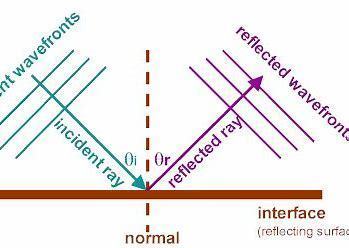
Law of reflection: angle of incidence=angle of reflection
- Normal: Imaginary line perpendicular to surface at the point of incidence, usually shown as a dotted line
- Angle of incidence: angle between incoming wave and the normal. Angel of reflection: angle between reflected wave and normal
- Virtual images form when light rays bouncing off an object onto a mirror are diverging so light from object appears to be coming from a completely different place
- Angle of incidence: angle between incoming wave and the normal. Angel of reflection: angle between reflected wave and normal
- Normal: Imaginary line perpendicular to surface at the point of incidence, usually shown as a dotted line
Shining white light into a triangular prism causes the light to disperse into different colours, which have different wavelengths The different wavelengths refract by different amounts (red refracts the least, violet refracts the most)
(Snell's law) refractive index=angle of incidence/angle of refraction (n=sin(i)/sin(r))
- Refractive index of a transparent material tells you how fast light travels in that material. High refractive index means light travels slowly
Total internal reflection: no light leaves the medium. Happens when critical angle is reached,and light is refracted right along boundary, and total internal reflection is above the critical angle. When i=critical angle, r=90 degrees
- IF i<critical angle, most of the light passes out, although a little is internally reflected
- If i=critical angle, lot of internal reflection
- If i>critical angle, no light comes out and all of it is internally reflected (total internal reflection)
- sin Critical angle=1/refractive index (sinC=1/n)
- If i>critical angle, no light comes out and all of it is internally reflected (total internal reflection)
- If i=critical angle, lot of internal reflection
- Used in optical fibres, which consist of a central core surrounded by cladding with a lower refractive index. Core of fibre is so narrow, light signals passing through it always hit the core-cladding boundary at angles higher than C, so light is always totally internally reflected. Only stops working if fibre is bent too sharply
- Also allows us to use prisms to see objects not in our direct line of sight, which is how a periscope works. Ray of light travels into one prism, where it's totally internally reflected b 90 degrees, which then travels to another prism lower down, and is totally internally reflected by 90 degrees. Ray is now travelling parallel to its initial path, but at a different height
- IF i<critical angle, most of the light passes out, although a little is internally reflected
Images and files in the map
Information
- Description
- Physics Mind Map on Waves, created by Sophie J Evans on 28/05/2019.
- Created by
- Sophie J Evans
- Views
- 0
- Rating