
Mind map
EVOLUTION IN FOSSIL RECORD 2
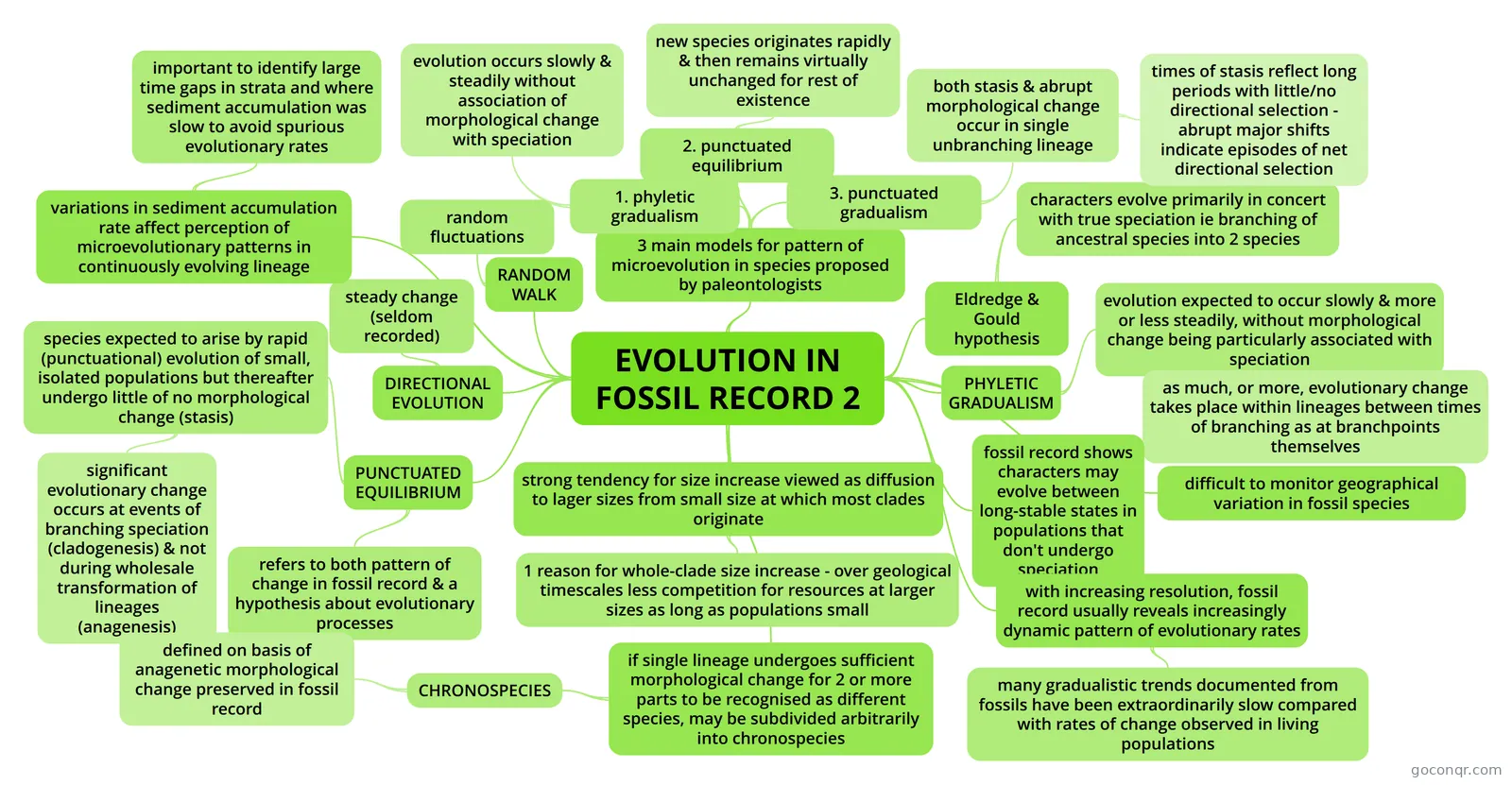
Mind map: evolution in fossil record
Map content
EVOLUTION IN FOSSIL RECORD 2
strong tendency for size increase viewed as diffusion to lager sizes from small size at which most clades originate
- 1 reason for whole-clade size increase - over geological timescales less competition for resources at larger sizes as long as populations small
PUNCTUATED EQUILIBRIUM
- species expected to arise by rapid (punctuational) evolution of small, isolated populations but thereafter undergo little of no morphological change (stasis)
- significant evolutionary change occurs at events of branching speciation (cladogenesis) & not during wholesale transformation of lineages (anagenesis)
- refers to both pattern of change in fossil record & a hypothesis about evolutionary processes
- species expected to arise by rapid (punctuational) evolution of small, isolated populations but thereafter undergo little of no morphological change (stasis)
PHYLETIC GRADUALISM
- evolution expected to occur slowly & more or less steadily, without morphological change being particularly associated with speciation
- as much, or more, evolutionary change takes place within lineages between times of branching as at branchpoints themselves
- evolution expected to occur slowly & more or less steadily, without morphological change being particularly associated with speciation
Eldredge & Gould hypothesis
- characters evolve primarily in concert with true speciation ie branching of ancestral species into 2 species
fossil record shows characters may evolve between long-stable states in populations that don't undergo speciation
DIRECTIONAL EVOLUTION
- steady change (seldom recorded)
RANDOM WALK
- random fluctuations
3 main models for pattern of microevolution in species proposed by paleontologists
- 1. phyletic gradualism
- evolution occurs slowly & steadily without association of morphological change with speciation
- 2. punctuated equilibrium
- new species originates rapidly & then remains virtually unchanged for rest of existence
- 3. punctuated gradualism
- both stasis & abrupt morphological change occur in single unbranching lineage
- times of stasis reflect long periods with little/no directional selection - abrupt major shifts indicate episodes of net directional selection
- both stasis & abrupt morphological change occur in single unbranching lineage
- 1. phyletic gradualism
if single lineage undergoes sufficient morphological change for 2 or more parts to be recognised as different species, may be subdivided arbitrarily into chronospecies
- CHRONOSPECIES
- defined on basis of anagenetic morphological change preserved in fossil record
- CHRONOSPECIES
difficult to monitor geographical variation in fossil species
variations in sediment accumulation rate affect perception of microevolutionary patterns in continuously evolving lineage
- important to identify large time gaps in strata and where sediment accumulation was slow to avoid spurious evolutionary rates
with increasing resolution, fossil record usually reveals increasingly dynamic pattern of evolutionary rates
- many gradualistic trends documented from fossils have been extraordinarily slow compared with rates of change observed in living populations
Information
- Description
- Mind Map on EVOLUTION IN FOSSIL RECORD 2, created by tomking304 on 01/09/2013.
- Created by
- tomking304
- Views
- 52
- Rating