
Mind map
Evolution driven by 4 process
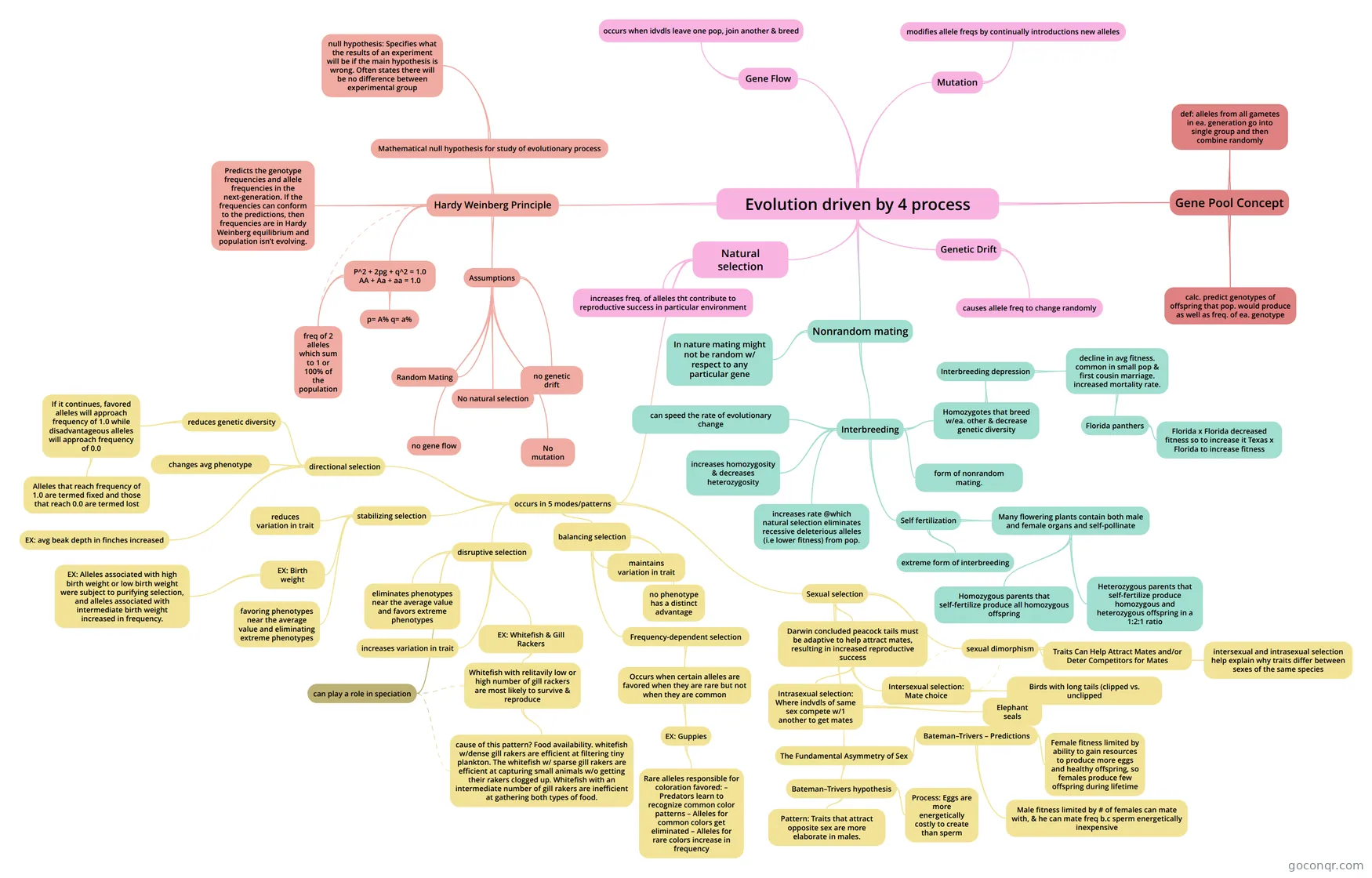
Mind map: Evolution driven by 4 process
Map content
Evolution driven by 4 process
Natural selection
- increases freq. of alleles tht contribute to reproductive success in particular environment
- occurs in 5 modes/patterns
- directional selection
- changes avg phenotype
- reduces genetic diversity
- If it continues, favored alleles will approach frequency of 1.0 while disadvantageous alleles will approach frequency of 0.0
- Alleles that reach frequency of 1.0 are termed fixed and those that reach 0.0 are termed lost
- If it continues, favored alleles will approach frequency of 1.0 while disadvantageous alleles will approach frequency of 0.0
- EX: avg beak depth in finches increased
- stabilizing selection
- reduces variation in trait
- EX: Birth weight
- EX: Alleles associated with high birth weight or low birth weight were subject to purifying selection, and alleles associated with intermediate birth weight increased in frequency.
- favoring phenotypes near the average value and eliminating extreme phenotypes
- disruptive selection
- increases variation in trait
- eliminates phenotypes near the average value and favors extreme phenotypes
- EX: Whitefish & Gill Rackers
- Whitefish with relitavily low or high number of gill rackers are most likely to survive & reproduce
- cause of this pattern? Food availability. whitefish w/dense gill rakers are efficient at filtering tiny plankton. The whitefish w/ sparse gill rakers are efficient at capturing small animals w/o getting their rakers clogged up. Whitefish with an intermediate number of gill rakers are inefficient at gathering both types of food.
- Whitefish with relitavily low or high number of gill rackers are most likely to survive & reproduce
- can play a role in speciation
- balancing selection
- maintains variation in trait
- no phenotype has a distinct advantage
- Frequency-dependent selection
- Occurs when certain alleles are favored when they are rare but not when they are common
- EX: Guppies
- Rare alleles responsible for coloration favored: – Predators learn to recognize common color patterns – Alleles for common colors get eliminated – Alleles for rare colors increase in frequency
- EX: Guppies
- Occurs when certain alleles are favored when they are rare but not when they are common
- Sexual selection
- Darwin concluded peacock tails must be adaptive to help attract mates, resulting in increased reproductive success
- Intrasexual selection: Where indvdls of same sex compete w/1 another to get mates
- Elephant seals
- Intersexual selection: Mate choice
- Birds with long tails (clipped vs. unclipped
- Intrasexual selection: Where indvdls of same sex compete w/1 another to get mates
- The Fundamental Asymmetry of Sex
- Bateman–Trivers hypothesis
- Pattern: Traits that attract opposite sex are more elaborate in males.
- Process: Eggs are more energetically costly to create than sperm
- Bateman–Trivers – Predictions
- Female fitness limited by ability to gain resources to produce more eggs and healthy offspring, so females produce few offspring during lifetime
- Male fitness limited by # of females can mate with, & he can mate freq b.c sperm energetically inexpensive
- Bateman–Trivers hypothesis
- sexual dimorphism
- intersexual and intrasexual selection help explain why traits differ between sexes of the same species
- Traits Can Help Attract Mates and/or Deter Competitors for Mates
- Darwin concluded peacock tails must be adaptive to help attract mates, resulting in increased reproductive success
- directional selection
Genetic Drift
- causes allele freq to change randomly
Gene Flow
- occurs when idvdls leave one pop, join another & breed
Mutation
- modifies allele freqs by continually introductions new alleles
Gene Pool Concept
- def: alleles from all gametes in ea. generation go into single group and then combine randomly
- calc. predict genotypes of offspring that pop. would produce as well as freq. of ea. genotype
Hardy Weinberg Principle
- Mathematical null hypothesis for study of evolutionary process
- null hypothesis: Specifies what the results of an experiment will be if the main hypothesis is wrong. Often states there will be no difference between experimental group
- Predicts the genotype frequencies and allele frequencies in the next-generation. If the frequencies can conform to the predictions, then frequencies are in Hardy Weinberg equilibrium and population isn’t evolving.
- P^2 + 2pg + q^2 = 1.0 AA + Aa + aa = 1.0
- p= A% q= a%
- freq of 2 alleles which sum to 1 or 100% of the population
- Assumptions
- Random Mating
- No natural selection
- no genetic drift
- no gene flow
- No mutation
- Mathematical null hypothesis for study of evolutionary process
Nonrandom mating
- In nature mating might not be random w/ respect to any particular gene
- Interbreeding
- form of nonrandom mating.
- Homozygotes that breed w/ea. other & decrease genetic diversity
- Interbreeding depression
- decline in avg fitness. common in small pop & first cousin marriage. increased mortality rate.
- Florida panthers
- Florida x Florida decreased fitness so to increase it Texas x Florida to increase fitness
- Florida panthers
- decline in avg fitness. common in small pop & first cousin marriage. increased mortality rate.
- Interbreeding depression
- increases homozygosity & decreases heterozygosity
- can speed the rate of evolutionary change
- increases rate @which natural selection eliminates recessive deleterious alleles (i.e lower fitness) from pop.
- Self fertilization
- extreme form of interbreeding
- Many flowering plants contain both male and female organs and self-pollinate
- Homozygous parents that self-fertilize produce all homozygous offspring
- Heterozygous parents that self-fertilize produce homozygous and heterozygous offspring in a 1:2:1 ratio
Information
- Description
- Mind Map on Evolution driven by 4 process, created by Luna Gonzalez on 30/09/2019.
- Created by
- Luna Gonzalez
- Views
- 0
- History
-
- Created by Luna Gonzalez · Sep 29, 2019
- Copied by Luna Gonzalez · Sep 30, 2019
- Rating