
Mind map
Questionnaires
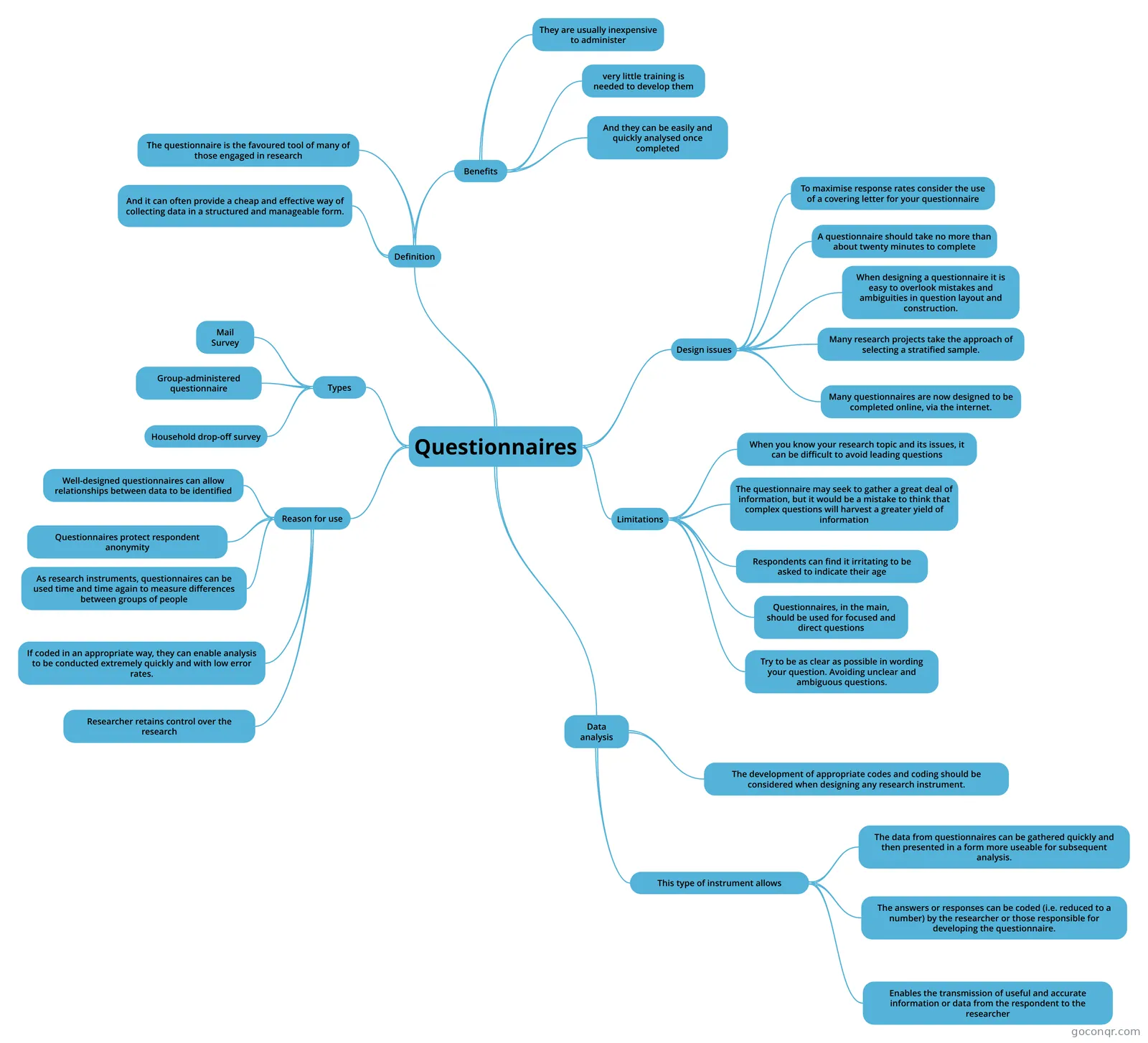
Mind map: questionnaires
Map content
Questionnaires
Types
- Mail Survey
- Group-administered questionnaire
- Household drop-off survey
Reason for use
- Well-designed questionnaires can allow relationships between data to be identified
- Questionnaires protect respondent anonymity
- As research instruments, questionnaires can be used time and time again to measure differences between groups of people
- If coded in an appropriate way, they can enable analysis to be conducted extremely quickly and with low error rates.
- Researcher retains control over the research
Limitations
- When you know your research topic and its issues, it can be difficult to avoid leading questions
- The questionnaire may seek to gather a great deal of information, but it would be a mistake to think that complex questions will harvest a greater yield of information
- Respondents can find it irritating to be asked to indicate their age
- Questionnaires, in the main, should be used for focused and direct questions
- Try to be as clear as possible in wording your question. Avoiding unclear and ambiguous questions.
Design issues
- To maximise response rates consider the use of a covering letter for your questionnaire
- A questionnaire should take no more than about twenty minutes to complete
- When designing a questionnaire it is easy to overlook mistakes and ambiguities in question layout and construction.
- Many research projects take the approach of selecting a stratified sample.
- Many questionnaires are now designed to be completed online, via the internet.
Data analysis
- The development of appropriate codes and coding should be considered when designing any research instrument.
- This type of instrument allows
- The data from questionnaires can be gathered quickly and then presented in a form more useable for subsequent analysis.
- The answers or responses can be coded (i.e. reduced to a number) by the researcher or those responsible for developing the questionnaire.
- Enables the transmission of useful and accurate information or data from the respondent to the researcher
Definition
- The questionnaire is the favoured tool of many of those engaged in research
- And it can often provide a cheap and effective way of collecting data in a structured and manageable form.
- Benefits
- They are usually inexpensive to administer
- very little training is needed to develop them
- And they can be easily and quickly analysed once completed