
Mind map
Ecology & Evolution Exam II
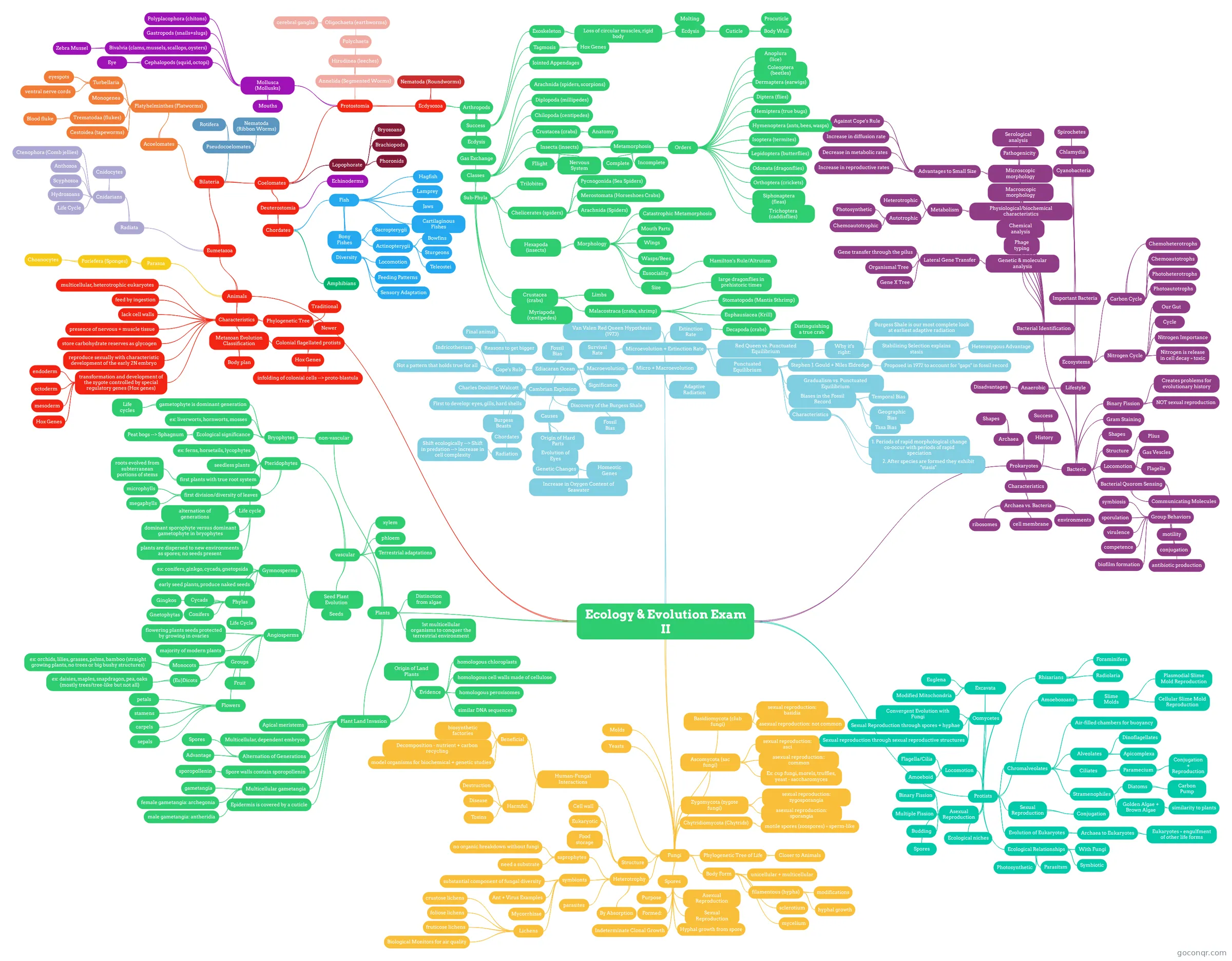
Mind map: Ecology and evolution exam II
Map content
Ecology & Evolution Exam II
Micro + Macroevolution
- Microevolution + Extinction Rate
- Extinction Rate
- the probability of extinction remains consistent → over time competition and natural selection will not change the extinction risk
- Survival Rate
- the survival rate is a straight line decay (constant extinction)
- Van Valen Red Queen Hypothesis (1973)
- a constant rate of competition between species; the species run to catch one another and they’re always running and always changing (arms race) The species will move together over time to maintain a coevolutionary path
- Punctuated Equilibrium
- Stephen J. Gould + Niles Eldredge
- Proposed in 1972 to account for "gaps" in fossil record
- Biases in the Fossil Record
- Geographic Bias
- not all specimen have an equal likelihood of being preserved in the fossil record
- Taxa Bias
- some taxa are more likely to be fossilized than others
- Temporal Bias
- pull of the present more recent fossils are more likely to be found
- Geographic Bias
- Characteristics
- 1. Periods of rapid morphological change co-occur with periods of rapid speciation
- 2. After species are formed they exhibit "stasis"
- Gradualism vs. Punctuated Equilibrium
- Gradualism: Over time the butterflies would slowly change and diverge to different species Punctuated Equilibrium: Stasis → adaptive radiation; big change → stasis → big change; adaptive radiation
- Why it's right:
- Stabilizing Selection explains stasis
- Heterozygous Advantage
- selection stabilizing phenotype in between diversification events
- Heterozygous Advantage
- Burgess Shale is our most complete look at earliest adaptive radiation
- whole lineages → can look at diversification patterns
- Stabilizing Selection explains stasis
- Stephen J. Gould + Niles Eldredge
- Red Queen vs. Punctuated Equilibrium
- Red Queen: explains stasis Punctuated Equilibrium: how to get from stasis to diversity
- Extinction Rate
- Macroevolution
- Ediacaran Ocean
- Significance
- important transition from multicellular life with one cell type to explosion of different tissue types (Cambrian)
- Cambrian Explosion
- Discovery of the Burgess Shale
- 540 million years ago different species of ancient organisms (fossils in the shale) Until the discovery of the Burgess Shale, there was no detailed understanding of what life was like that far back in time
- Fossil Bias
- 520 MYA Cambrian Explosion Great diversity of body forms the majority of the phyla are represented in the fossil record → most of the fossil biases were overcome (SO NO BIAS)
- Charles Doolittle Walcott
- First to develop: eyes, gills, hard shells
- Burgess Beasts
- hard shells → indicated evolution of a predatory selection (shells = defense mechanisms)
- Chordates
- pre-vertabrates (pikaia) hollow nerve cord led to vertebrates → fish → tetrapods
- Radiation
- Shift ecologically --> Shift in predation --> increase in cell complexity
- Causes
- Increase in Oxygen Content of Seawater
- allowed organisms to achieve increased sizes and metabolic rates large size is a prerequisite for the evolution of predators before the Cambrian you don’t see any evidence of predation
- Origin of Hard Parts
- Shells and mineralized exoskeletons some of the earliest shells have holes bored through them by predators strong selection pressures → favor in mineralized shells
- Evolution of Eyes
- to see predators and for predators to see prey
- Genetic Changes
- did the diversification of homeotic genes drive the Cambrian explosion?
- Homeotic Genes
- homeotic genes encode for transcription factors + activate suites of genes that control body plans during early development homeo genes to permit the switches to be turned off and on during development
- Increase in Oxygen Content of Seawater
- Discovery of the Burgess Shale
- Fossil Bias
- 560 MYA exclusively soft=bodied, many non-mobile ad non-burrowing animals
- Significance
- Cope's Rule
- population lineages tend to increase in body size over evolutionary time
- Indricotherium
- largest land mammal ever (15 tons) Cope described it as an evolutionary dead-end (last record of the lineage of this mammal and it was the largest)
- Final animal
- if a lineage did not make it through a bottleneck/extinction event then the final animal in the lineage would be large
- Not a pattern that holds true for all
- can really only be applied to some macroevolution of birds/mammals/reptiles but not necessarily anything else
- Reasons to get bigger
- reduced chance of being the target of predation better in sexual competition large organisms have more energetic efficiency
- Ediacaran Ocean
- Adaptive Radiation
- Definition (Mayr 1963): evolutionary divergence of members of single phyletic line into a series of rather different niches or adaptive zones early diversification from one common ancestor
- Microevolution + Extinction Rate
Prokaryotes
- Bacteria
- Shapes
- Bacilli Cocci Spirilla
- Structure
- no mitochondria, no chloroplasts ball of wrapped up chromosomal material held in place by actin filaments external structures attached to cell wall flagellum
- Plius
- little penis-like structure way to transfer genetic material between cells pseudo sexual reproduction
- Gram Staining
- staining bacteria for peptidoglycan in cell walls if it stains blue, peptidoglycan is there (gram-positive bacteria) if it doesn’t stain, then the gram can’t impregnate the peptidoglycan because there’s a layer in front of it (gram-negative bacteria)
- Locomotion
- Gas Vescles
- letting out bubbles of air to move basically just fart propelling
- Flagella
- “run and tumble” pattern flagellum push (like swimming) + bacteria flip (“tumble”)
- Gas Vescles
- Binary Fission
- Splitting event of one cell into two chromosomes duplicate as one big unit of two balls cells cleave and capture the separate balls of string that make up the chromosomes
- NOT sexual reproduction
- Creates problems for evolutionary history
- Bacterial Quorom Sensing
- has to be enough (threshold number) of bacteria → can communicate with one another
- Communicating Molecules
- substances released by communicators first hormones?
- Group Behaviors
- symbiosis
- act as a unit
- virulence
- to be bad to a host
- competence
- competing
- conjugation
- can get larger and draw in more cells from other colonies
- antibiotic production
- to fend off other organisms
- motility
- move as a group
- sporulation
- releasing buds of themselves (fission process) --> spores
- biofilm formation
- cells stick together and excrete a sticky-mucus layer
- symbiosis
- Lifestyle
- Anaerobic
- unable to latch onto oxygen to produce energy
- Disadvantages
- production of ATP = limited unless there is oxygen involved no way for anaerobic species to detoxify themselves (H2O2) anaerobes are usually in places with no oxygen → no toxic oxidized species → no threat; but cannot live in environments with aerobic species
- Ecosystems
- Nitrogen Cycle
- Nitrogen Importance
- Amino acids
- Nitrogen is release in cell decay = toxic
- Cycle
- nitrogen decays → ammonia (TOXIC) → nitrite (less toxic) → nitrate (relatively benign form of nitrogen)
- Our Gut
- when we digest things, we need bacteria to break down material or deal with toxic products of chemical breakdown
- Nitrogen Importance
- Carbon Cycle
- Photoautotrophs
- use light as energy and breaks down carbon dioxide in the air
- Photoheterotrophs
- swamps, bogs constant settling of organic matter in the environment breaking down the carbon that is trapped in the carbon compounds/tissues use light as the source of energy to break down components of an ecosystem
- Chemoautotrophs
- uses sulfur vents in the ocean energy is absorbed using carbon from the environment (NOT consuming from other compounds) usually found in very harsh environments sulfur metabolism nitrogen cycle
- Chemoheterotrophs
- consume carbon from their environment (other sources of life) using chemical sources as energy using chemical energies to power their cellular functions
- Photoautotrophs
- Nitrogen Cycle
- Anaerobic
- Bacterial Identification
- Microscopic morphology
- gram staining, shapes (cocci, spirilla), arrangements (colonies), motility
- Advantages to Small Size
- Against Cope's Rule
- Increase in diffusion rate
- S/V ratio is larger in smaller organisms
- Decrease in metabolic rates
- Increase in reproductive rates
- Macroscopic morphology
- colony appearance, motility (how it moves as an orchestrated unit)
- Physiological/biochemical characteristics
- aerobic, anaerobic, photosynthetic, growth on selective media
- Metabolism
- Heterotrophic
- Autotrophic
- Photosynthetic
- Chemoautotrophic
- Chemical analysis
- ex: peptides and lipids in cell membranes
- Phage typing
- which phage infects the bacterium (what viruses infect their single chromosomes, what viruses attack their DNA)
- Serological analysis
- what antibodies are produced against the bacterium
- Pathogenicity
- what diseases does the bacterium cause
- Genetic & molecular analysis
- DNA analysis using genetic probes Nucleic acid sequencing & rRNA analysis gives structure to bacterial tree of life
- Lateral Gene Transfer
- results in a mishmash of genomic material that makes it difficult to recover a phylogenetic history
- Gene transfer through the pilus
- Organismal Tree
- the tree that you recover without looking at the DNA splice
- Gene X Tree
- the tree you recover by looking at the gene splice (usually different from the organismal tree)
- Microscopic morphology
- Important Bacteria
- Spirochetes
- gram-negative chemoheterotroph parasite
- Chlamydia
- gram-negative cocci STI two different forms: elementary bodies reticular bodies if you study the life cycle of chlamydia: cells invade cells of the host → mature → reticulate bodies that take over the cell → produce elementary bodies → lyse + kill the host cell
- Cyanobacteria
- blue-green bacteria three cell types: vegetative cells (active) spores (waits dormant) heterocysts (waiting for some nutrient, cross between vegetative + spores; spores → vegetative cell) watching a pond change color = full of cyanobacteria presence of elements in the water that allow a bloom to take place (phosphorous/nitrogen)
- Spirochetes
- Shapes
- Characteristics
- no nucleus no mitochondria no chloroplasts no membrane-bound organelles Genetic material is contained in one long chromosome (circular); not surrounded by a membrane
- Archaea vs. Bacteria
- ribosomes
- smaller ribosomes in bacteria Archaea has a ribosome that is similar to that of Eukaryotes
- cell membrane
- Archaea has long, complicated, branched type hydrocarbons = distinct whereas Eukaryotes + Bacteria are simple
- environments
- ribosomes
- Archaea
- Shapes
- Square
- Shapes
- History
- Archaea + Bacteria are not primitive; they're just OLD they are the end product of billions of years of mutations + natural selection + genetic drift evolution they are not complex last common ancestor 2-3 billion years ago
- Success
- Most successful organisms on earth form multicellular communities communication systems Digestive system = bacteria ecosystem
- Bacteria
Protists
- Chromalveolates
- chroma = color; alveo = air-filled chamber organisms that have pigments & air-filled chambers important in marine ecosystems/photosynthetic plankton
- Ciliates
- use cilia for movement important in sexual reproduction interesting system of conjugation
- Paramecium
- see the first aspects of animal-like reproduction in conjugation use the cilia for locomotion + primitive feeding oral groove through which food + other things can pass into the cell
- Conjugation + Reproduction
- 1st complex sexual behavior meiotic + mitotic lifestyle
- Alveolates
- alveo: air-filled sacs (named after the sacs in the lungs, but not the same) more important marine phytoplankton that are photosynthetic
- Dinoflagellates
- Dino (rural) + flagellates heterotrophic; consume carbon compounds photosynthetic cause toxic red tide
- Apicomplexa
- typically parasites unicellular body has an apex that makes it conspicuous modified plastids (but not photosynthesis) → many have mitochondria malaria
- Air-filled chambers for buoyancy
- Stramenophiles
- stramen = straw; piles = hair → “straw-like hairs”
- Diatoms
- asexual reproduction rather than sexual reproduction stores energy in oils/some glucose
- Carbon Pump
- when they die off (photosynthetic ones) → send carbon into the ocean “biological carbon pump” → move carbon where carbon isn’t generated or fixed otherwise
- Golden Algae + Brown Algae
- plant-like photosynthesis some are mixotrophic (can perform photosynthesis but also engulf carbon through phagocytosis (like a paramecium)
- similarity to plants
- form carotenoids in plastids (like plants) similarity to plants evolved INDEPENDENTLY of plants
- Excavata
- includes organisms that cause Chaga’s disease + Sleeping Sickness
- Modified Mitochondria
- mitochondria that don’t use oxygen or organisms that have forsaken mitochondria all together
- Euglena
- Evolution of Eukaryotes
- Archaea to Eukaryotes
- no organelles or membrane bodies DNA was hanging out in the cell
- Eukaryotes = engulfment of other life forms
- animal cells: engulfed an aerobic heterotrophic prokaryote → mitochondria plant cells: engulfed a photosynthetic prokaryote → plastid (for photosynthesis)
- Archaea to Eukaryotes
- Ecological niches
- aquatic: marine, freshwater, body fluids planktonic: surface of the water, floating freely slime molds: snotty looking things that hang out on other things photo and autotrophic PROTOZOA (amoeba, paramecium) and ALGAE (trash bin category, seaweed)
- Locomotion
- Amoeboid
- Crawling/Adhesion on a substance
- Flagella/Cilia
- Amoeboid
- Asexual Reproduction
- Binary Fission
- Multiple Fission
- Budding
- an adult that is producing parts of itself/shedding → adult forms
- Spores
- having an adult body plant that produces unicellular spores
- Sexual Reproduction
- Conjugation
- first unification of bodies that come together in sexual reproduction in a way that is an exchange of gametes in a very primitive way exchange of micronuclei and join together
- Conjugation
- Oomycetes
- "egg fungus" no plastids get oxygen through decomposition or parasitism usually in fresh water or in air
- Convergent Evolution with Fungi
- similarities with fungi: multicellular hyphae (vegetative multicellular aspect of lifestyle) differences with fungi: cell walls are made of chitin in fungi but oomycetes don’t
- Sexual Reproduction through spores + hyphae
- sexual reproduction: spores released in an environment and in a period, a germ tube will develop and hyphae will develop from spores
- Sexual reproduction through sexual reproductive structures
- can produce sexual reproductive structures → make a spore zygote → hyphae
- Rhizarians
- important in understanding earth climate history very similar in systematics (all of the rhizarian groups look different but molecular data places them in a group that is unique among all eukaryotes) referred to as amoebas
- Foraminifera
- important marine species capable of photosynthesis by capturing photosynthetic algae in their bodies have foramen (holes); through the holes are pseudopodia for locomotion has a porous shell (tests) that form sedimentary rocks
- Radiolaria
- have pseudopodia (stiffer) that are reinforced by microtubules that line the exterior of the pseudopodia have intricate and symmetrical outer cell walls (star-shaped)
- Amoebozoans
- amoeba that have lobe (tube) shaped pseudopodia (rather than thread-shaped)
- Slime Molds
- mycetozoans (thought to be fungi) have a body plan that allows them to move through amoeba-like locomotion flat, pigmented, usually yellow/orange
- Plasmodial Slime Mold Reproduction
- spores that germinate that create amoeboid cells or flagellated cells → meet and fertilize to produce a zygote (growth body) → takes on enough nutrients to produce sporangium (to produce spores) → meiosis → cycles again
- Cellular Slime Mold Reproduction
- forms multicellular aggregates in which cells are separated by membranes cells feed individually, but can aggregate to form a fruiting body vegetative body for food is used for growth → spores → amoeba emerges → zygote forms → restart cycle
- Ecological Relationships
- With Fungi
- Symbiotic
- Parasitsm
- Photosynthetic
- Chromalveolates
Fungi
- Phylogenetic Tree of Life
- Closer to Animals
- Body Form
- unicellular + multicellular
- filamentous (hypha)
- tubular hard wall of chitin crosswalls may form compartments multinucleate grow at tips
- hyphal growth
- hyphae grow from tips mycelium = extensive, feeding web of hyphae ecologically active bodies of fungi assembly of organs working together to feed (enzymatically degrading whatever it’s feeding on)
- modifications
- the hyphae can be deployed in a complex manner can be modified to embed themselves in another organism suck the life out of another organism (degrade from the inside) nematode being eaten
- sclerotium
- hardened mass of mycelium that serves as an overwintering stage (protective layer that can protect against heat, cold, chemicals)
- mycelium
- aggregate of hyphae
- Heterotrophy
- ‘other food’ cannot produce own food
- saprophytes
- feed on dead tissues or organic waste (decomposers)
- no organic breakdown without fungi
- need a substrate
- ex: mold eating paper in drywall (that’s why you paint it so that the cellulose is covered up) ex: shelf fungus on a birch tree indicates that the tree is dying ex: cooking things = living tissue is killed → open to fungal infection
- symbionts
- mutually beneficial relationship between fungus and another organism
- substantial component of fungal diversity
- Ant + Virus Examples
- ex: ants use fungus to break down their food + so that their pupae can eat it too ex: viral fungal symbionts; virus uses fungus as a nice way to live while fungus uses virus to exchange genetic material
- Mycorrhizae
- “fungus roots” mutualism between: -fungus (nutrient & water uptake for the plant) -plant (carbohydrate for fungus) extremely important ecological role of fungi
- Lichens
- mutualism between: fungus (structure) alga or cyanobacterium (provides food)
- crustose lichens
- form flat crusty plates
- foliose lichens
- leafy in appearance, although lobed or branched structures are not true leaves
- fruticose lichens
- even more finely branched and may hang down like beards from branches or grow up from the ground like tiny shrubs
- Biological Monitors for air quality
- take substances from the air thalli: intricate mycelial pores that open up and accept particles in the air → act like sponges some species are more sensitive to pollution certain species that are present = indicate air quality more resistant species can be analyzed for pollutants (bioaccumulation of heavy metals + radioactive isotopes)
- parasites
- feeding on living tissue of a host
- By Absorption
- get carbon from organic sources Hyphal tips release enzymes enzymatic breakdown of substrate (soup) products diffuse back into hyphae
- Spores
- asexual (product of mitosis) or sexual (product of meiosis) in origin reproductive tissues of fungi
- Purpose
- allows fungus to move to a new food source resistant stage - allows fungus to survive periods of adversity means of introducing new genetic combinations into a population
- Formed:
- directly on hyphae bud from the tips inside sporangia fruiting bodies
- Hyphal growth from spore
- germinating spore is released spore settles somewhere where it’s happy → mitosis grows from tips (bifurcation) → layers of hyphae + mycelium grows through its food source (substratum) + excretes extracellular digestive enzymes + absorbs dissolved food
- Indeterminate Clonal Growth
- will grow forever given the right conditions not programmed to die vegetative phase of fungus is generally sedentary if conditions are not ok then they just chill out (vegetative state)
- Sexual Reproduction
- mycelium born from spores after germination → fusion of cytoplasm (plasmogamy) + exchange material between cells → dikaryotic (2 genomes) → fusion of nuclei (karyogamy) → diploid (2n) → meiosis → spore-producing structures → spores → germination → mycelium
- Asexual Reproduction
- Mycelium produces spore-producing structures → spores → germination → mycelium
- Structure
- Cell wall
- cell wall composed of cellulose and/or chitin
- Food storage
- food storage in the form of lipids and glycogen (in mycelial bodies)
- Eukaryotic
- true nucleus + organelles (mitochondria) all fungi require water + oxygen for glycolysis NO ANAEROBES
- Cell wall
- Chytridiomycota (Chytrids)
- simple fungi mostly saprobes + parasites in aquatic habitats if in liquid, they can move around causes the amphibian decline
- motile spores (zoospores) = sperm-like
- Zygomycota (zygote fungi)
- grow rapidly decomposers, pathogens, and some form mycorrhizal associations with plants
- sexual reproduction: zygosporangia
- unification of genomes through spores spores that have come together and release as zygotes → mother + father → zygote
- asexual reproduction: sporangia
- bags of asexual spores
- Ascomycota (sac fungi)
- important plant parasites & saprobes decomposers, pathogens, and found in most lichens
- sexual reproduction: asci
- asexual reproduction:: common
- Ex: cup fungi, morels, truffles, yeast - saccharomyces
- Basidiomycota (club fungi)
- Long-lived dikaryotic mycelia two copies of genome Rusts-plant parasites Enzymes decompose wood, leaves, and other organic material Decomposers, pathogens, and some form mycorrhizal associations with plants
- sexual reproduction: basidia
- asexual reproduction: not common
- Yeasts
- single celled fungi adapted to liquids: plant saps water films moist animal tissues (or most? like idk)
- Molds
- rapid growth asexual spores many human importances: food spoilage food products (CHEESE) antibiotics
- Human-Fungal Interactions
- Beneficial
- Decomposition - nutrient + carbon recycling
- if there were no fungi, once something dies then the carbon would remain in that dead form; little carbon cycling without fungi moving carbon from living big things to living small things
- biosynthetic factories
- used to produce drugs, antibiotics, alcohol, acids, food
- model organisms for biochemical + genetic studies
- Decomposition - nutrient + carbon recycling
- Harmful
- Destruction
- of food, lumber, paper, cloth
- Disease
- Toxins
- toxins produced by poisonous mushrooms and within food
- Destruction
- Beneficial
- Phylogenetic Tree of Life
Plants
- Distinction from algae
- reproduction (life cycle) that involves the development of a multicellular embryo attached to the mother plant for its protection and nourishment
- 1st multicellular organisms to conquer the terrestrial environment
- non-vascular
- Bryophytes
- live in damp/moist environments that are small so that they don’t need vascular tissue
- ex: liverworts, hornworts, mosses
- gametophyte is dominant generation
- Life cycles
- bryophyte sporophytes produces and disperses huge numbers of spores
- Life cycles
- Ecological significance
- for longest time, they were the only land plant (100mil years)
- Peat bogs --> Sphagnum
- They contain 400bil tons of carbon and cut down the amount of greenhouse gases a considerable part of the carbon cycle
- Bryophytes
- vascular
- vascular plants have cells that are joined to produce tubes that transport water + nutrients throughout the plant (pipes)
- Pteridophytes
- ex: ferns, horsetails, lycophytes
- seedless plants
- first plants with true root system
- roots evolved from subterranean portions of stems
- first division/diversity of leaves
- microphylls
- leaves of lycophytes small leaves with a single, unbranched veinprimitive extension of the stem
- megaphylls
- leaves of modern megaphylls larger leaves that have a branched vascular system complexifies and changes that don’t resemble the stem
- microphylls
- Life cycle
- zygote → mitosis → gametophyte → sporophyte → matures → sporangium → meiosis for gametes → gametes in spores → gametophyte develops → life cycle repeats
- alternation of generations
- dominant sporophyte versus dominant gametophyte in bryophytes
- plants are dispersed to new environments as spores; no seeds present
- xylem
- consists of dead cells that carry water and nutrients from roots to the rest of the plant (pipes)
- phloem
- consists of living cells that distribute sugars and amino acids throughout the plant
- Terrestrial adaptations
- Xylem + phloem Dominant sporophyte generation independent of the gametophyte → different from bryophytes
- Seed Plant Evolution
- 1. reduction of gametophyte (gametophytes of seed plants are tiny → can exist within sporophyte) 2. seeds become an important means of dispersal 3. pollen (sperm cells) eliminate the liquid-water requirement for fertilization
- Gymnosperms
- Mesozoic Era most common land plants during time of dinosaurs
- ex: conifers, ginkgo, cycads, gnetopsida
- early seed plants, produce naked seeds
- Phylas
- Gingkos
- Cycads
- Gnetophytas
- Conifers
- Life Cycle
- 1. tree is sporophyte 2. female gametophyte develops within sporangium 3. pollen cone has microsporangium that develops into pollen (male gametophyte) 4. after fertilization, the embryo develops and is surrounded by food reserves + a seed coat 5. embryo grows to produce a new sporophyte
- Angiosperms
- flowering plants seeds protected by growing in ovaries
- majority of modern plants
- Groups
- Monocots
- -possess one embryonic seed leaf (cotyldeon) -veins are usually parallel with one another -vascular bundles are complexly arranged -fibrous root system -usually in multiples of three for flowers
- ex: orchids, lilies, grasses, palms, bamboo (straight growing plants, no trees or big bushy structures)
- (Eu)Dicots
- -posess two embryonic seed leaves -veins are net-like -vascular bundles are usually arranged in a ring -taproot usually present (main root in the stem and subroots come off of it) -floral parts in groups of 4 or 5
- ex: daisies, maples, snapdragon, pea, oaks (mostly trees/tree-like but not all)
- Monocots
- Flowers
- reproductive adaptation of angiosperms development of a flower = modification of a leaf
- stamens
- male reproductive organs that produce microspores
- carpels
- female reproductive organs that produce megaspores
- sepals
- petals
- Fruit
- mature ovary -protects dormant seeds- -aids in seed dispersal
- Seeds
- -resistant to environmental stress -multicellular complex that consist of a sporophyte embryo, food supply + protective coat -heterosporous
- Plant Land Invasion
- Apical meristems
- growth area of a plant similar to fungal hyphae
- Multicellular, dependent embryos
- -a zygote that forms that is dependent on a mother plant -will retain its water and be given nutrients from mother plant -embryo develops within female tissue; female plant provides nutrition (sugars, proteins)
- Alternation of Generations
- -gametophyte (haploid): produces gametes; fuse to form zygotes that develop into sporophytes -sporophyte (diploid): produces spores
- Spores
- haploid cells that can develop into a new organism without fusing with another cell
- Advantage
- 1. the changing of memories over time in ways consistent with current beliefs 2. By producing sporophyte, many gametophytes can be produced from one zygote because many, many spores are produced → maximizes output of sexual reproduction
- Spore walls contain sporopollenin
- -shores up the cell wall of a spore to be very rigid + watertight -produced by sporangia (cells in the sporophyte) through the process of meiosis -durable spores are an adaptation for surviving on land -can withstand long periods of adverse conditions -easily transported by wind + water -spores can land somewhere and remain dormant
- sporopollenin
- polymer that makes the walls of plant spores very tough + resistant to tough conditions
- Multicellular gametangia
- -tissues that give rise to the gametes (eggs/pollen) is multicellular -nice protective home -gametes are produced within these
- gametangia
- gametophyte forms of bryophytes, pteridophytes, and gymnosperms
- female gametangia: archegonia
- male gametangia: antheridia
- Epidermis is covered by a cuticle
- -prevents excess loss of water -pores (stomata) in cell layer can be opened and closed to allow O2 out and CO2 in
- Origin of Land Plants
- Theory is that land plants evolved from charophycean algae over 500mil years ago
- Evidence
- homologous chloroplasts
- homologous cell walls made of cellulose
- homologous peroxisomes
- similar DNA sequences
- Apical meristems
- Distinction from algae
Animals
- Characteristics
- Metazoan Evolution Classification
- Body plan
- -symmetry -internal characters -developmental characters -reflects the traditional view of relationships
- Colonial flagellated protists
- Hox Genes
- infolding of colonial cells --> proto-blastula
- Hox Genes
- Body plan
- multicellular, heterotrophic eukaryotes
- feed by ingestion
- lack cell walls
- bodies are held together by structural proteins embedded in tissues (collagen) and between cells
- presence of nervous + muscle tissue
- store carbohydrate reserves as glycogen
- reproduce sexually with characteristic development of the early 2N embryo
- -dominant stage is typically diploid -motile sperm fertilizes a larger, non-motile egg (both 1n) -the resulting zygote (2n) goes through embryonic development
- transformation and development of the zygote controlled by special regulatory genes (Hox genes)
- endoderm
- digestive tract epithelial lining of digestive tract (except mouth and rectum); epithelial lining of respitory system; liver; pancreas; thyroid; parathyroids; thymus; lining of urethra, urinary bladder, and reproductive system
- ectoderm
- skins, nerves epidermis (skin, glands, nails), epithelial lining of mouth and rectum; sense receptors in epidermis; corna and lens of eye; nervous system; adrenal medulla; tooth enamel; epithelium of pineal and pituitary
- mesoderm
- Notochord; skeletal system; muscular system; circulatory + lymphatic systems; excretory system; reproductive system (except germ cells, which start to differentiate during cleavage); dermis of skin; lining of body cavity; adrenal cortex
- Hox Genes
- growth from embryo to adult is modulated by hox genes -the sequence in which the genes are turned on and off in development causes embryos to develop into different animals
- endoderm
- Phylogenetic Tree
- Traditional
- based on anatomy + embryology
- Newer
- molecular evidence; less complex --> more omcplex
- Traditional
- Metazoan Evolution Classification
- Parazoa
- No true tissues
- Poriefera (Sponges)
- -Non-moving (sessile) animals -No nerves or muscles (no tissue differentiation) -Mostly marine -Hermaphrodites -Filter feeders
- Choanocytes
- -colonies of organisms that are inside of the sponge that whip their flagellum -choanocytes suck in the food through its collar -confirms the fact that animals evolved from choanoflagellates -evolution: the cells gathered together, formed a tube, and sucked in water to push it out and eat it
- Eumetazoa
- True tissues
- Radiata
- Radial symmetry
- Cnidarians
- -start of the true metazoans + symmetrical organisms -polyp + medusa forms of cnidarians -radial symmetry with central digestive system (gastrovascular) cavity -have an endoderm tube -one opening in the gastrovascular cavity serves as both mouth and anus -carnivores
- Cnidocytes
- stinging cells that inject a toxin -has a trigger that discharges a thread covered in barbs/hairs that can inject toxin to the prey → captures the prey
- Hydrozoans
- -most marine, few fresh water; both polyp and medusa stages in most species; polyp stage often colonial -Portuguese man-of-war, hydras, some coral
- Scyphozoa
- -all marine; polyp stage reduced; free-warming; medusas up to 2m in diameter -jellies, sea wasp, sea nettle
- Anthozoa
- -all marine; medusa stage completely absent; sessile, many colonial -sea anemones, most corals, sea fans
- Ctenophora (Comb jellies)
- -not true jellyfish, but gelatinous -resemble cnidarian medusas -use cilia for locomotion -have ciliated combs down their body
- Life Cycle
- Very short haploid phase in the life cycle (NO alternation of generations) Gametes meet → zygote → cleavage → planula larva → developing polyp → mature polyp → asexual reproduction (budding) + portion of a colony of polyps → can become a medusa (non-sessile)
- Bilateria
- Bilateral symmetry
- Acoelomates
- No body cavity
- Platyhelminthes (Flatworms)
- Turbellaria
- -scavengers, filter feeders -most marine, some freshwater -mostly free-living (non parasitic) -feed on small animals, dead animals -very flat for O2 exchange -have no gas exchange organs -increasing surface area = flat
- eyespots
- first time you see an eye in the animal kingdom
- ventral nerve cords
- first time you see something that resembles a central nervous system
- Monogenea
- marine + freshwater parasites; live in tissue + fluids of other organisms
- Trematodaa (flukes)
- -parasites
- Blood fluke
- blood fluke → schistosoma sis -infects folks in poorly developed areas -must have fecal material released into water (rice farming) → gastropods carry it as a host → larval form of the parasite that infects the human
- Cestoidea (tapeworms)
- -parasites -head contains suckers and hooks that lock onto the intestinal lining of the host -the rest of the body is mostly unit called proglottids that are sex organs -eggs transferred to new hosts by consuming fecal contaminated water
- Turbellaria
- Pseudocoelomates
- Body cavity not enclosed by mesoderm
- Rotifera
- -Aquatic -sizes range from 0.5 to 2mm -complete digestive tract -don’t resemble worms, they’re like flowers floating in the oceans -has a mouth + endodermal tube
- Nematoda (Ribbon Worms)
- -30m in length -worms have a hydraulically-operated proboscis that is used to capture prey -closed circulatory system -can squeeze fluid into nose → use to capture prey fluid can spear prey
- Coelomates
- Body cavity enclosed by mesoderm
- Protostomia
- coelom from cell masses
- Mollusca (Mollusks)
- All mollusks have similar body plans: -Muscular Foot -Visceral mass with organs -Mantle that secretes the shell -
- Mouths
- first time to see really hard teeth-lie structures in animals (chiton) -radula = hardest thing produced in nature
- Polyplacophora (chitons)
- marine organisms that have a shell with 8 plates; foot used for locomotion; head reduced
- Gastropods (snails+slugs)
- marine, freshwater, or terrestrial; asymmetric body, usually with a coiled shell; shell reduced or absent in some; foot used for locomotion; radula present
- Bivalvia (clams, mussels, scallops, oysters)
- -have shells that are joined at a hinge and within the shell is the muscular mass -filter feeders; few are predatory; flattened shell with 2 valves; head reduced; paired gills -use gill structures for feeding + breathing
- Zebra Mussel
- -invasive species that came over on ships from the Adriatic Sea → took up shop in Great Lakes + lakes in the midwest → colonial (form by the thousands in long, long beds) -can overtake large ecosystems and filter the water very well → allow the water in the Great Lakes to be drinkable (take out pollution) problems: foul everything; cover pipes
- Cephalopods (squid, octopi)
- -marinel head surrounded by tentacles, usually suckers; shell external, internal, or absent (only group with an internal shell; mantle envelops the shell); mouth with or without radula; locomotion by jet propulsion using siphon made from mantle
- Eye
- -eye is ancestor to human eye -eye is incompressible -octopus can go through any hole that is slightly bigger than its eye
- Annelida (Segmented Worms)
- -sizes range from 1mm to 3m in length -each segment contains a pair of excretory tubes called metanephridia (kidney or waste disposal) -involved in complex waste filtering + removal -many are hermaphrodites that cross-fertilize
- Oligochaeta (earthworms)
- -reduced head; no parapodia, but setae present (small fibers that surrounded the body used for feeling + manipulate)
- cerebral ganglia
- -formation of neurons that are afferent + efferent (rudimentary brains) -brings signals into and out of “brain”
- Polychaeta
- -mostly marine -well-developed head (hard teeth); -each segment usually has parapodia with setae; tube-dwelling + free living look like millipedes flower-like
- Hirudinea (leeches)
- -flat, non-descript with reduced coelom and segmentation; sucker at anterior + posterior end; parasites, predators, and scavengers -anti-coagulation compounds in saliva to prevent clotting → use their compounds in surgery
- Ecdysozoa
- Shedding an outer cuticle
- Nematoda (Roundworms)
- -non-segmented -some are important parasites of animals -sister to the arthropods (who also shed) -pinworms + hookworms
- Arthropods
- -hard exoskeleton, segmented bodies, jointed appendages (arthropods) -exoskeleton (cuticle) composed of protein + chitin -open circulatory systems in which a heart pumps hemolymph through short arteries and into open spaces (sinuses)
- Success
- -most successful of all animal phyla based on diversity, distribution + numbers -nearly 1 million species identified so far (mostly insects)
- Exoskeleton
- -allowed moving out of the wet environment to be possible → transition to life on land -gave protection + osmoregulation
- Loss of circular muscles, rigid body
- -coelom not needed for hydrostatic skeleton -replaced with open circulatory system + hemocoel (like in mollusks but independently evolved) -one fluid that services all the functions in the arthropod
- Ecdysis
- -Growth must proceed through a series of molts, controlled by hormone ecdysone -softens the cuticle so that the organisms can slip out of their cuticle
- Cuticle
- -divided into outer layers for water retention, inner for rigidity -composed of water-retaining layers of oily lipoproteins, wax -made of chitin, cross-linked proteins and CaCO3
- Body Wall
- epidermis is a single layer of epithelial cells that secrete the cuticle in layers
- Procuticle
- made of protein + chitin hardened by: 1. scerotization = cross-linking of proteins into a 3D matrix 2. mineralization = depositing calcium carbonate in procuticle of crustaceans
- Molting
- -stages between molts are called instars -when actual tissue growth occurs, although there’s no size increase until after the molt -cuticle is weakened enzymatically → animal crawls out -after molting, animal sucks in air/water to inflate new cuticle, which then hardens animal is very vulnerable after molting → linked to very wet + protective environments
- Tagmosis
- -specialization of segments, regions & appendages -Tagmosis: segments are grouped together + specialized functions → greater efficiency -head, thorax & abdomen are tagmata (regions specialized for performing different tasks)
- Hox Genes
- arise from spatially restricted expression of Hox genes and other developmental regulatory genes
- Jointed Appendages
- -first animal group that can move without cilia -Jointed appendages (limbs) + specialized muscles to move the limb pieces (podites) -extrinsic muscles connect to body wall -intrinsic muscles are contained entirely inside the limb
- Ecdysis
- molting of cuticle
- Gas Exchange
- Aquatic members - gills for gas exchange in abdomen Terrestrial members - tracheal system of branched tubes leading from surface throughout body
- Classes
- Sub-Phyla
- Trilobites
- EXTINCT disappeared in paleozoic (345 MYA) and didn’t make it to the mesozoic (dinosaurs)
- Chelicerates (spiders)
- -body of 2 tagmata: Cephalothorax + abdomen -1st pair of appendages = chelicerae (look like fangs) -no antennae -gas exchange by book gills (book lungs or tracheae)flat surface for gas exchange -separate sexes (NO hermaphrodites)
- Pycnogonida (Sea Spiders)
- -sucking proboscis on 1st head segment used to feed on soft-bodied invertebrates -males: brood eggs on ovigers, special leg appendages (used to cultivate eggs he receives from females) -females: hollow legs filled with eggs
- Merostomata (Horseshoes Crabs)
- -5 living species (all others extinct) -small chelicerae Anatomy: -4 pairs of walking legs in horseshoe legs -telson is an extension of the abdomen (not a separate aspect of morphology) -heavily harvested to make feed for farm animals + biomedical research
- Arachnida (Spiders)
- -opisthosomal (abdominal) appendages absent or modified as spinnerets for spinning silk proteins into webs -no compound eyes -gas exchange by tracheae or book lungs -tracheae are openings in the cuticle that tie the outside to the muscle
- Hexapoda (insects)
- Morphology
- -cornerstone of terrestrial ecosystems are insects -they are the trophic link in nearly every ecosystem -complex developmental + reproductive behaviors
- Catastrophic Metamorphosis
- -growth happens between ecdysis → leaves insects very vulnerable -cannot make use of a shell when growing -all groups have larval stages that constitute the instar face = soft + vulnerable -butterflies hang from leaves in metamorphosis
- Mouth Parts
- -segments in head can be joined or refaseted to be distinct or functionally different -mouth parts like a bird beak (crushing); siphoning devices (straw); piercing devices (mosquito), sucking devices
- Wings
- -formed by millions of millions of small crystals → scales -layered + fold over one another to provide flection (bending) + durability + light -stiff but light-weight wings
- Wasps/Bees
- -can sting you with a modified ovipositor -can expel eggs from their abdomen and the ovipositor has been modified to inject the barb into people they don’t like -when the stinging apparatus → they lose their sexual organ and they can’t reproduce afterwards (very costly)
- Eusociality
- -Found in ant + bee societies -Looking out for one another -queen controls the haploid and diploid individuals -queen creates haploid drones that she later mates with to make diploid drones
- Hamilton's Rule/Altruism
- rB>C C: cost to the altruist (cost of risk) B: benefit to the recipient (how many more offspring are produced) r: relatedness (proportion of shared genes) in Altruism, insects are more likely to protect those who are 75% them
- Size
- -insects breathe dependent on surface to volume ratio -canals/trachea in the skin for breathing are related to the surface area -large insects do not have enough surface area to deliver enough oxygen for breathing in proportion to their body volume as opposed to a small fly → that’s why you don’t see large bugs as often
- large dragonflies in prehistoric times
- -500 MYA (Cambrian → Mesozoic) there was an explosion of atmospheric oxygen → size of insects relates to the concentration of oxygen -more oxygen = larger insects
- Morphology
- Crustacea (crabs)
- -defined by 3 tagmata system: 5-segmented head, thorax & abdomen -cephalic shield or carapace present to protected dorsum-mandibles, modified limbs, act as jaws; 2 pairs of antennae-biramous limbs (2 forks)-“gills” actually legs modified for gas exchange-simple ocelli + compound eyes (often stalked)
- Limbs
- -branches join at base, the protopod (where it joins at the body) -inner branch = endopod -outer branch = exopod -extensions on outer side = epidpods -extensions towards the body = endites
- Malacostraca (crabs, shrimp)
- Body of 19 segments: head (5), thorax (8), abdomen (6) + telson (tail)
- Stomatopods (Mantis Sthrimp)
- vicious predators, snagging prey with raptorial limbs
- Euphausiacea (Krill)
- krill form feeding swarms, especially at poles primary food source for many whales
- Decapoda (crabs)
- -3 maxillipeds (non-walking legs) leaving 5 pairs of pereopods (walking legs) → 10 walking legs -at least one pair usually modified as chelae (or claws) -large carapace covering head, branchial chamber (looks like they have a cephalothorax) -5th walking leg → modified for swimming
- Distinguishing a true crab
- -both the 1st & second antennae are between the eyes on the false crab -true crabs have A2 between eyes and A1 outside eyes
- Myriapoda (centipedes)
- Trilobites
- Arachnida (spiders, scorpions)
- Diplopoda (millipedes)
- Chilopoda (centipedes)
- Insecta (insects)
- -most successful group -compounded eye -legs on abdomen
- Fllight
- -evolved flight during Carboniferous period -wings are an extension of the cuticle (waxy + protein rich covering)
- Nervous System
- has a pair of ventral nerve chords that join in the head to form a cerebral ganglion (brain) that is close to the sensory organs in the head (cephalization)
- Orders
- Anoplura (lice)
- Coleoptera (beetles)
- Dermaptera (earwigs)
- Diptera (flies)
- Hemiptera (true bugs)
- Hymenoptera (ants, bees, wasps)
- Isoptera (termites)
- Lepidoptera (butterflies)
- Odonata (dragonflies)
- Orthoptera (crickets)
- Siphonaptera (fleas)
- Trichoptera (caddisflies)
- Metamorphosis
- Complete
- -a process where the larval stages (larva, maggot, or grub) are specialized for eating -the adult stage is specialized for reproduction and dispersal (flight) -the process of metamorphosis occurs during a pupal stage
- Incomplete
- -a process whereby the young look like the adults, but have different body proportions -starts and stops and starts and stops
- Complete
- Crustacea (crabs)
- Anatomy
- -Legs on THORAX (not abdomen) -tagmosis -ecdysis; cuticle forms well-developed exoskeleton -first animal to forsake cilia in movement -main body cavity = hemocoel -open circulatory system
- Anatomy
- Sub-Phyla
- Deuterostomia
- coelom from digestive tube
- Echinoderms
- water vascular systems - network of hydraulic canals used for locomotion, feeding, and gas exchange. It extends into tube feet that are used for locomotion + feeding appear to be radial (starfish) but are bilateral in larval stages
- Chordates
- -has a notochord; not a spinal chord just a stiffening chord -one nerve tube that goes down the body (dorsal hollow nerve chord) that is unlike the insects
- Fish
- Hagfish
- -non-jawed eggnaffin -excretes a slime when agitated that congeals very quickly to a glue-like substance that is impossible to break from -adaptive significance: predators learn very quickly that eating a hagfish is bad because they’ll never be able to open their mouth ever again
- Lamprey
- -use a sucker-like mouth to grab onto a substrate -chitinous teeth to rasp through the side of another fish and suck the life out of another fish
- Jaws
- Ostracoderm -most powerful jaw in all of vertebrate history -massive adductor muscles to power their jaw -Devonian: explosion of armor in chordate fishes → jaws were important evolution in fishes that permitted the eating of hard things Placoderm -big, fast, powerful jaws, shields -jaws evolved to crack into shield Origin: adam’s apples/on throat are the remnants of the gill arches → through evolution have become important in vertebrates 1st arch is the lower jaw in vertebrates
- Cartilaginous Fishes
- Sharks, skates, manta rays, chimeras -lost the ability to ossify major skeletal structures -teeth are well ossified -teeth are dermal derivatives of scales -the scales of sharks look like the teeth of sharks → shows the evolutionary origin of teeth
- Bony Fishes
- Sacropterygii
- "lobed fin" we are sarcopterygian fish
- Actinopterygii
- "ray finned fishes"
- Bowfins
- basic ray-finned fish
- Sturgeons
- -primitive looking actinophrys -have scales that resemble shark-like scales -process nitrogenous wastes like sharks -have the same shark-like tails -don’t have an ossified skeleton
- Teleostei
- -largest group + most diverse includes: eels, herring, catfish, trout, lizard fish, cods, anglerfish, spiny-finned fishes (most diverse)
- Sacropterygii
- Diversity
- 32,000 species of fishes today fish is singular, fishes = more than one species 43% freshwater 56% seawater ~1% both
- Locomotion
- their ability to have to most diverse types of locomotion -beating a cottlefin (using a trunk and tail) -swimming with fins (fish that fly) -sending sine waves through anal fin (beard wiggling) -allows them to access environments differentially + control their bodies in different ways structure fluid interactions are poorly understood
- Feeding Patterns
- -Suction feeding = fastest movement in a vertebrate -Ram feeding -Cleaning
- Sensory Adaptation
- Kalmijn Experiment 1971 -Sharks + Ray fin fishes success is tied to sensory adaptation -pits in nose important in sensing electromagnetic radiation (sensing electricity) Experiment: -buried a live fish under the sand → shark found it there -buried a live fish under a box under the sand → shark couldn’t find it -sharks have a sense of live things -put dead pieces under the sand → shark couldn’t find it -put batteries in the sand that released minor voltages → shark could find it
- Hagfish
- Amphibians
- -amphibians have moist skin + have to live near water (fish ancestry) but they also breathe through skin = can drown -eggs have no developing shell and must always be near moisture
- Lopophorate
- -all groups have a lophophore -lophophore: a horseshoe shaped fold near the mouth that is surrounded by ciliated tentacles
- Bryozoans
- -resemble mosses -have a hard exoskeleton -important as reef builders
- Phoronids
- marine worms
- Brachiopods
- resemble clams convergence with mollusks shell is formed of a different substance than molluskscanted 90 degrees (dorsal + ventral; not right and left)
- Characteristics
Information
- Description
- Mind Map on Ecology & Evolution Exam II, created by Tisshu on 22/03/2015.
- Created by
- Tisshu
- Views
- 5
- Rating