
Mind map
Enter text here
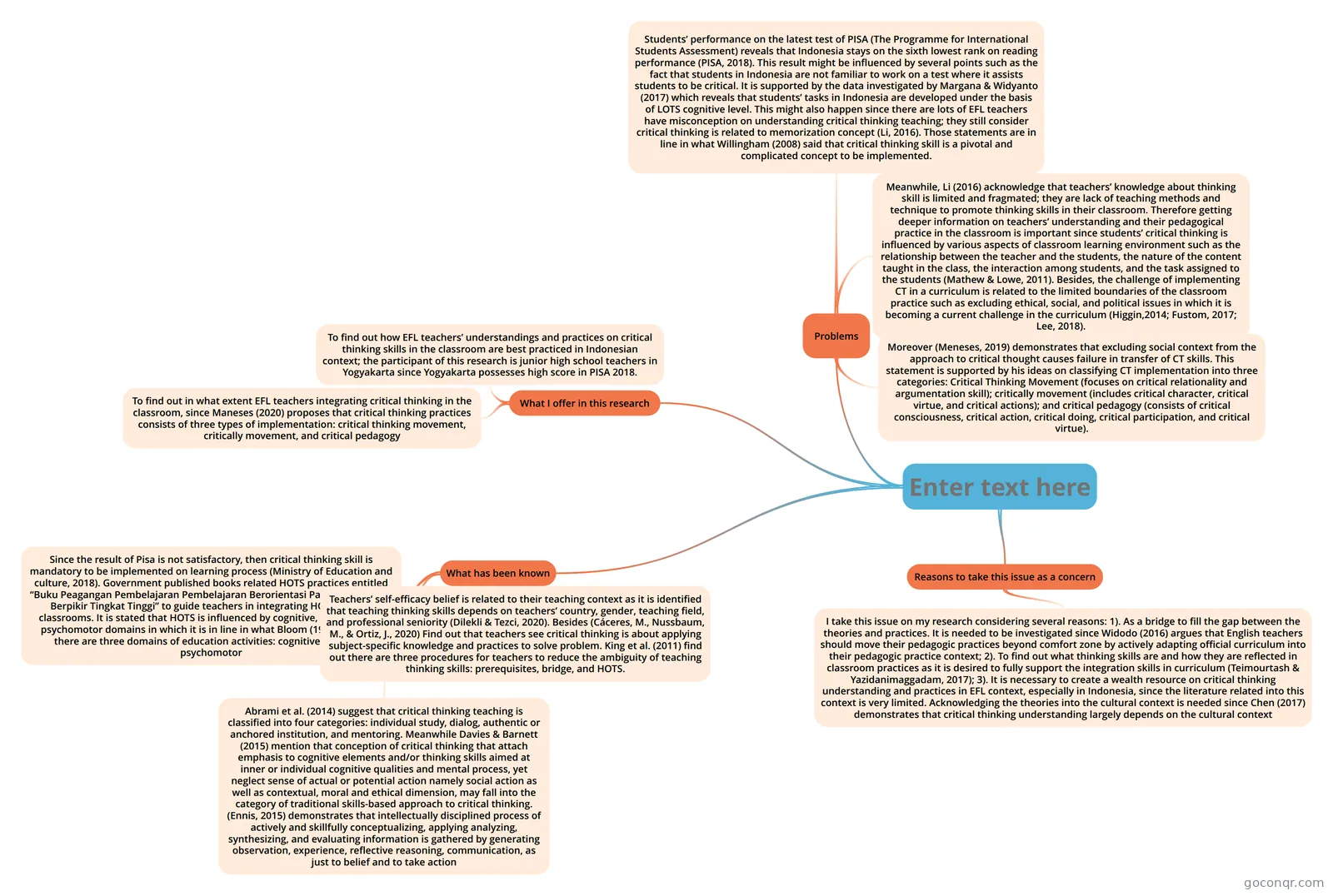
Mind map: Critical thinking in EFL classrooms in Indonesia
Map content
Enter text here
Problems
- Students’ performance on the latest test of PISA (The Programme for International Students Assessment) reveals that Indonesia stays on the sixth lowest rank on reading performance (PISA, 2018). This result might be influenced by several points such as the fact that students in Indonesia are not familiar to work on a test where it assists students to be critical. It is supported by the data investigated by Margana & Widyanto (2017) which reveals that students’ tasks in Indonesia are developed under the basis of LOTS cognitive level. This might also happen since there are lots of EFL teachers have misconception on understanding critical thinking teaching; they still consider critical thinking is related to memorization concept (Li, 2016). Those statements are in line in what Willingham (2008) said that critical thinking skill is a pivotal and complicated concept to be implemented.
- Meanwhile, Li (2016) acknowledge that teachers’ knowledge about thinking skill is limited and fragmated; they are lack of teaching methods and technique to promote thinking skills in their classroom. Therefore getting deeper information on teachers’ understanding and their pedagogical practice in the classroom is important since students’ critical thinking is influenced by various aspects of classroom learning environment such as the relationship between the teacher and the students, the nature of the content taught in the class, the interaction among students, and the task assigned to the students (Mathew & Lowe, 2011). Besides, the challenge of implementing CT in a curriculum is related to the limited boundaries of the classroom practice such as excluding ethical, social, and political issues in which it is becoming a current challenge in the curriculum (Higgin,2014; Fustom, 2017; Lee, 2018).
- Moreover (Meneses, 2019) demonstrates that excluding social context from the approach to critical thought causes failure in transfer of CT skills. This statement is supported by his ideas on classifying CT implementation into three categories: Critical Thinking Movement (focuses on critical relationality and argumentation skill); critically movement (includes critical character, critical virtue, and critical actions); and critical pedagogy (consists of critical consciousness, critical action, critical doing, critical participation, and critical virtue).
Reasons to take this issue as a concern
- I take this issue on my research considering several reasons: 1). As a bridge to fill the gap between the theories and practices. It is needed to be investigated since Widodo (2016) argues that English teachers should move their pedagogic practices beyond comfort zone by actively adapting official curriculum into their pedagogic practice context; 2). To find out what thinking skills are and how they are reflected in classroom practices as it is desired to fully support the integration skills in curriculum (Teimourtash & Yazidanimaggadam, 2017); 3). It is necessary to create a wealth resource on critical thinking understanding and practices in EFL context, especially in Indonesia, since the literature related into this context is very limited. Acknowledging the theories into the cultural context is needed since Chen (2017) demonstrates that critical thinking understanding largely depends on the cultural context
What I offer in this research
- To find out how EFL teachers’ understandings and practices on critical thinking skills in the classroom are best practiced in Indonesian context; the participant of this research is junior high school teachers in Yogyakarta since Yogyakarta possesses high score in PISA 2018.
- To find out in what extent EFL teachers integrating critical thinking in the classroom, since Maneses (2020) proposes that critical thinking practices consists of three types of implementation: critical thinking movement, critically movement, and critical pedagogy
What has been known
- Since the result of Pisa is not satisfactory, then critical thinking skill is mandatory to be implemented on learning process (Ministry of Education and culture, 2018). Government published books related HOTS practices entitled “Buku Peagangan Pembelajaran Pembelajaran Berorientasi Pada Ketrampilan Berpikir Tingkat Tinggi” to guide teachers in integrating HOTS in their classrooms. It is stated that HOTS is influenced by cognitive, affective, and psychomotor domains in which it is in line in what Bloom (1956) said that there are three domains of education activities: cognitive, affective, psychomotor
- Abrami et al. (2014) suggest that critical thinking teaching is classified into four categories: individual study, dialog, authentic or anchored institution, and mentoring. Meanwhile Davies & Barnett (2015) mention that conception of critical thinking that attach emphasis to cognitive elements and/or thinking skills aimed at inner or individual cognitive qualities and mental process, yet neglect sense of actual or potential action namely social action as well as contextual, moral and ethical dimension, may fall into the category of traditional skills-based approach to critical thinking. (Ennis, 2015) demonstrates that intellectually disciplined process of actively and skillfully conceptualizing, applying analyzing, synthesizing, and evaluating information is gathered by generating observation, experience, reflective reasoning, communication, as just to belief and to take action
- Teachers’ self-efficacy belief is related to their teaching context as it is identified that teaching thinking skills depends on teachers’ country, gender, teaching field, and professional seniority (Dilekli & Tezci, 2020). Besides (Cáceres, M., Nussbaum, M., & Ortiz, J., 2020) Find out that teachers see critical thinking is about applying subject-specific knowledge and practices to solve problem. King et al. (2011) find out there are three procedures for teachers to reduce the ambiguity of teaching thinking skills: prerequisites, bridge, and HOTS.
Information
- Description
- Mind Map on Enter text here, created by Hilda Nur Fadhlia on 28/08/2020.
- Created by
- Hilda Nur Fadhlia
- Views
- 2
- Rating