
Mind map
Physics Unit 2
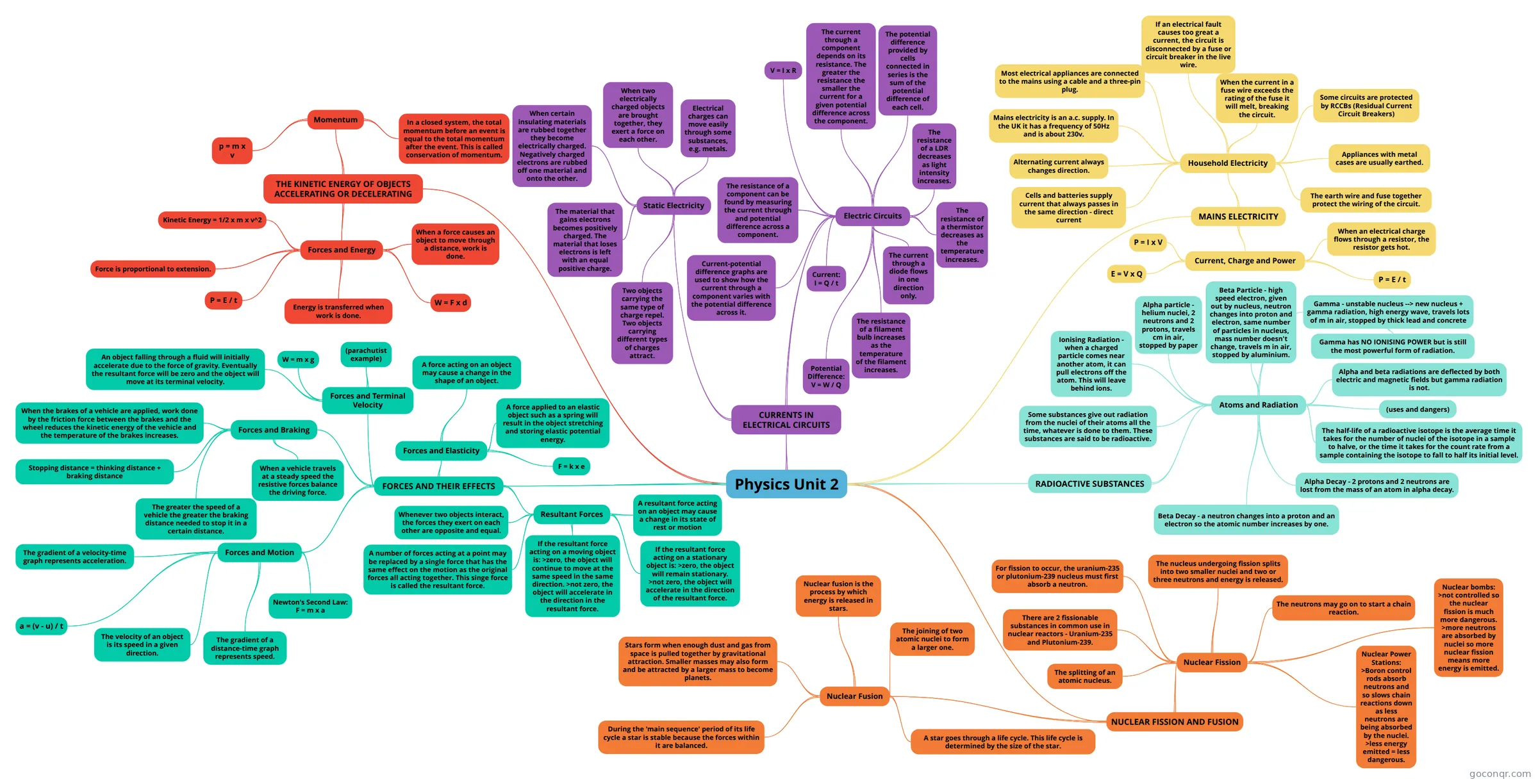
Mind map: Physics Unit 2
Map content
Physics Unit 2
FORCES AND THEIR EFFECTS
- Resultant Forces
- Whenever two objects interact, the forces they exert on each other are opposite and equal.
- A number of forces acting at a point may be replaced by a single force that has the same effect on the motion as the original forces all acting together. This singe force is called the resultant force.
- A resultant force acting on an object may cause a change in its state of rest or motion
- If the resultant force acting on a stationary object is: >zero, the object will remain stationary. >not zero, the object will accelerate in the direction of the resultant force.
- If the resultant force acting on a moving object is: >zero, the object will continue to move at the same speed in the same direction. >not zero, the object will accelerate in the direction in the resultant force.
- Forces and Motion
- Newton's Second Law: F = m x a
- The gradient of a distance-time graph represents speed.
- The velocity of an object is its speed in a given direction.
- a = (v - u) / t
- The gradient of a velocity-time graph represents acceleration.
- Forces and Braking
- When a vehicle travels at a steady speed the resistive forces balance the driving force.
- The greater the speed of a vehicle the greater the braking distance needed to stop it in a certain distance.
- Stopping distance = thinking distance + braking distance
- When the brakes of a vehicle are applied, work done by the friction force between the brakes and the wheel reduces the kinetic energy of the vehicle and the temperature of the brakes increases.
- Forces and Terminal Velocity
- An object falling through a fluid will initially accelerate due to the force of gravity. Eventually the resultant force will be zero and the object will move at its terminal velocity.
- W = m x g
- (parachutist example)
- Forces and Elasticity
- A force acting on an object may cause a change in the shape of an object.
- A force applied to an elastic object such as a spring will result in the object stretching and storing elastic potential energy.
- F = k x e
- Resultant Forces
THE KINETIC ENERGY OF OBJECTS ACCELERATING OR DECELERATING
- Forces and Energy
- When a force causes an object to move through a distance, work is done.
- W = F x d
- Energy is transferred when work is done.
- P = E / t
- Kinetic Energy = 1/2 x m x v^2
- Force is proportional to extension.
- Momentum
- p = m x v
- In a closed system, the total momentum before an event is equal to the total momentum after the event. This is called conservation of momentum.
- Forces and Energy
CURRENTS IN ELECTRICAL CIRCUITS
- Static Electricity
- When certain insulating materials are rubbed together they become electrically charged. Negatively charged electrons are rubbed off one material and onto the other.
- The material that gains electrons becomes positively charged. The material that loses electrons is left with an equal positive charge.
- When two electrically charged objects are brought together, they exert a force on each other.
- Two objects carrying the same type of charge repel. Two objects carrying different types of charges attract.
- Electrical charges can move easily through some substances, e.g. metals.
- Electric Circuits
- Current: I = Q / t
- Potential Difference: V = W / Q
- Current-potential difference graphs are used to show how the current through a component varies with the potential difference across it.
- The resistance of a component can be found by measuring the current through and potential difference across a component.
- V = I x R
- The current through a component depends on its resistance. The greater the resistance the smaller the current for a given potential difference across the component.
- The potential difference provided by cells connected in series is the sum of the potential difference of each cell.
- The resistance of a filament bulb increases as the temperature of the filament increases.
- The current through a diode flows in one direction only.
- The resistance of a LDR decreases as light intensity increases.
- The resistance of a thermistor decreases as the temperature increases.
- Static Electricity
MAINS ELECTRICITY
- Household Electricity
- Cells and batteries supply current that always passes in the same direction - direct current
- Alternating current always changes direction.
- Mains electricity is an a.c. supply. In the UK it has a frequency of 50Hz and is about 230v.
- Most electrical appliances are connected to the mains using a cable and a three-pin plug.
- If an electrical fault causes too great a current, the circuit is disconnected by a fuse or circuit breaker in the live wire.
- When the current in a fuse wire exceeds the rating of the fuse it will melt, breaking the circuit.
- Some circuits are protected by RCCBs (Residual Current Circuit Breakers)
- Appliances with metal cases are usually earthed.
- The earth wire and fuse together protect the wiring of the circuit.
- Current, Charge and Power
- When an electrical charge flows through a resistor, the resistor gets hot.
- P = E / t
- P = I x V
- E = V x Q
- Household Electricity
RADIOACTIVE SUBSTANCES
- Atoms and Radiation
- Some substances give out radiation from the nuclei of their atoms all the time, whatever is done to them. These substances are said to be radioactive.
- Ionising Radiation - when a charged particle comes near another atom, it can pull electrons off the atom. This will leave behind ions.
- Alpha particle - helium nuclei, 2 neutrons and 2 protons, travels cm in air, stopped by paper
- Beta Particle - high speed electron, given out by nucleus, neutron changes into proton and electron, same number of particles in nucleus, mass number doesn't change, travels m in air, stopped by aluminium.
- Gamma - unstable nucleus --> new nucleus + gamma radiation, high energy wave, travels lots of m in air, stopped by thick lead and concrete
- Gamma has NO IONISING POWER but is still the most powerful form of radiation.
- Alpha and beta radiations are deflected by both electric and magnetic fields but gamma radiation is not.
- (uses and dangers)
- The half-life of a radioactive isotope is the average time it takes for the number of nuclei of the isotope in a sample to halve, or the time it takes for the count rate from a sample containing the isotope to fall to half its initial level.
- Alpha Decay - 2 protons and 2 neutrons are lost from the mass of an atom in alpha decay.
- Beta Decay - a neutron changes into a proton and an electron so the atomic number increases by one.
- Atoms and Radiation
NUCLEAR FISSION AND FUSION
- Nuclear Fission
- The splitting of an atomic nucleus.
- There are 2 fissionable substances in common use in nuclear reactors - Uranium-235 and Plutonium-239.
- For fission to occur, the uranium-235 or plutonium-239 nucleus must first absorb a neutron.
- The nucleus undergoing fission splits into two smaller nuclei and two or three neutrons and energy is released.
- The neutrons may go on to start a chain reaction.
- Nuclear bombs: >not controlled so the nuclear fission is much more dangerous. >more neutrons are absorbed by nuclei so more nuclear fission means more energy is emitted.
- Nuclear Power Stations: >Boron control rods absorb neutrons and so slows chain reactions down as less neutrons are being absorbed by the nuclei. >less energy emitted = less dangerous.
- Nuclear Fusion
- The joining of two atomic nuclei to form a larger one.
- Nuclear fusion is the process by which energy is released in stars.
- Stars form when enough dust and gas from space is pulled together by gravitational attraction. Smaller masses may also form and be attracted by a larger mass to become planets.
- During the 'main sequence' period of its life cycle a star is stable because the forces within it are balanced.
- A star goes through a life cycle. This life cycle is determined by the size of the star.
- Nuclear Fission