
Mind map
Piaget's Cognitive Development Theory
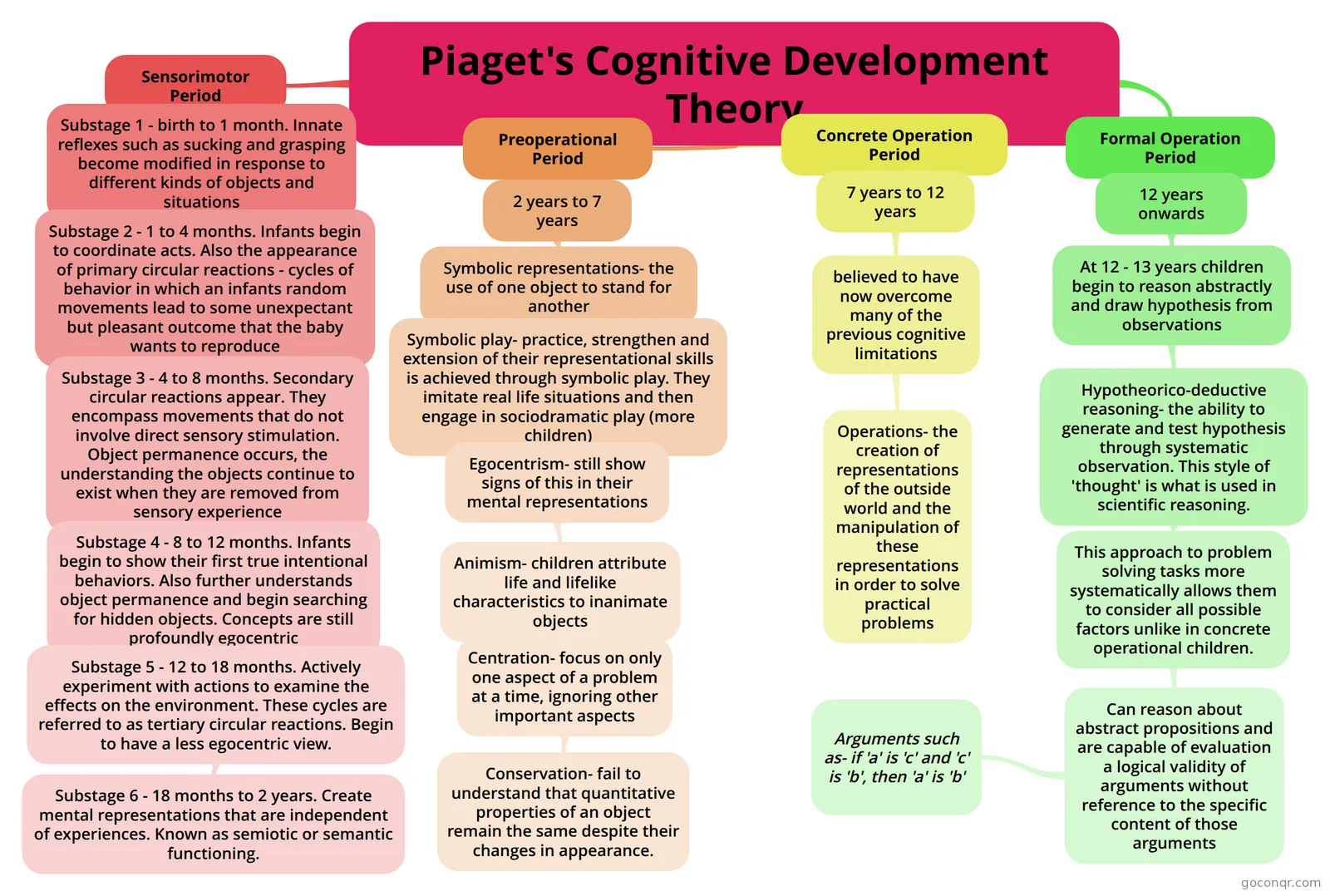
Mind map: Piaget's cognitive development theory
Map content
Piaget's Cognitive Development Theory
Sensorimotor Period
- Substage 1 - birth to 1 month. Innate reflexes such as sucking and grasping become modified in response to different kinds of objects and situations
- Substage 2 - 1 to 4 months. Infants begin to coordinate acts. Also the appearance of primary circular reactions - cycles of behavior in which an infants random movements lead to some unexpectant but pleasant outcome that the baby wants to reproduce
- Substage 3 - 4 to 8 months. Secondary circular reactions appear. They encompass movements that do not involve direct sensory stimulation. Object permanence occurs, the understanding the objects continue to exist when they are removed from sensory experience
- Substage 4 - 8 to 12 months. Infants begin to show their first true intentional behaviors. Also further understands object permanence and begin searching for hidden objects. Concepts are still profoundly egocentric
- Substage 5 - 12 to 18 months. Actively experiment with actions to examine the effects on the environment. These cycles are referred to as tertiary circular reactions. Begin to have a less egocentric view.
- Substage 6 - 18 months to 2 years. Create mental representations that are independent of experiences. Known as semiotic or semantic functioning.
- Substage 5 - 12 to 18 months. Actively experiment with actions to examine the effects on the environment. These cycles are referred to as tertiary circular reactions. Begin to have a less egocentric view.
- Substage 4 - 8 to 12 months. Infants begin to show their first true intentional behaviors. Also further understands object permanence and begin searching for hidden objects. Concepts are still profoundly egocentric
- Substage 3 - 4 to 8 months. Secondary circular reactions appear. They encompass movements that do not involve direct sensory stimulation. Object permanence occurs, the understanding the objects continue to exist when they are removed from sensory experience
- Substage 2 - 1 to 4 months. Infants begin to coordinate acts. Also the appearance of primary circular reactions - cycles of behavior in which an infants random movements lead to some unexpectant but pleasant outcome that the baby wants to reproduce
- Substage 1 - birth to 1 month. Innate reflexes such as sucking and grasping become modified in response to different kinds of objects and situations
Preoperational Period
- 2 years to 7 years
- Symbolic representations- the use of one object to stand for another
- Symbolic play- practice, strengthen and extension of their representational skills is achieved through symbolic play. They imitate real life situations and then engage in sociodramatic play (more children)
- Egocentrism- still show signs of this in their mental representations
- Animism- children attribute life and lifelike characteristics to inanimate objects
- Centration- focus on only one aspect of a problem at a time, ignoring other important aspects
- Conservation- fail to understand that quantitative properties of an object remain the same despite their changes in appearance.
- Centration- focus on only one aspect of a problem at a time, ignoring other important aspects
- Animism- children attribute life and lifelike characteristics to inanimate objects
- Egocentrism- still show signs of this in their mental representations
- Symbolic play- practice, strengthen and extension of their representational skills is achieved through symbolic play. They imitate real life situations and then engage in sociodramatic play (more children)
- Symbolic representations- the use of one object to stand for another
- 2 years to 7 years
Concrete Operation Period
- 7 years to 12 years
- believed to have now overcome many of the previous cognitive limitations
- Operations- the creation of representations of the outside world and the manipulation of these representations in order to solve practical problems
- believed to have now overcome many of the previous cognitive limitations
- 7 years to 12 years
Formal Operation Period
- 12 years onwards
- At 12 - 13 years children begin to reason abstractly and draw hypothesis from observations
- Hypotheorico-deductive reasoning- the ability to generate and test hypothesis through systematic observation. This style of 'thought' is what is used in scientific reasoning.
- This approach to problem solving tasks more systematically allows them to consider all possible factors unlike in concrete operational children.
- Can reason about abstract propositions and are capable of evaluation a logical validity of arguments without reference to the specific content of those arguments
- Arguments such as- if 'a' is 'c' and 'c' is 'b', then 'a' is 'b'
- Can reason about abstract propositions and are capable of evaluation a logical validity of arguments without reference to the specific content of those arguments
- This approach to problem solving tasks more systematically allows them to consider all possible factors unlike in concrete operational children.
- Hypotheorico-deductive reasoning- the ability to generate and test hypothesis through systematic observation. This style of 'thought' is what is used in scientific reasoning.
- At 12 - 13 years children begin to reason abstractly and draw hypothesis from observations
- 12 years onwards
Information
- Description
- Child And Adolescent Development Mind Map on Piaget's Cognitive Development Theory, created by lynda_ashford_25 on 23/10/2013.
- Created by
- lynda_ashford_25
- Views
- 141
- Tags
- Rating