
Mind map
World Economy
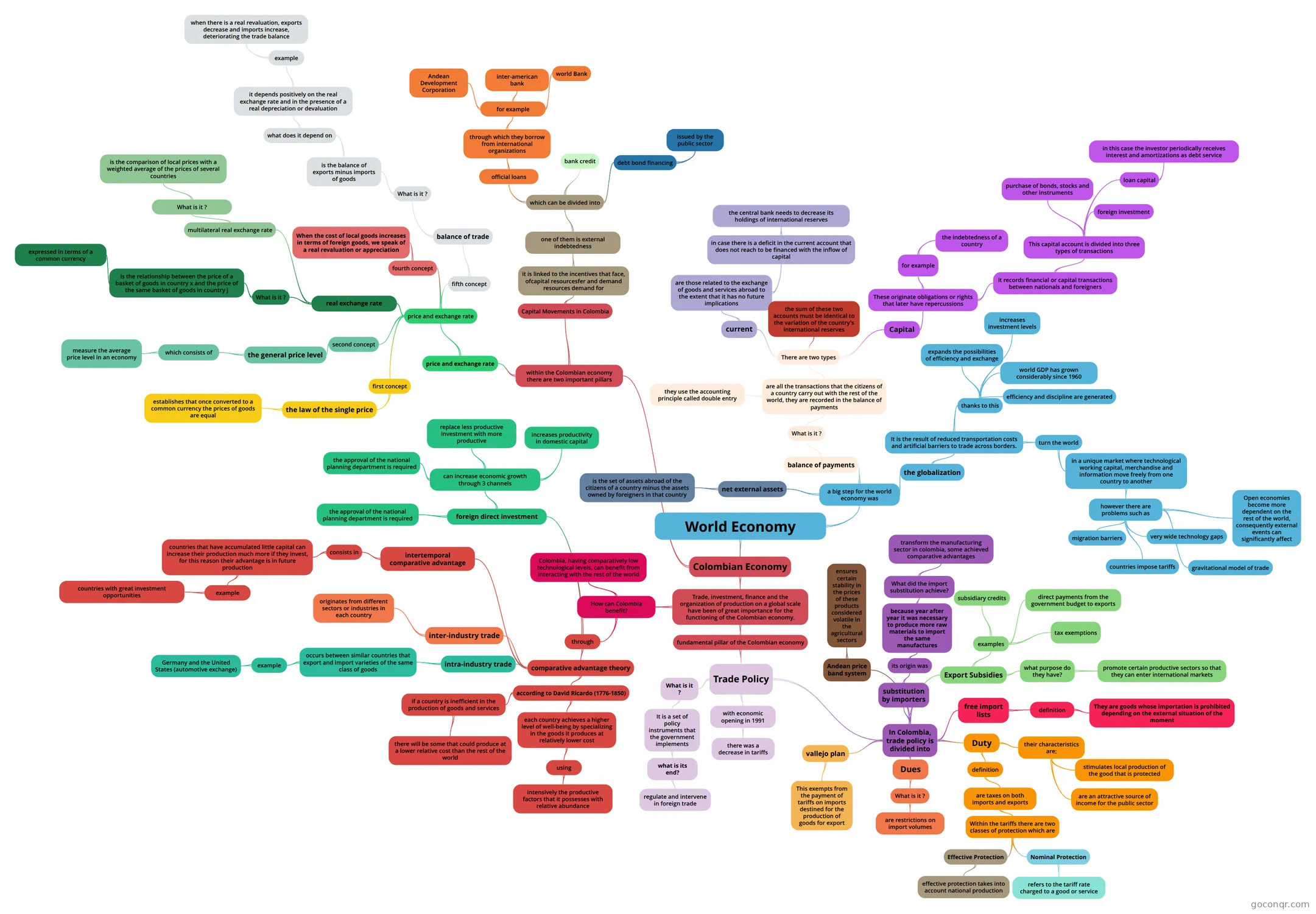
Mind map: World economy
Map content
World Economy
Colombian Economy
- Trade, investment, finance and the organization of production on a global scale have been of great importance for the functioning of the Colombian economy.
- How can Colombia benefit?
- Colombia, having comparatively low technological levels, can benefit from interacting with the rest of the world
- through
- comparative advantage theory
- according to David Ricardo (1776-1850)
- each country achieves a higher level of well-being by specializing in the goods it produces at relatively lower cost
- using
- intensively the productive factors that it possesses with relative abundance
- using
- if a country is inefficient in the production of goods and services
- there will be some that could produce at a lower relative cost than the rest of the world
- each country achieves a higher level of well-being by specializing in the goods it produces at relatively lower cost
- intra-industry trade
- occurs between similar countries that export and import varieties of the same class of goods
- example
- Germany and the United States (automotive exchange)
- example
- occurs between similar countries that export and import varieties of the same class of goods
- inter-industry trade
- originates from different sectors or industries in each country
- intertemporal comparative advantage
- consists in
- countries that have accumulated little capital can increase their production much more if they invest, for this reason their advantage is in future production
- example
- countries with great investment opportunities
- example
- countries that have accumulated little capital can increase their production much more if they invest, for this reason their advantage is in future production
- consists in
- according to David Ricardo (1776-1850)
- foreign direct investment
- can increase economic growth through 3 channels
- the approval of the national planning department is required
- replace less productive investment with more productive
- increases productivity in domestic capital
- the approval of the national planning department is required
- can increase economic growth through 3 channels
- comparative advantage theory
- fundamental pillar of the Colombian economy
- Trade Policy
- What is it ?
- It is a set of policy instruments that the government implements
- what is its end?
- regulate and intervene in foreign trade
- what is its end?
- It is a set of policy instruments that the government implements
- In Colombia, trade policy is divided into
- Duty
- their characteristics are;
- stimulates local production of the good that is protected
- are an attractive source of income for the public sector
- definition
- are taxes on both imports and exports
- Within the tariffs there are two classes of protection which are
- Nominal Protection
- refers to the tariff rate charged to a good or service
- Effective Protection
- effective protection takes into account national production
- Nominal Protection
- Within the tariffs there are two classes of protection which are
- are taxes on both imports and exports
- their characteristics are;
- Dues
- What is it ?
- are restrictions on import volumes
- What is it ?
- Export Subsidies
- what purpose do they have?
- promote certain productive sectors so that they can enter international markets
- examples
- subsidiary credits
- tax exemptions
- direct payments from the government budget to exports
- what purpose do they have?
- substitution by importers
- its origin was
- because year after year it was necessary to produce more raw materials to import the same manufactures
- What did the import substitution achieve?
- transform the manufacturing sector in colombia, some achieved comparative advantages
- What did the import substitution achieve?
- because year after year it was necessary to produce more raw materials to import the same manufactures
- its origin was
- free import lists
- definition
- They are goods whose importation is prohibited depending on the external situation of the moment
- definition
- vallejo plan
- This exempts from the payment of tariffs on imports destined for the production of goods for export
- Andean price band system
- ensures certain stability in the prices of these products considered volatile in the agricultural sectors
- Duty
- with economic opening in 1991
- there was a decrease in tariffs
- What is it ?
- Trade Policy
- How can Colombia benefit?
- within the Colombian economy there are two important pillars
- price and exchange rate
- price and exchange rate
- fifth concept
- balance of trade
- What is it ?
- is the balance of exports minus imports of goods
- what does it depend on
- it depends positively on the real exchange rate and in the presence of a real depreciation or devaluation
- example
- when there is a real revaluation, exports decrease and imports increase, deteriorating the trade balance
- example
- it depends positively on the real exchange rate and in the presence of a real depreciation or devaluation
- what does it depend on
- is the balance of exports minus imports of goods
- What is it ?
- balance of trade
- real exchange rate
- What is it ?
- is the relationship between the price of a basket of goods in country x and the price of the same basket of goods in country j
- expressed in terms of a common currency
- is the relationship between the price of a basket of goods in country x and the price of the same basket of goods in country j
- multilateral real exchange rate
- What is it ?
- is the comparison of local prices with a weighted average of the prices of several countries
- What is it ?
- What is it ?
- second concept
- the general price level
- which consists of
- measure the average price level in an economy
- which consists of
- the general price level
- first concept
- the law of the single price
- establishes that once converted to a common currency the prices of goods are equal
- the law of the single price
- fourth concept
- When the cost of local goods increases in terms of foreign goods, we speak of a real revaluation or appreciation
- fifth concept
- price and exchange rate
- Capital Movements in Colombia
- it is linked to the incentives that face, ofcapital resourcesfer and demand resources demand for
- one of them is external indebtedness
- which can be divided into
- official loans
- through which they borrow from international organizations
- for example
- Andean Development Corporation
- inter-american bank
- world Bank
- for example
- through which they borrow from international organizations
- bank credit
- debt bond financing
- issued by the public sector
- official loans
- which can be divided into
- one of them is external indebtedness
- it is linked to the incentives that face, ofcapital resourcesfer and demand resources demand for
- price and exchange rate
- Trade, investment, finance and the organization of production on a global scale have been of great importance for the functioning of the Colombian economy.
a big step for the world economy was
- the globalization
- It is the result of reduced transportation costs and artificial barriers to trade across borders.
- thanks to this
- world GDP has grown considerably since 1960
- expands the possibilities of efficiency and exchange
- efficiency and discipline are generated
- increases investment levels
- turn the world
- in a unique market where technological working capital, merchandise and information move freely from one country to another
- however there are problems such as
- migration barriers
- very wide technology gaps
- countries impose tariffs
- gravitational model of trade
- Open economies become more dependent on the rest of the world, consequently external events can significantly affect
- however there are problems such as
- in a unique market where technological working capital, merchandise and information move freely from one country to another
- thanks to this
- It is the result of reduced transportation costs and artificial barriers to trade across borders.
- balance of payments
- What is it ?
- are all the transactions that the citizens of a country carry out with the rest of the world, they are recorded in the balance of payments
- they use the accounting principle called double entry
- There are two types
- Capital
- These originate obligations or rights that later have repercussions
- for example
- the indebtedness of a country
- it records financial or capital transactions between nationals and foreigners
- This capital account is divided into three types of transactions
- foreign investment
- loan capital
- in this case the investor periodically receives interest and amortizations as debt service
- purchase of bonds, stocks and other instruments
- This capital account is divided into three types of transactions
- for example
- These originate obligations or rights that later have repercussions
- current
- are those related to the exchange of goods and services abroad to the extent that it has no future implications
- in case there is a deficit in the current account that does not reach to be financed with the inflow of capital
- the central bank needs to decrease its holdings of international reserves
- in case there is a deficit in the current account that does not reach to be financed with the inflow of capital
- are those related to the exchange of goods and services abroad to the extent that it has no future implications
- the sum of these two accounts must be identical to the variation of the country's international reserves
- Capital
- are all the transactions that the citizens of a country carry out with the rest of the world, they are recorded in the balance of payments
- What is it ?
- net external assets
- is the set of assets abroad of the citizens of a country minus the assets owned by foreigners in that country
- the globalization
Information
- Description
- Mind Map on World Economy, created by laura melissa leon cortez on 13/04/2021.
- Created by
- laura melissa leon cortez
- Views
- 1
- Rating
More on Protectionism and Trade Policy