
Mind map
The Three Refuges
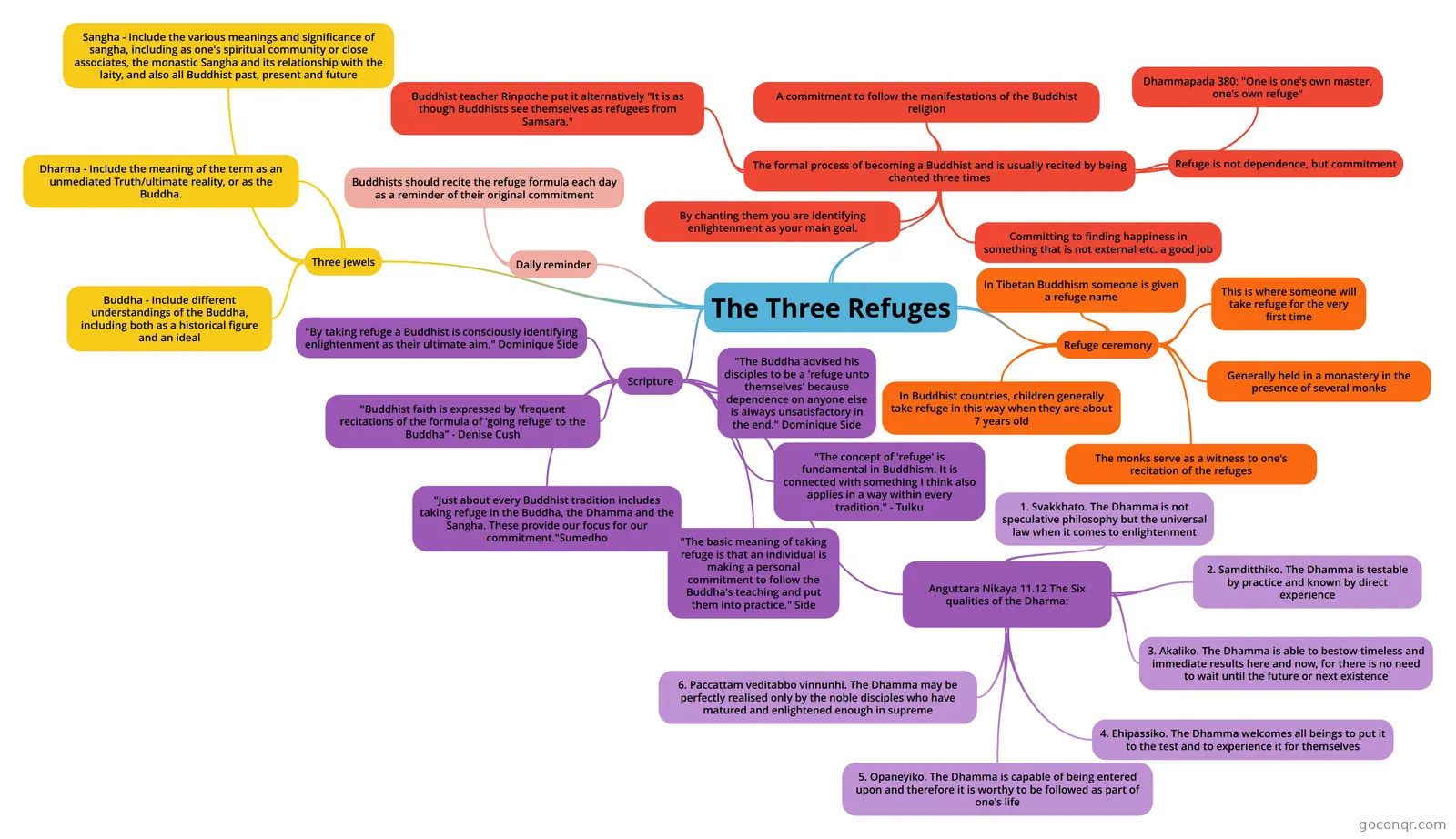
Mind map: The Three Refuges
Map content
The Three Refuges
The formal process of becoming a Buddhist and is usually recited by being chanted three times
- By chanting them you are identifying enlightenment as your main goal.
- Committing to finding happiness in something that is not external etc. a good job
- A commitment to follow the manifestations of the Buddhist religion
- Buddhist teacher Rinpoche put it alternatively "It is as though Buddhists see themselves as refugees from Samsara."
- Dhammapada 380: "One is one's own master, one's own refuge"
- Refuge is not dependence, but commitment
Refuge ceremony
- This is where someone will take refuge for the very first time
- Generally held in a monastery in the presence of several monks
- The monks serve as a witness to one's recitation of the refuges
- In Buddhist countries, children generally take refuge in this way when they are about 7 years old
- In Tibetan Buddhism someone is given a refuge name
Daily reminder
- Buddhists should recite the refuge formula each day as a reminder of their original commitment
Scripture
- "Buddhist faith is expressed by 'frequent recitations of the formula of 'going refuge' to the Buddha" - Denise Cush
- "By taking refuge a Buddhist is consciously identifying enlightenment as their ultimate aim." Dominique Side
- "Just about every Buddhist tradition includes taking refuge in the Buddha, the Dhamma and the Sangha. These provide our focus for our commitment."Sumedho
- "The basic meaning of taking refuge is that an individual is making a personal commitment to follow the Buddha's teaching and put them into practice." Side
- "The concept of 'refuge' is fundamental in Buddhism. It is connected with something I think also applies in a way within every tradition." - Tulku
- "The Buddha advised his disciples to be a 'refuge unto themselves' because dependence on anyone else is always unsatisfactory in the end." Dominique Side
- Anguttara Nikaya 11.12 The Six qualities of the Dharma:
- 1. Svakkhato. The Dhamma is not speculative philosophy but the universal law when it comes to enlightenment
- 2. Samditthiko. The Dhamma is testable by practice and known by direct experience
- 3. Akaliko. The Dhamma is able to bestow timeless and immediate results here and now, for there is no need to wait until the future or next existence
- 4. Ehipassiko. The Dhamma welcomes all beings to put it to the test and to experience it for themselves
- 5. Opaneyiko. The Dhamma is capable of being entered upon and therefore it is worthy to be followed as part of one's life
- 6. Paccattam veditabbo vinnunhi. The Dhamma may be perfectly realised only by the noble disciples who have matured and enlightened enough in supreme
Three jewels
- Dharma - Include the meaning of the term as an unmediated Truth/ultimate reality, or as the Buddha.
- Buddha - Include different understandings of the Buddha, including both as a historical figure and an ideal
- Sangha - Include the various meanings and significance of sangha, including as one's spiritual community or close associates, the monastic Sangha and its relationship with the laity, and also all Buddhist past, present and future
Information
- Description
- Mind Map on The Three Refuges, created by Sophie Kivell on 09/05/2021.
- Created by
- Sophie Kivell
- Views
- 0
- Rating