
Mind map
Types of technological fix
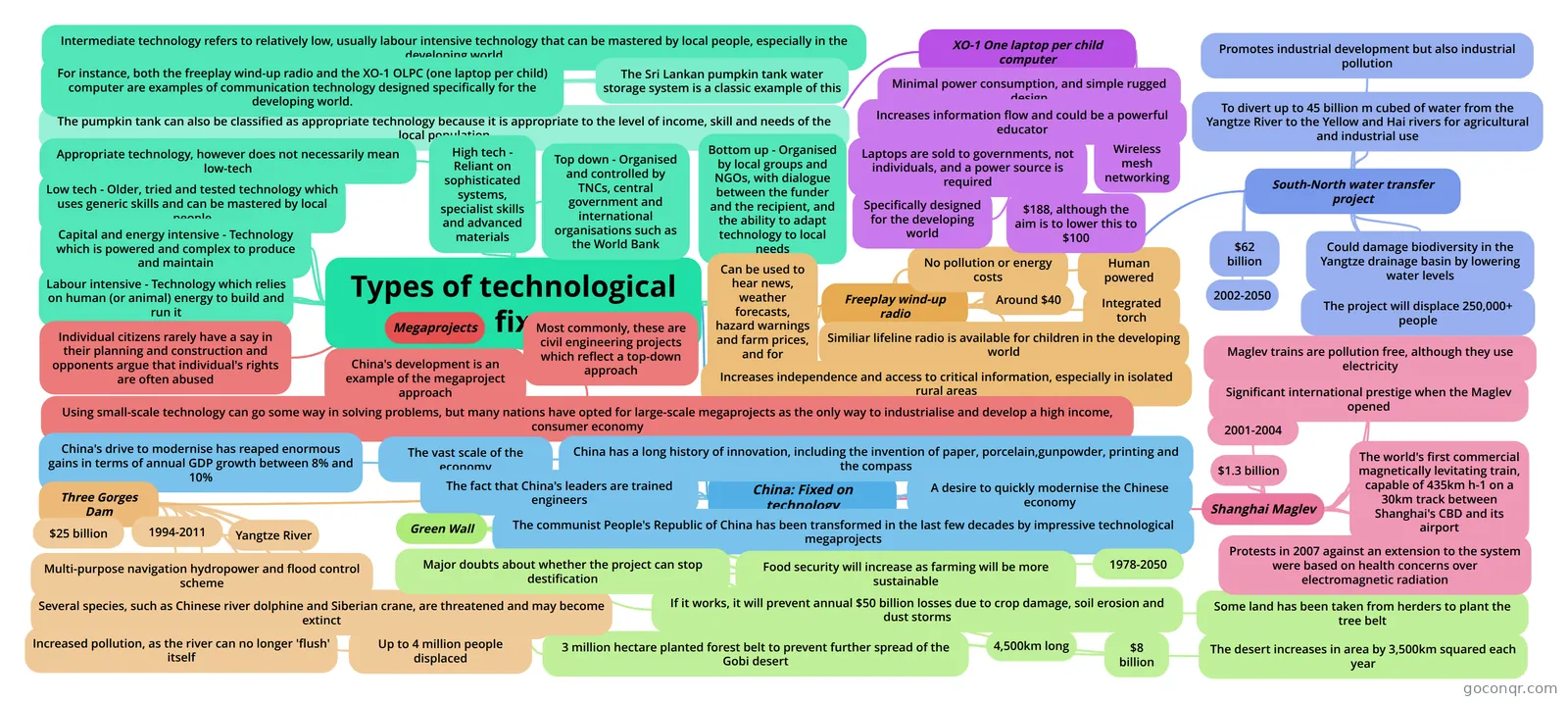
Mind map: types of technological fix
Map content
Types of technological fix
Intermediate technology refers to relatively low, usually labour intensive technology that can be mastered by local people, especially in the developing world
- The Sri Lankan pumpkin tank water storage system is a classic example of this
- The pumpkin tank can also be classified as appropriate technology because it is appropriate to the level of income, skill and needs of the local population
- The Sri Lankan pumpkin tank water storage system is a classic example of this
Appropriate technology, however does not necessarily mean low-tech
For instance, both the freeplay wind-up radio and the XO-1 OLPC (one laptop per child) computer are examples of communication technology designed specifically for the developing world.
Top down - Organised and controlled by TNCs, central government and international organisations such as the World Bank
Bottom up - Organised by local groups and NGOs, with dialogue between the funder and the recipient, and the ability to adapt technology to local needs
High tech - Reliant on sophisticated systems, specialist skills and advanced materials
Low tech - Older, tried and tested technology which uses generic skills and can be mastered by local people
Capital and energy intensive - Technology which is powered and complex to produce and maintain
Labour intensive - Technology which relies on human (or animal) energy to build and run it
Freeplay wind-up radio
- Around $40
- Similiar lifeline radio is available for children in the developing world
- Human powered
- No pollution or energy costs
- Integrated torch
- Can be used to hear news, weather forecasts, hazard warnings and farm prices, and for education
- Increases independence and access to critical information, especially in isolated rural areas
XO-1 One laptop per child computer
- $188, although the aim is to lower this to $100
- Specifically designed for the developing world
- Minimal power consumption, and simple rugged design
- Wireless mesh networking
- Increases information flow and could be a powerful educator
- Laptops are sold to governments, not individuals, and a power source is required
Megaprojects
- Using small-scale technology can go some way in solving problems, but many nations have opted for large-scale megaprojects as the only way to industrialise and develop a high income, consumer economy
- Most commonly, these are civil engineering projects which reflect a top-down approach
- Individual citizens rarely have a say in their planning and construction and opponents argue that individual's rights are often abused
- China's development is an example of the megaproject approach
China: Fixed on technology
- China has a long history of innovation, including the invention of paper, porcelain,gunpowder, printing and the compass
- The communist People's Republic of China has been transformed in the last few decades by impressive technological megaprojects
- A desire to quickly modernise the Chinese economy
- The vast scale of the economy
- The fact that China's leaders are trained engineers
- China's drive to modernise has reaped enormous gains in terms of annual GDP growth between 8% and 10%
- Three Gorges Dam
- $25 billion
- 1994-2011
- Multi-purpose navigation hydropower and flood control scheme
- Yangtze River
- Increased pollution, as the river can no longer 'flush' itself
- 1,300 historic sites flooded
- Up to 4 million people displaced
- Several species, such as Chinese river dolphine and Siberian crane, are threatened and may become extinct
- Green Wall
- $8 billion
- 1978-2050
- 4,500km long
- 3 million hectare planted forest belt to prevent further spread of the Gobi desert
- The desert increases in area by 3,500km squared each year
- If it works, it will prevent annual $50 billion losses due to crop damage, soil erosion and dust storms
- Food security will increase as farming will be more sustainable
- Major doubts about whether the project can stop destification
- Some land has been taken from herders to plant the tree belt
- Shanghai Maglev
- The world's first commercial magnetically levitating train, capable of 435km h-1 on a 30km track between Shanghai's CBD and its airport
- $1.3 billion
- 2001-2004
- Maglev trains are pollution free, although they use electricity
- Significant international prestige when the Maglev opened
- Protests in 2007 against an extension to the system were based on health concerns over electromagnetic radiation
- South-North water transfer project
- $62 billion
- 2002-2050
- To divert up to 45 billion m cubed of water from the Yangtze River to the Yellow and Hai rivers for agricultural and industrial use
- The project will displace 250,000+ people
- Could damage biodiversity in the Yangtze drainage basin by lowering water levels
- Promotes industrial development but also industrial pollution
Information
- Description
- A-Levels Geography (The Technological Fix) Mind Map on Types of technological fix, created by Jodie Goodacre on 03/11/2013.
- Created by
- Jodie Goodacre
- Views
- 973
- Tags
- Rating