
Mind map
2nd Partial Evaluation for Phsycolinguistic
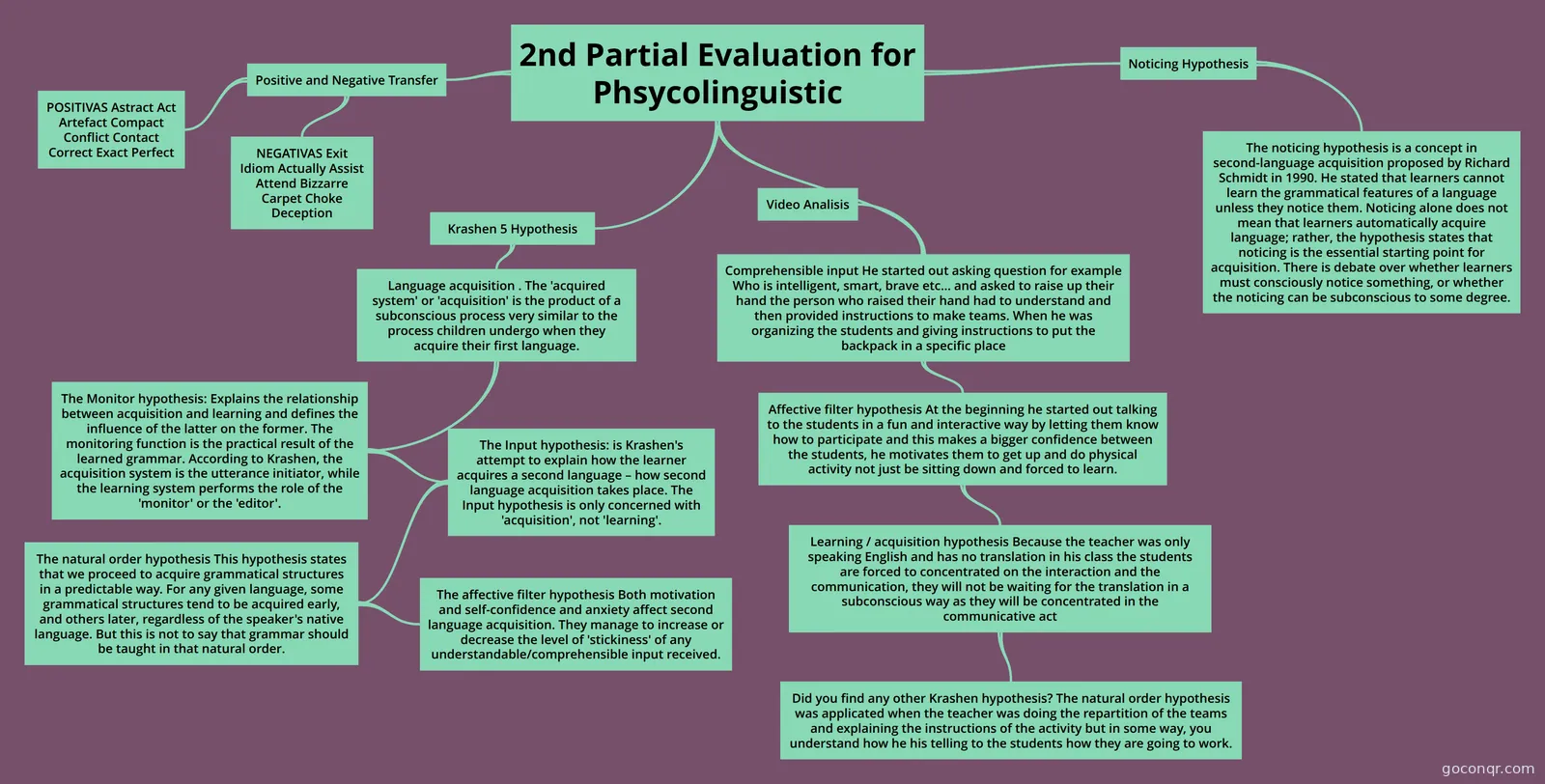
Mind map: Psycholinguistic 2nd partial evaluation
Map content
2nd Partial Evaluation for Phsycolinguistic
Positive and Negative Transfer
- POSITIVAS Astract Act Artefact Compact Conflict Contact Correct Exact Perfect
- NEGATIVAS Exit Idiom Actually Assist Attend Bizzarre Carpet Choke Deception
Krashen 5 Hypothesis
- Language acquisition . The 'acquired system' or 'acquisition' is the product of a subconscious process very similar to the process children undergo when they acquire their first language.
- The Monitor hypothesis: Explains the relationship between acquisition and learning and defines the influence of the latter on the former. The monitoring function is the practical result of the learned grammar. According to Krashen, the acquisition system is the utterance initiator, while the learning system performs the role of the 'monitor' or the 'editor'.
- The Input hypothesis: is Krashen's attempt to explain how the learner acquires a second language – how second language acquisition takes place. The Input hypothesis is only concerned with 'acquisition', not 'learning'.
- The natural order hypothesis This hypothesis states that we proceed to acquire grammatical structures in a predictable way. For any given language, some grammatical structures tend to be acquired early, and others later, regardless of the speaker's native language. But this is not to say that grammar should be taught in that natural order.
- The affective filter hypothesis Both motivation and self-confidence and anxiety affect second language acquisition. They manage to increase or decrease the level of 'stickiness' of any understandable/comprehensible input received.
- The natural order hypothesis This hypothesis states that we proceed to acquire grammatical structures in a predictable way. For any given language, some grammatical structures tend to be acquired early, and others later, regardless of the speaker's native language. But this is not to say that grammar should be taught in that natural order.
- The Input hypothesis: is Krashen's attempt to explain how the learner acquires a second language – how second language acquisition takes place. The Input hypothesis is only concerned with 'acquisition', not 'learning'.
- The Monitor hypothesis: Explains the relationship between acquisition and learning and defines the influence of the latter on the former. The monitoring function is the practical result of the learned grammar. According to Krashen, the acquisition system is the utterance initiator, while the learning system performs the role of the 'monitor' or the 'editor'.
- Language acquisition . The 'acquired system' or 'acquisition' is the product of a subconscious process very similar to the process children undergo when they acquire their first language.
Comprehensible input He started out asking question for example Who is intelligent, smart, brave etc… and asked to raise up their hand the person who raised their hand had to understand and then provided instructions to make teams. When he was organizing the students and giving instructions to put the backpack in a specific place
- Video Analisis
- Affective filter hypothesis At the beginning he started out talking to the students in a fun and interactive way by letting them know how to participate and this makes a bigger confidence between the students, he motivates them to get up and do physical activity not just be sitting down and forced to learn.
- Learning / acquisition hypothesis Because the teacher was only speaking English and has no translation in his class the students are forced to concentrated on the interaction and the communication, they will not be waiting for the translation in a subconscious way as they will be concentrated in the communicative act
- Did you find any other Krashen hypothesis? The natural order hypothesis was applicated when the teacher was doing the repartition of the teams and explaining the instructions of the activity but in some way, you understand how he his telling to the students how they are going to work.
- Learning / acquisition hypothesis Because the teacher was only speaking English and has no translation in his class the students are forced to concentrated on the interaction and the communication, they will not be waiting for the translation in a subconscious way as they will be concentrated in the communicative act
Noticing Hypothesis
- The noticing hypothesis is a concept in second-language acquisition proposed by Richard Schmidt in 1990. He stated that learners cannot learn the grammatical features of a language unless they notice them. Noticing alone does not mean that learners automatically acquire language; rather, the hypothesis states that noticing is the essential starting point for acquisition. There is debate over whether learners must consciously notice something, or whether the noticing can be subconscious to some degree.
Information
- Description
- Mind Map on 2nd Partial Evaluation for Phsycolinguistic, created by King Ezekiel on 04/11/2021.
- Created by
- King Ezekiel
- Views
- 4
- Rating
More on Krashen's Theory of Second Language Acquisition