
Mind map
Language Source
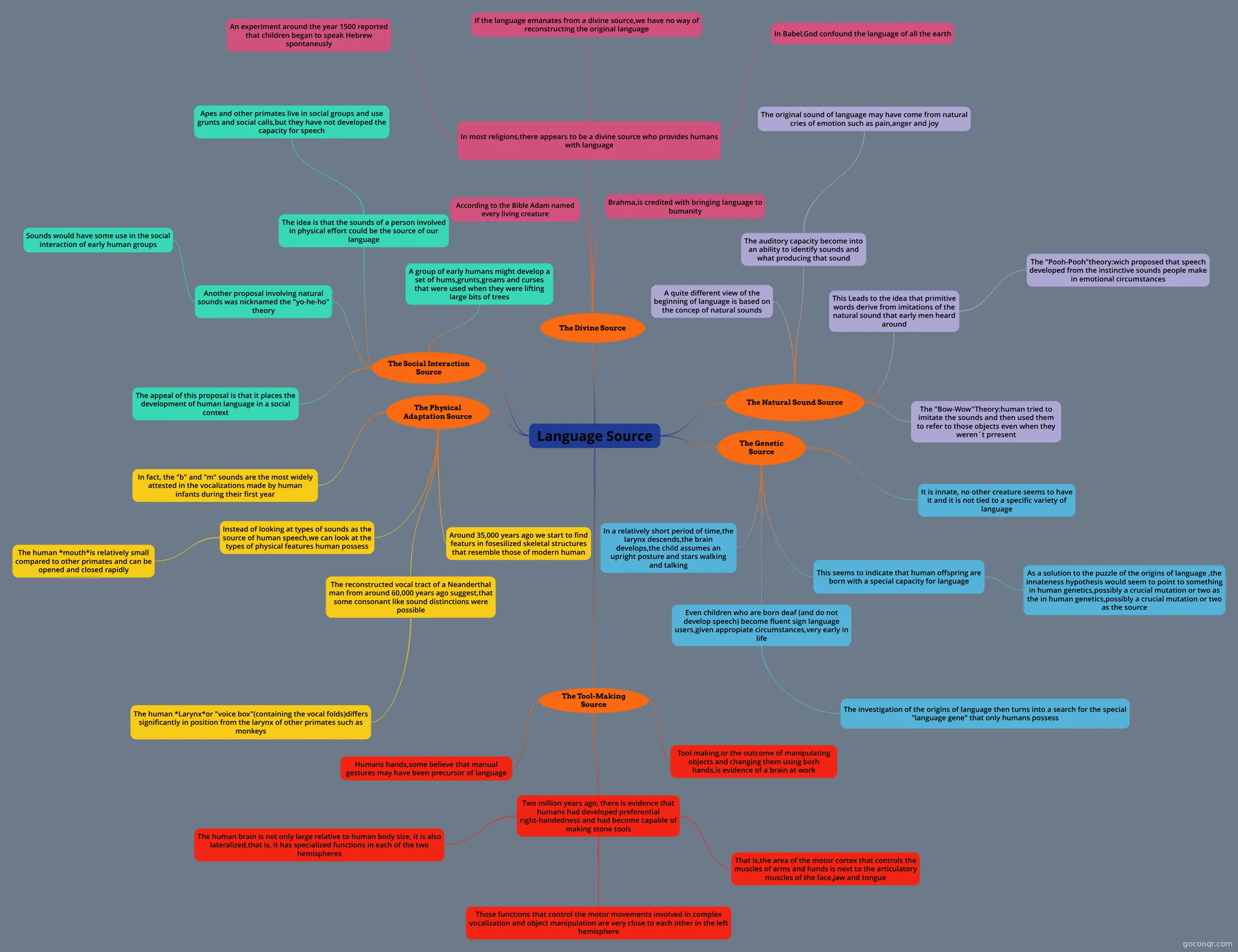
Mind map: Language source theories
Map content
Language Source
The Tool-Making Source
- Two million years ago, there is evidence that humans had developed preferential right-handedness and had become capable of making stone tools
- The human brain is not only large relative to human body size, it is also lateralized,that is, it has specialized functions in each of the two hemispheres
- Those functions that control the motor movements involved in complex vocalization and object manipulation are very close to each other in the left hemisphere
- That is,the area of the motor cortex that controls the muscles of arms and hands is next to the articulatory muscles of the face,jaw and tongue
- Humans hands,some believe that manual gestures may have been precursor of language
- Tool making,or the outcome of manipulating objects and changing them using both hands,is evidence of a brain at work
- Two million years ago, there is evidence that humans had developed preferential right-handedness and had become capable of making stone tools
The Divine Source
- In most religions,there appears to be a divine source who provides humans with language
- An experiment around the year 1500 reported that children began to speak Hebrew spontaneusly
- If the language emanates from a divine source,we have no way of reconstructing the original language
- In Babel,God confound the language of all the earth
- According to the Bible Adam named every living creature
- Brahma,is credited with bringing language to bumanity
- In most religions,there appears to be a divine source who provides humans with language
The Natural Sound Source
- The auditory capacity become into an ability to identify sounds and what producing that sound
- The original sound of language may have come from natural cries of emotion such as pain,anger and joy
- A quite different view of the beginning of language is based on the concep of natural sounds
- This Leads to the idea that primitive words derive from imitations of the natural sound that early men heard around
- The "Pooh-Pooh"theory:wich proposed that speech developed from the instinctive sounds people make in emotional circumstances
- The "Bow-Wow"Theory:human tried to imitate the sounds and then used them to refer to those objects even when they weren´t prresent
- The auditory capacity become into an ability to identify sounds and what producing that sound
The Genetic Source
- Even children who are born deaf (and do not develop speech) become fluent sign language users,given appropiate circumstances,very early in life
- The investigation of the origins of language then turns into a search for the special "language gene" that only humans possess
- In a relatively short period of time,the larynx descends,the brain develops,the child assumes an upright posture and stars walking and talking
- This seems to indicate that human offspring are born with a special capacity for language
- As a solution to the puzzle of the origins of language ,the innateness hypothesis would seem to point to something in human genetics,possibly a crucial mutation or two as the in human genetics,possibly a crucial mutation or two as the source
- It is innate, no other creature seems to have it and it is not tied to a specific variety of language
- Even children who are born deaf (and do not develop speech) become fluent sign language users,given appropiate circumstances,very early in life
The Social Interaction Source
- Another proposal involving natural sounds was nicknamed the "yo-he-ho" theory
- Sounds would have some use in the social interaction of early human groups
- The idea is that the sounds of a person involved in physical effort could be the source of our language
- Apes and other primates live in social groups and use grunts and social calls,but they have not developed the capacity for speech
- A group of early humans might develop a set of hums,grunts,groans and curses that were used when they were lifting large bits of trees
- The appeal of this proposal is that it places the development of human language in a social context
- Another proposal involving natural sounds was nicknamed the "yo-he-ho" theory
The Physical Adaptation Source
- The reconstructed vocal tract of a Neanderthal man from around 60,000 years ago suggest,that some consonant like sound distinctions were possible
- The human *Larynx*or "voice box"(containing the vocal folds)differs significantly in position from the larynx of other primates such as monkeys
- Around 35,000 years ago we start to find featurs in fosesilized skeletal structures that resemble those of modern human
- Instead of looking at types of sounds as the source of human speech,we can look at the types of physical features human possess
- The human *mouth*is relatively small compared to other primates and can be opened and closed rapidly
- In fact, the "b" and "m" sounds are the most widely attested in the vocalizations made by human infants during their first year
- The reconstructed vocal tract of a Neanderthal man from around 60,000 years ago suggest,that some consonant like sound distinctions were possible
Information
- Description
- Magisterio (Educación) Mind Map on Language Source, created by Andrea Maria Alvarado Henriquez on 16/03/2022.
- Created by
- Andrea Maria Alvarado Henriquez
- Views
- 2
- History
-
- Created by Andrea Maria Alvarado Henriquez · Mar 16, 2022
- Copied by Andrea Maria Alvarado Henriquez · Mar 16, 2022
- Rating