
Mind map
Real Time Operating Systems (RTOS)
Map content
Real Time Operating Systems (RTOS)
Definition
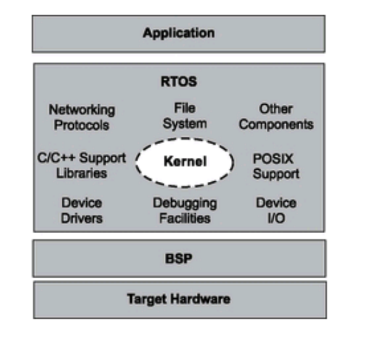
- It is the software that is responsible for scheduling tasks, managing resources, and provide an abstraction layer for the application code development.
- Its kernel provides minimal logic, scheduler and resource management algorithms
- Kernel
- Its kernel provides minimal logic, scheduler and resource management algorithms
- It is the software that is responsible for scheduling tasks, managing resources, and provide an abstraction layer for the application code development.
Board Support Package (BSP)
- The interface between RTOS and the hardware platform. It is a set of software drivers for specific hardware components. It has information about the hardware characteristics.
- It includes
- System scheduler timer configuration
- Hardware interrupt configuration
- Memory configuration (stack and heap)
- CPU configuration
- Hard to develop.
- Requires knowledge of
- Hardware
- Assembly
- Operating System
- Requires knowledge of
- RTOS porting
- Development process of BSP where an already developed BSP is used as a basis, where adaptations and new developments are carried out.
Scheduler
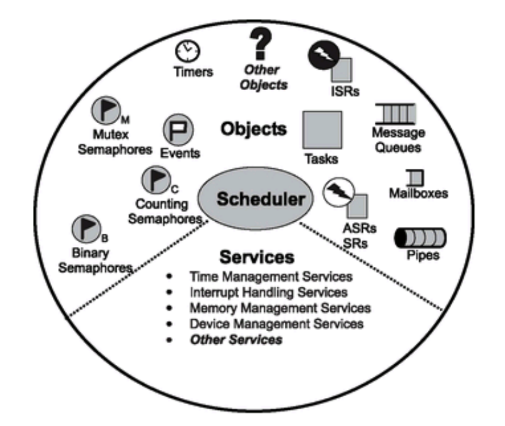
- It is the algorithm that decides which entity or task will run and when it will run.
- Schedulable entities
- They are kernel object that competes for an execution time in the system, based on a predefined scheduling algorithm. Ex. processes or tasks.
- Schedulable entities
- Context switching
- What does CONTEXT mean?
- State of the CPU required each time the task is scheduled to run.
- A context switch occurs when the scheduler performs the swap on a processor from task A to task B
- Task Control Block (TCB)
- is a data structure that the kernel maintains for storing task-specific data
- Steps
- 1. Kernel saves the context of task 1 in its respective TCB
- 2. Kernel loads the context information of task 2, which becomes the running task
- 3. Task 1 context remains frozen while task 2 is executed
- 4. If the scheduler needs to run task 1 again, it runs where it left off before the context switch
- Context switch Time
- Time taken by the scheduler to switch from one task to another. Should not be disregarded.
- What does CONTEXT mean?
- Dispatcher
- Part of the scheduler responsible for executing the switch of contexts and changes in the execution flow
- Possible areas for control flow
- Kernel
- Interrupt service routine (ISR)
- Application task
- What happens when a task or ISR makes a system call?
- Control flow is passed through kernel to perform the requested function and passed to task or ISR again.
- Deadlines
- Types
- Hard
- Soft
- Maximum time a task must finish its execution completely, after being activated again.
- Types
- Scheduling Algorithms (Scheduling policies)
- Most common
- Collaborative (non-preemptive)
- Cooperative Cyclic Executive (CCE)
- Performed through a loop of functions called cyclic executive. It is non-preemptive.
- Cyclic executive
- Non-preemptive (cooperative)
- No infinity loops
- Code example
- Temporal Aspect
- Performed through a loop of functions called cyclic executive. It is non-preemptive.
- Cooperative Cyclic Executive (CCE)
- Fixed priority-based and preemptive
- Preemptive priority-based
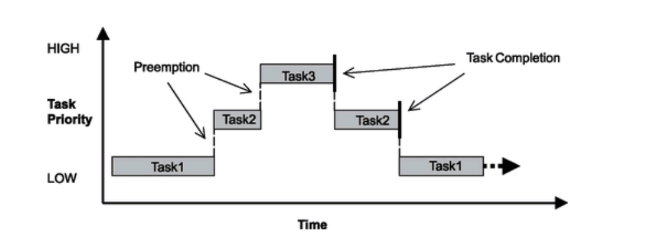
- The task that gets the processor to run in it, considering any instant of time, is the highest priority task among the tasks in the “ready” state of the system. Priorities are fixed and defined during design time. If any task with higher priority (in relation to the current running task) enters the “ready” state, the kernel preempts the lower priority to this one with highest priority,
- Highest priority task executing
- Priority
- Fixed
- Defined at design time (off line)
- Preempts if higher priority task appears
- The task that gets the processor to run in it, considering any instant of time, is the highest priority task among the tasks in the “ready” state of the system. Priorities are fixed and defined during design time. If any task with higher priority (in relation to the current running task) enters the “ready” state, the kernel preempts the lower priority to this one with highest priority,
- Rate Monotonic (RM)
- Assumptions
- 2. the tasks are independent and do not have intercommunication;
- 3. the deadline of a task is the start of its next period (D = T);
- 4. constant execution time for tasks;
- 5. all tasks have the same criticality level;
- 1. all tasks are periodic;
- 6. aperiodic tasks are limited to initialization and some fault recovery mechanisms;
- The less the execution period, the higher the priority assigned to the task
- Processor Utilization Factor
- Theoretical limit of use
- Assumptions
- Preemptive priority-based
- Execution time-based and preemptive
- Round-Robin or Time Slicing
- Allocates an equal and predetermined time slice for tasks to run. Round-robin “alone” does not meet the requirements for real time systems, since tasks perform roles in different levels of importance. It can be used together with preemptive priority-based as tiebreaker between tasks with equal priorities in “ready” state
- Equal time slice
- Does not meet the real-time requirements alone
- Usid with preemptive priority-based.
- Allocates an equal and predetermined time slice for tasks to run. Round-robin “alone” does not meet the requirements for real time systems, since tasks perform roles in different levels of importance. It can be used together with preemptive priority-based as tiebreaker between tasks with equal priorities in “ready” state
- Round-Robin or Time Slicing
- Dynamic priority-based and preemptive
- Earliest Deadline First (EDF)
- It is a dynamic scheduling class algorithm. The lower the deadline, the higher the priority of the task.
- Dynamic priorities (can change over time)
- Lower deadline, higher priority.
- Process utilization factor
- It is a dynamic scheduling class algorithm. The lower the deadline, the higher the priority of the task.
- Earliest Deadline First (EDF)
- Collaborative (non-preemptive)
- Schedulability Analisys
- 1. all tasks of the system can be scheduled to execute and fulfill their deadlines according to the scheduling algorithm used;
- 2. still achieve optimal processor utilization
- Only temporal requirements
- Most common
- It is the algorithm that decides which entity or task will run and when it will run.
Tasks
- Computation performed by a processor in a sequential order. A system can be decomposed into multiple concurrent tasks.
- Main states
- Ready
- Blocked
- Running
- Classification
- Periodic
- Aperiodic
Multi-tasking system
- Operating system ability (or real-time frame) to manage various activities/tasks considering their deadlines.
- Implies
- CPU competition
- more than one task competing to be executed
- consideration of the scheduling algorithm and the real time model (hard, soft) used
Images and files in the map



Information
- Description
- Superior Embedded Systems Mind Map on Real Time Operating Systems (RTOS), created by Artur Assis on 11/07/2022.
- Created by
- Artur Assis
- Views
- 4
- Rating